Mississippi Science BOT.2
Standard Cluster
Students will identify evolutionary modifications necessary for the terrestrial survival of plants. Summarize and justify the characteristics of nonvascular algae (blue-green and green algae) and bryophytes that provide evidence of evolution within the plant kingdom. Referencing the USDA plants database, identify, compare, and contrast seedless, naked seed, and enclosed-seed modifications for reproduction. Calculate the occurrence of seed types in given habitats. Summarize and justify the characteristics of angiosperms and gymnosperms that lead to their success as terrestrial plants. Research information to develop, produce, and communicate a scientifically justifiable argument for the rapid amplification and success of angiosperm compared to other plant divisions. Enrichment: Referencing the National Center for Biotechnology Information’s gene/protein databases, propose and design a scientifically supportable cladogram or phylogenetic tree that illustrates the evolutionary modifications of the plant kingdom using genetic (DNA) or protein sequence comparisons/alignments.
2026 Mississippi College- and Career-Readiness Standards for Science · Plant Evolution
Cluster contents
Standards in This Cluster
BOT.2 is a cluster heading. These are the individual standards under it.
- BOT.2.1
Summarize and justify the characteristics of nonvascular algae (blue-green and green algae) and bryophytes that provide evidence of evolution within the plant k...
- BOT.2.2
Referencing the USDA plants database, identify, compare, and contrast seedless, naked seed, and enclosed-seed modifications for reproduction. Calculate the occu...
- BOT.2.3
Summarize and justify the characteristics of angiosperms and gymnosperms that lead to their success as terrestrial plants.
- BOT.2.4
Research information to develop, produce, and communicate a scientifically justifiable argument for the rapid amplification and success of angiosperm compared t...
- BOT.2.5
Enrichment: Referencing the National Center for Biotechnology Information’s gene/protein databases, propose and design a scientifically supportable cladogram or...
Teacher's field guide
What This Cluster Means
What Students Need to Do
- Students compare cyanobacteria, green algae, mosses, ferns, conifers, and flowering plants to trace changes that helped plants live on land. They use USDA PLANTS records to group species by spores, exposed seeds, or seeds inside fruits, then calculate each group's share in a habitat. They use evidence to explain why flowering plants became widespread.
What Mastery Looks Like
- Students can explain how a moss's protected embryo, a pine's pollen and seeds, and a flowering plant's fruit help each survive or reproduce on land. They correctly group species from USDA PLANTS records and calculate percentages from habitat counts. They support a claim about flowering plant success with evidence about pollination and seed dispersal.
Common Misconceptions
- Students may call blue-green algae plants, but they are cyanobacteria, not part of the plant lineage. They may mistake fern spores for seeds or think pine seeds grow inside fruits. Some assume mosses have no land adaptations because their sperm still need water to reach eggs.
How to Assess It
- Exit ticket: A habitat list has four fern species, three conifer species, and nine flowering plant species. Name each group's reproductive type, calculate its percentage of the 16 species, and give one reason flowering plants can spread to new habitats.
Lesson moves
Ways to Teach It
Set out an open pine cone, an apple half, and a fern spore photo; students label spores, exposed seeds, and enclosed seeds.
Ask why pines reproduce without a film of water while mosses need one; students name pollen and swimming sperm in their answers.
Give pairs six species from USDA PLANTS records for one habitat; students sort by reproductive type and calculate each type's percentage.
Show a photo of maple samaras on a sidewalk; students explain how the fruit moves seeds to new patches of soil.
Free download
Printable BOT.2 Worksheet
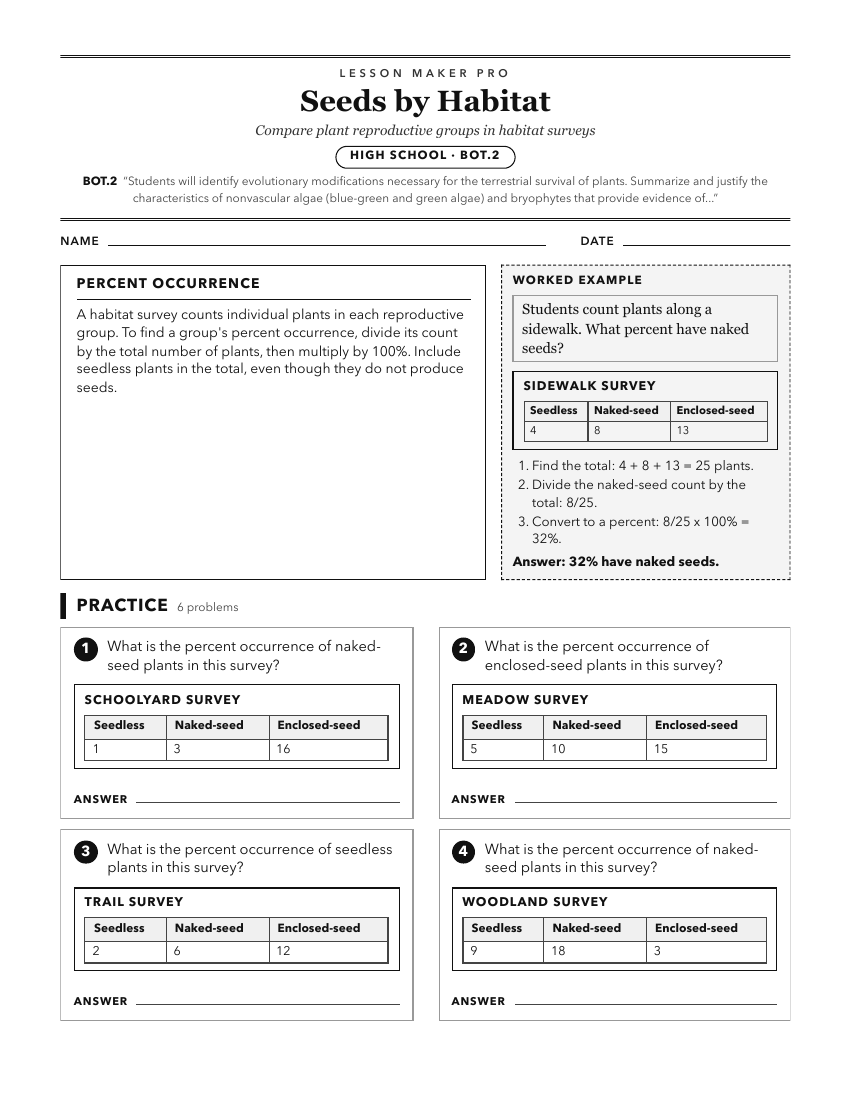
A ready-to-print activity worksheet aligned to BOT.2, with an answer key for the teacher on its own page. No account needed.
PDF, US Letter, prints cleanly in black and white.
Download the worksheetKeep exploring
Related Standards
- L.K.3A
Students will demonstrate an understanding of what animals and plants need to live and grow.
- L.1.4
Students will demonstrate an understanding of the ways plants adapt to their environment in order to survive.
- BOT.5
Students will explore adaptations that allow plants to survive in various habitats.
- BOT.3
Students will characterize the reproductive strategies of plants.
Turn this cluster into a lesson
Grade, subject, topic, and the complete cluster are prefilled. Create one free, no account needed.
Also for this cluster:Make a WorksheetMake a QuizMake a Sub Lesson