Mississippi Science BOT.2.1
The Standard
- BOT.2
- Students will identify evolutionary modifications necessary for the terrestrial survival of plants.
Summarize and justify the characteristics of nonvascular algae (blue-green and green algae) and bryophytes that provide evidence of evolution within the plant kingdom.
2026 Mississippi College- and Career-Readiness Standards for Science · Plant Evolution
Teacher's field guide
What This Standard Means
What Students Need to Do
- Students compare cyanobacteria, green algae, and bryophytes by looking at their cells and reproduction. They use shared traits to explain how green algae and early land plants are related.
What Mastery Looks Like
- Students identify chloroplasts and cellulose cell walls in green algae and mosses. They point to protected embryos as a land plant trait. They place cyanobacteria outside the plant lineage but link ancient cyanobacteria to the origin of chloroplasts.
Common Misconceptions
- Students may call cyanobacteria plants because they photosynthesize, though they lack nuclei and chloroplasts. They may mistake moss rhizoids for true roots or assume moss has vascular tissue. Some think living green algae turned directly into living mosses.
How to Assess It
- Exit ticket: Which of cyanobacteria, green algae, and moss have chloroplasts? Which protects embryos, and why are cyanobacteria not classified as plants?
Lesson moves
Ways to Teach It
Give groups photos of cyanobacteria, green algae, and moss, plus trait cards; have them place each trait beside every organism that has it.
Ask students to write three sentences explaining why moss is more closely related to green algae than to cyanobacteria.
Deal organism and trait cards to pairs; players keep each match only after explaining why it fits.
Show photos of moss on damp and dry stone walls; ask which site better supports fertilization and why.
Free download
Printable BOT.2.1 Worksheet
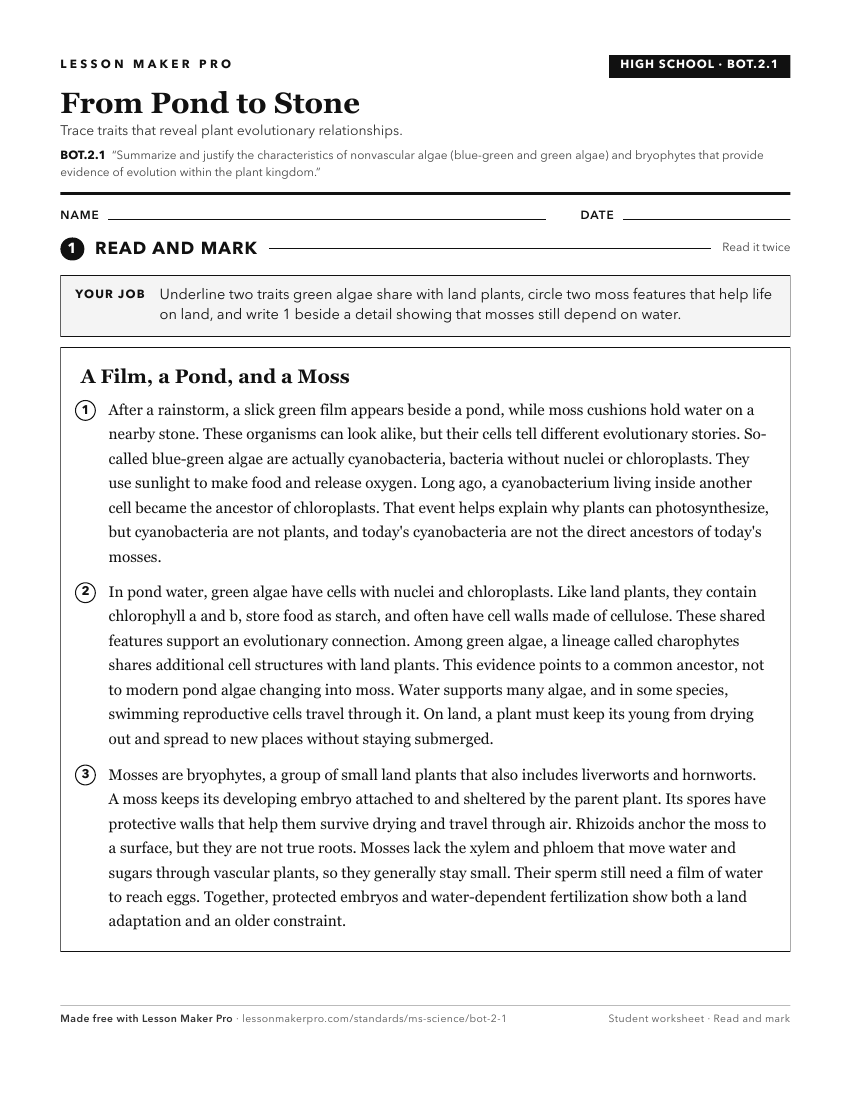
A ready-to-print activity worksheet aligned to BOT.2.1, with an answer key for the teacher on its own page. No account needed.
PDF, US Letter, prints cleanly in black and white.
Download the worksheetKeep exploring
Related Standards
- BOT.1.1
Analyze models (3-D, paper, and/or computer-based) to distinguish the basic morphology of the plant kingdom, with attention to structures and their related func...
- BOT.2.3
Summarize and justify the characteristics of angiosperms and gymnosperms that lead to their success as terrestrial plants.
- ESS.3.7
Cite evidence and develop logical arguments to identify the cause-and-effect relationships of the evolutionary milestones (e.g., photosynthesis and the atmosphe...
- L.3.2.4
Obtain and communicate data to provide evidence that plants and animals have traits inherited from both parent organisms and that variations of these traits exi...
Turn this exact standard into a lesson
Grade, subject, topic, and the complete standard are prefilled. Create one free, no account needed.
Also for this standard:Make a WorksheetMake a QuizMake a Sub Lesson