Indiana ELA 3.W
Standard Cluster
Students research and write for various purposes using processes and applying their knowledge of language and sentence structure.
Indiana Academic Standards for English/Language Arts (2023)
Cluster contents
Standards in This Cluster
3.W is a cluster heading. These are the individual standards under it.
- 3.W.1
Write legibly in print or cursive, leaving space between letters in a word, words, in a sentence, and words and the edges of the paper.
- 3.W.2.a
State the opinion in an introductory statement or section.
- 3.W.2.b
Support the opinion with reasons in an organized way.
- 3.W.3.a
State the topic, develop a main idea for the introductory paragraph, and group related information together.
- 3.W.3.b
Develop the topic with facts and details.
- 3.W.3.d
Use text features (e.g., photographs, maps) when useful to aid comprehension.
- 3.W.4.a
Establish an introduction (e.g., situation, narrator, characters).
- 3.W.4.b
Include specific descriptive details and clear event sequences.
- 3.W.4.c
Include dialogue.
- 3.W.4.d
Connect ideas and events using introduction and transition words.
- 3.W.4.e
Provide an ending. (E)
- 3.W.5
Apply the writing process to –
- 3.W.5.a
Generate a draft by developing, selecting, and organizing ideas relevant to topic, purpose, and genre; revise to improve writing, using appropriate reference ma...
- 3.W.5.b
Use available technology to produce and publish legible documents.
- 3.W.6
Conduct research on a topic.
- 3.W.6.a
Identify a specific topic or question of interest (e.g., where did Benjamin Harrison grow up?).
- 3.W.6.b
Locate information in reference texts, electronic resources, or through interviews.
- 3.W.6.c
Recognize that some sources may be more reliable than others.
- 3.W.6.d
Record relevant information in their own words.
- 3.W.6.e
Present the information, choosing from a variety of formats. (E)
- 3.W.7.a
Nouns/Pronouns – Writing sentences using abstract nouns (e.g., hope, thought).
- 3.W.7.b
Verbs – Writing sentences that use regular and irregular verbs and simple verb tenses to convey various times, sequences, states, and conditions.
- 3.W.7.c
Adjectives/ Adverbs – Writing sentences that include comparative and superlative adjectives and adverbs, choosing between them depending on what is being modifi...
- 3.W.7.d
Usage – Writing complete simple, compound, and complex declarative, interrogative, imperative, and exclamatory sentences, using coordinating and subordinating c...
- 3.W.8.a
Capitalization – Capitalizing appropriate words in titles, historical periods, company names, product names, and special events.
- 3.W.8.b
Punctuation –
- 3.W.8.b.I
Correctly using apostrophes to form contractions and singular and plural possessives.
- 3.W.8.b.II
Using quotation marks to mark direct speech.
- 3.W.8.b.III
Using commas in locations and addresses, to mark direct speech, and for coordinating adjectives (e.g., a small, red bicycle).
- 3.W.8.c
Spelling –
- 3.W.8.c.I
Using correct spelling for irregularly spelled words (e.g., said, does, gone) and other studied words and for adding affixes to base words.
- 3.W.1aWrite legibly by correctly forming capital and lowercase letters and using appropriate spacing between letters, words, and sentences, and write within the space provided.
- 3.W.2Write persuasive compositions in a variety of forms that: a. State the opinion in an introductory statement or section. b. Support the opinion with reasons in an organized way. c. Connect opinion and reasons using words and phrases. d. Provide a concluding statement or section. (E)
- 3.W.2aWrite a persuasive piece on a provided or selected topic that: a. Introduces an opinion. b. Supports the opinion with at least one supporting reason. c. Uses connecting words or phrases between the opinion and reason(s). d. Includes a concluding statement. (E)
- 3.W.3Write informative compositions on a variety of topics that: a. State the topic, develop a main idea for the introductory paragraph, and group related information together. b. Develop the topic with facts and details. c. Connect ideas within categories of information using words and phrases. d. Use text features (e.g., photographs, maps) when useful to aid comprehension. e. Provide a concluding statement or section. (E)
- 3.W.3aWrite an informative piece on a provided or selected topic that: a. Introduces the topic and main idea in an introductory statement. b. Develops the topic with at least one fact and one detail. c. Uses connecting words or phrases between ideas. d. Includes a concluding statement. (E)
- 3.W.4Write narrative compositions in a variety of forms that: a. Establish an introduction (e.g., situation, narrator, characters). b. Include specific descriptive details and clear event sequences. c. Include dialogue. d. Connect ideas and events using introduction and transition words. e. Provide an ending. (E)
- 3.W.4aWrite a narrative piece on a provided or selected topic that: a. Introduces a situation and narrator and/or at least one character. b. Includes at least one descriptive detail and two to three ordered events. c. Includes dialogue. d. Connects ideas and events using introduction and transition words. e. Includes an ending statement. (E)
- 3.W.5aApply the writing process to – a. Generate and record ideas for writing through discussions, pictures, and/or drawings about a topic or experience; b. Develop drafts in pictorial and/or written form by organizing or sequencing ideas using a graphic organizer; c. Use varied forms of provided feedback (e.g., questions related to sequence details, adding words or ideas and/or pictures) to revise writing. d. Edit writing for conventions including: capitalization of names of people, names of places, dates, and holidays; end punctuation, comma use in greetings and closings, dates, and locations or addresses; and/or spelling of high frequency, common, and irregularly spelled words; e. Use available and familiar technology to produce and publish writing.
- 3.W.6aConduct research on a topic. a. Identify a topic or question of interest from provided sources of information (e.g., What states have mountains?). b. Find information from at least two provided sources including texts, electronic resources, and/or interviews that can be used to answer the question(s) about the topic. c. Record relevant information in their own words using graphic organizers or other aids. d. Present information that has been gathered using an appropriate format (e.g., text, labeled diagrams, poster, diorama, or multimedia). (E)
- 3.W.7Demonstrate command of English grammar and usage, focusing on: a. Nouns/Pronouns – Writing sentences using abstract nouns (e.g., hope, thought). b. Verbs – Writing sentences that use regular and irregular verbs and simple verb tenses to convey various times, sequences, states, and conditions. c. Adjectives/ Adverbs – Writing sentences that include comparative and superlative adjectives and adverbs, choosing between them depending on what is being modified, and explaining their functions in the sentence. d. Usage – Writing complete simple, compound, and complex declarative, interrogative, imperative, and exclamatory sentences, using coordinating and subordinating conjunctions (e.g., and, for, but, or) correctly. (E)
- 3.W.7aCorrectly apply English grammar and usage when writing or speaking, focusing on: a. Nouns/Pronouns - Producing simple sentences that include proper and/or collective nouns and pronouns. b. Verbs - Producing simple sentences that use regular and irregular verbs and simple verb tenses to convey a variety of times, sequences, states, and/or conditions. c. Adjectives/Adverbs - Producing simple sentences that include comparative and/or superlative adjectives and adverbs. d. Usage - With the aid of cloze activities, producing complete simple, and compound declarative, interrogative, imperative, and/or exclamatory sentences using coordinating or subordinating conjunctions (e.g., and, for, but, or). (E)
- 3.W.8Demonstrate command of capitalization, punctuation, and spelling, focusing on: a. Capitalization – Capitalizing appropriate words in titles, historical periods, company names, product names, and special events. b. Punctuation – I. Correctly using apostrophes to form contractions and singular and plural possessives. II. Using quotation marks to mark direct speech. III. Using commas in locations and addresses, to mark direct speech, and for coordinating adjectives (e.g., a small, red bicycle). c. Spelling – I. Using correct spelling for irregularly spelled words (e.g., said, does, gone) and other studied words and for adding affixes to base words. II. Using spelling patterns and generalizations (e.g., word families, position-based spellings, syllable patterns, ending rules, meaningful word parts, homophones/ homographs) when writing. (E)
- 3.W.8aApply capitalization, punctuation, and spelling conventions focusing on: a. Capitalization - Capitalizing appropriate words in titles, company names, product names, or special events. b. Punctuation – I. Using apostrophes to form common contractions and singular and plural possessives. II. Using commas in locations and addresses c. Spelling – I. Using correct spelling for common irregularly spelled words (e.g., said, does, gone), regularly spelled common words, and for adding affixes to base words. II. Using spelling patterns and generalizations (e.g., word families, position-based spellings, syllable patterns, ending rules, and common homophones/homographs) when writing. (E)
Teacher's field guide
What This Cluster Means
What Students Need to Do
- Students gather facts from short sources and choose details that fit their reader and purpose. They plan, draft, and revise their writing. They use complete sentences and check capitals and punctuation.
What Mastery Looks Like
- A student can use facts from two sources to write a clear paragraph for a named reader. The facts are accurate and the sentences are complete. The student can reread and fix a confusing sentence.
Common Misconceptions
- Students may copy whole sentences from a source instead of using their own words. They may include facts that do not help their message. Some write fragments or join too many ideas with only 'and.'
How to Assess It
- Give students two cards: 'Monarch caterpillars eat milkweed leaves' and 'Monarchs lay eggs on milkweed.' Ask them to write three sentences for a second grader explaining why milkweed helps monarchs, then improve one sentence.
Lesson moves
Ways to Teach It
Give groups two printed monarch fact cards; students highlight one useful fact on each and arrange their facts on sticky notes before writing.
Ask, 'Which monarch fact would help a second grader understand milkweed?' Partners explain their choice, then write an opening sentence.
Hand out monarch sentence strips with fragments and run-ons; pairs fix each one and read their corrected sentences aloud.
Show a photo of the school garden; students write a sign suggesting milkweed for monarchs, backed by a fact card.
Free download
Printable 3.W Worksheet
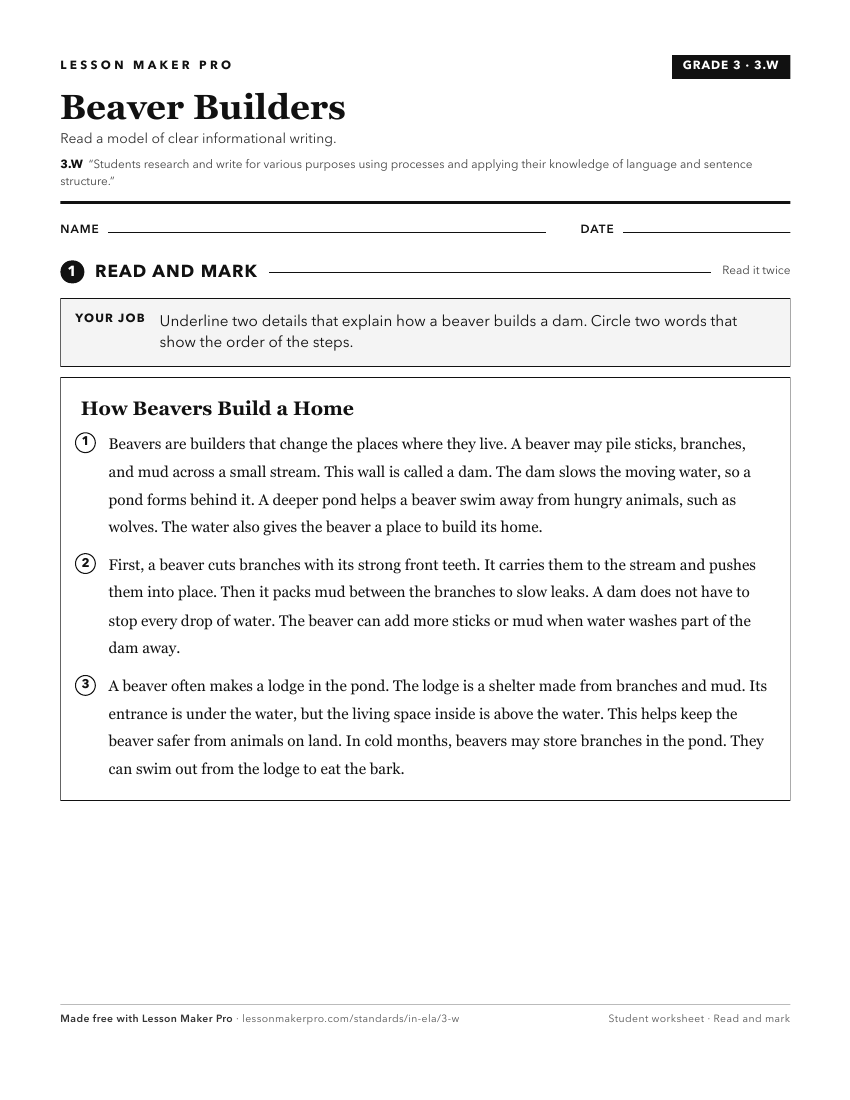
A ready-to-print activity worksheet aligned to 3.W, with an answer key for the teacher on its own page. No account needed.
PDF, US Letter, prints cleanly in black and white.
Download the worksheetKeep exploring
Related Standards
- 4.W
The 4th Grade version of this standard.
- 5.W
The 5th Grade version of this standard.
- 1.W
Students produce writing for a variety of purposes applying their knowledge of language and sentence structure.
- 2.W
Students produce writing for a variety of purposes, applying their knowledge of language and sentence structure.
Turn this cluster into a lesson
Grade, subject, topic, and the complete cluster are prefilled. Create one free, no account needed.
Also for this cluster:Make a WorksheetMake a QuizMake a Sub Lesson