Indiana ELA 3.W.8.b.III
The Standard
- 3.W.8
- Demonstrate command of capitalization, punctuation, and spelling, focusing on: a. Capitalization – Capitalizing appropriate words in titles, historical periods, company names, product names, and special events. b. Punctuation – I. Correctly using apostrophes to form contractions and singular and plural possessives. II. Using quotation marks to mark direct speech. III. Using commas in locations and addresses, to mark direct speech, and for coordinating adjectives (e.g., a small, red bicycle). c. Spelling – I. Using correct spelling for irregularly spelled words (e.g., said, does, gone) and other studied words and for adding affixes to base words. II. Using spelling patterns and generalizations (e.g., word families, position-based spellings, syllable patterns, ending rules, meaningful word parts, homophones/ homographs) when writing. (E)
- 3.W.8.b
- Punctuation –
Using commas in locations and addresses, to mark direct speech, and for coordinating adjectives (e.g., a small, red bicycle).
Indiana Academic Standards for English/Language Arts (2023) · Demonstrate command of capitalization, punctuation, and spelling, focusing on:
Teacher's field guide
What This Standard Means
What Students Need to Do
- Students place commas in addresses and between a city and state. They use commas with a speaker’s words and between adjectives that can be joined by 'and.'
What Mastery Looks Like
- A student writes '42 Pine Street, Boise, Idaho' and '“Wait,” said Ana' with commas in the right places. They can explain why 'bright, shiny kite' has a comma.
Common Misconceptions
- Students may leave out the comma between a city and state or put the comma outside the quotation marks. They may put a comma between every pair of adjectives without checking whether 'and' fits.
How to Assess It
- Exit ticket: Add the missing commas to 'We visited Boise Idaho. “Come here” said Mia. I saw a bright shiny kite.' Ask students to explain one choice.
Lesson moves
Ways to Teach It
Give pairs cards labeled street, city, and state; have them arrange the cards and write the address on one line with commas.
Write 'Mia said, “Come here.”' and '“Come here,” said Mia.' Ask partners to explain why the comma moves.
Play comma repair: display three sentences with missing commas and have students correct them on mini whiteboards.
Show a one-line mailing address, then have students write a pretend address and circle the commas.
Free download
Printable 3.W.8.b.III Worksheet
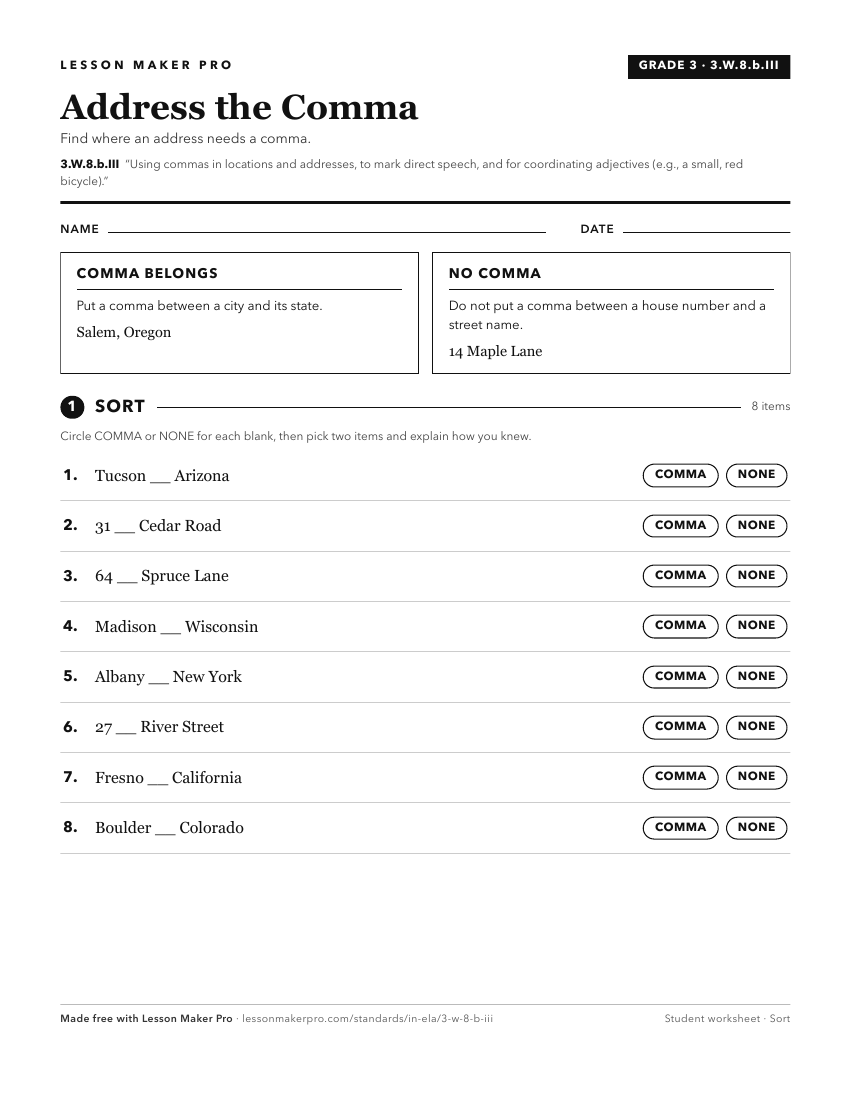
A ready-to-print activity worksheet aligned to 3.W.8.b.III, with an answer key for the teacher on its own page. No account needed.
PDF, US Letter, prints cleanly in black and white.
Download the worksheetKeep exploring
Related Standards
- 5.W.7.b.II
Using a comma for appositives, to set off the words yes and no, to set off a tag question from the rest of the sentence, and to indicate direct address.
- 4.W.7.b.II
Correctly using quotation marks and commas to mark direct speech.
- 2.W.8.b.III
Using commas in greetings and closings of letters, dates, and to separate items in a series.
- 1.W.8.b.II
Using commas in dates and to separate items in a series.
Turn this exact standard into a lesson
Grade, subject, topic, and the complete standard are prefilled. Create one free, no account needed.
Also for this standard:Make a WorksheetMake a QuizMake a Sub Lesson