Indiana ELA 4.W
Standard Cluster
Students research and write for various purposes using processes and applying their knowledge of language and sentence structure.
Indiana Academic Standards for English/Language Arts (2023)
Cluster contents
Standards in This Cluster
4.W is a cluster heading. These are the individual standards under it.
- 4.W.1.a
In an introductory statement, clearly state an opinion to a particular audience.
- 4.W.1.b
Support the opinion with facts and details from various sources, including texts.
- 4.W.1.c
Use an organizational structure to group related ideas that support the purpose.
- 4.W.2.a
Provide an introductory paragraph with a clear main idea.
- 4.W.2.b
Provide supporting paragraphs with topic and summary sentences.
- 4.W.2.c
Provide facts, specific details, and examples from various sources and texts to support ideas and extend explanations.
- 4.W.2.d
Connect ideas using words and phrases.
- 4.W.2.e
Include text features (e.g., formatting, photographs, maps) and multimedia when useful to aid comprehension.
- 4.W.2.f
Use language and vocabulary appropriate to the audience and topic.
- 4.W.3.a
Establish an introduction with context to allow the reader to imagine the world of the event or experience.
- 4.W.3.b
Organize events that unfold naturally, using meaningful paragraphing and transitional words and phrases.
- 4.W.3.c
Use dialogue and descriptive details to develop events and reveal characters' personalities, feelings, and responses to situations.
- 4.W.3.d
Employ vocabulary with sufficient sensory (i.e., sight, sound, smell, touch, taste) details to give clear pictures of ideas and events.
- 4.W.4.a
Generate a draft by developing, selecting, and organizing ideas relevant to topic, purpose, and genre; revise to improve writing, using appropriate reference ma...
- 4.W.4.b
Use technology to interact and collaborate with others to produce and publish legible documents.
- 4.W.5
Conduct research on a topic.
- 4.W.5.a
Identify a specific question to address (e.g., What is the history of the Indy 500?).
- 4.W.5.b
Use organizational features of print and digital sources to efficiently locate further information.
- 4.W.5.c
Determine the reliability of the sources.
- 4.W.5.d
Summarize and organize information in their own words, giving credit to the source.
- 4.W.5.e
Present the research information, choosing from a variety of formats. (E)
- 4.W.6.a
Nouns/Pronouns – Writing sentences that include relative pronouns (e.g., who, which) and reflexive pronouns (e.g., myself, ourselves) and explaining their funct...
- 4.W.6.b.I
Writing sentences that use progressive verb tenses.
- 4.W.6.b.II
Recognizing and correcting inappropriate shifts in verb tense.
- 4.W.6.b.III
Using modal auxiliaries (e.g., can, may, must).
- 4.W.6.c
Adjectives/Adverbs – Writing sentences using relative adverbs (e.g., where, when), explaining their functions in the sentence.
- 4.W.6.d
Prepositions – Writing sentences that include prepositions, explaining their functions in the sentence.
- 4.W.6.e
Usage – Writing complete simple, compound, and complex declarative, interrogative, imperative, and exclamatory sentences, using coordinating and subordinating c...
- 4.W.7.a
Capitalization – Capitalizing names of magazines, newspapers, works of art, musical compositions, organizations, and the first word in quotations, when appropri...
- 4.W.7.b
Punctuation –
- 4.W.7.b.I
Correctly using apostrophes to form possessives and contractions.
- 4.W.7.b.II
Correctly using quotation marks and commas to mark direct speech.
- 4.W.7.c
Spelling – Using spelling patterns and generalizations (e.g., word families, position-based spellings, syllable patterns, ending rules, meaningful word parts, h...
- 4.W.1Write persuasive compositions in a variety of forms that: a. In an introductory statement, clearly state an opinion to a particular audience. b. Support the opinion with facts and details from various sources, including texts. c. Use an organizational structure to group related ideas that support the purpose. d. Connect opinion and reasons using words and phrases. e. Provide a concluding statement or section related to the position presented. (E)
- 4.W.1aWrite a persuasive piece on a selected topic that: a. Presents an opinion in an introductory statement to an identified audience. b. Supports the opinion with at least two qualitative or quantitative facts and details from teacher-curated sources, including texts. c. Uses a provided organizational structure to group related ideas that support the purpose. d. Connects reasons to the position using words and phrases. e. Provides a concluding statement or section related to the position presented. (E)
- 4.W.2Write informative compositions on a variety of topics that: a. Provide an introductory paragraph with a clear main idea. b. Provide supporting paragraphs with topic and summary sentences. c. Provide facts, specific details, and examples from various sources and texts to support ideas and extend explanations. d. Connect ideas using words and phrases. e. Include text features (e.g., formatting, photographs, maps) and multimedia when useful to aid comprehension. f. Use language and vocabulary appropriate to the audience and topic. g. Provide a concluding statement or section. (E)
- 4.W.2aWrite an informative piece on a selected topic that: a. Introduces a topic; organizes sentences and paragraphs logically, using an organizational form that suits the topic. b. Uses at least two examples, facts, specific details, or examples from sources to give clear support for topics. c. Connects ideas within and across categories using at least two transition words (e.g., therefore, in addition). d. Includes at least one text feature (e.g., formatting, photographs, maps, diagrams) and multimedia when useful to aid comprehension. e. Uses appropriate language and vocabulary to convey meaning. f. Provides a concluding statement or section. (E)
- 4.W.3Write narrative compositions in a variety of forms that: a. Establish an introduction with context to allow the reader to imagine the world of the event or experience. b. Organize events that unfold naturally, using meaningful paragraphing and transitional words and phrases. c. Use dialogue and descriptive details to develop events and reveal characters’ personalities, feelings, and responses to situations. d. Employ vocabulary with sufficient sensory (i.e., sight, sound, smell, touch, taste) details to give clear pictures of ideas and events. e. Provide an ending that follows the narrated experiences or events. (E)
- 4.W.3aWrite a narrative that: a. Establishes an introduction with some context to allow the reader to begin to know a character, event, or experience. b. Describes an event or an experience that unfolds naturally into a beginning, a middle, and an end, using at least two paragraphs and including transitional words or phrases. c. Uses at least two lines of dialogue and/or descriptive details to develop a story and reveal character traits. d. Employs vocabulary with some sensory (i.e., sight, sound, smell, touch, taste) details to give mostly clear pictures of ideas and events. e. Provides an ending that follows the narrated experiences or events. (E)
- 4.W.4Apply the writing process to: a. Generate a draft by developing, selecting, and organizing ideas relevant to topic, purpose, and genre; revise to improve writing, using appropriate reference materials (e.g., quality of ideas, organization, sentence fluency, word choice); edit writing for format and conventions (e.g., spelling, capitalization, usage, punctuation). b. Use technology to interact and collaborate with others to produce and publish legible documents.
- 4.W.4aApply the writing process to: a. Plan by generating and recording ideas for writing through discussions, pictures, drawings, and/or provided reference materials about a topic or experience; b. Select a topic, purpose, and genre. c. Develop drafts in written form by organizing or sequencing ideas using a graphic organizer. d. Use varied forms of provided feedback (e.g., questions related to sequence details, adding words or ideas and/or pictures) to revise writing by adding events and/or details using pictures or words and/or reordering ideas or events. e. Edit writing for conventions including: capitalization of names of books, poems, songs, magazines, newspapers, organizations, and the first word in quotations, when appropriate; end punctuation, apostrophes, quotation marks, and commas; and/or spelling words with syllable patterns and common ending rules. f. Use available and familiar technology to produce and publish writing.
- 4.W.5aConduct research on a topic. a. Identify a topic or question of interest from provided sources of information (e.g., What is the history of the Indy 500?). b. Use organizational features of three provided print and/or digital sources to efficiently locate information. c. Organize and/or summarize information in own words, and give credit to the source when appropriate. d. Present information that has been gathered using an appropriate format. (E)
- 4.W.6Demonstrate command of English grammar and usage, focusing on: a. Nouns/Pronouns – Writing sentences that include relative pronouns (e.g., who, which) and reflexive pronouns (e.g., myself, ourselves) and explaining their functions in the sentence. b. Verbs – I. Writing sentences that use progressive verb tenses. II. Recognizing and correcting inappropriate shifts in verb tense. III. Using modal auxiliaries (e.g., can, may, must). c. Adjectives/Adverbs – Writing sentences using relative adverbs (e.g., where, when), explaining their functions in the sentence. d. Prepositions – Writing sentences that include prepositions, explaining their functions in the sentence. e. Usage – Writing complete simple, compound, and complex declarative, interrogative, imperative, and exclamatory sentences, using coordinating and subordinating conjunctions (e.g., yet, nor, so) correctly. (E)
- 4.W.6aCorrectly apply English and grammar usage, focusing on: a. Nouns/Pronouns – producing short, simple sentences that include a relative pronoun (e.g., who, which) or a reflexive pronoun (e.g., myself, ourselves) and explaining their functions in the sentence. b. Verbs – I. Producing short, simple sentences that use progressive verb tenses. II. With the help of such visual aids as verb charts or audio clips, recognizing and correcting inappropriate shifts in verb tense. III. With the help of visual aids or audio clips, using modal auxiliaries (e.g., can, may, must). c. Adjectives/Adverbs – Writing simple sentences using relative adverbs (e.g., where, when), explaining their functions in the sentence. d. Prepositions – Producing simple sentences that include prepositions, explaining their functions in the sentence. e. Usage – With the aid of cloze activities, producing complete simple, compound, and complex declarative, interrogative, imperative, and exclamatory sentences, using coordinating and subordinating conjunctions (e.g., yet, nor, so). (E)
- 4.W.7Demonstrate command of capitalization, punctuation, and spelling, focusing on: a. Capitalization – Capitalizing names of magazines, newspapers, works of art, musical compositions, organizations, and the first word in quotations, when appropriate. b. Punctuation – I. Correctly using apostrophes to form possessives and contractions. II. Correctly using quotation marks and commas to mark direct speech. III. Using a comma before a coordinating conjunction in a compound sentence. c. Spelling – Using spelling patterns and generalizations (e.g., word families, position-based spellings, syllable patterns, ending rules, meaningful word parts, homophones/homographs) in writing single and multisyllable words. (E)
- 4.W.7aApply capitalization, punctuation, and spelling conventions, focusing on: a. Capitalization – Capitalizing names of books, songs, magazines, newspapers, organizations, and the first word in quotations, when appropriate. b. Punctuation – I. Correctly using apostrophes to form possessives and simple contractions. II. Correctly using quotation marks and commas to mark direct speech. III. Using a comma before a coordinating conjunction in a compound sentence. c. Spelling – Use assistive technology or tools for spell checking so that words in compositions use spelling patterns and generalizations (e.g., word families, position-based spellings, syllable patterns, ending rules, meaningful word parts, homophones/homographs) in writing words with one, two, or three syllables. (E)
Teacher's field guide
What This Cluster Means
What Students Need to Do
- Students gather facts from short sources and use them to write for a clear purpose and audience. They plan, draft, revise, and edit, choosing words and sentence patterns that make their ideas clear.
What Mastery Looks Like
- A student can take notes in their own words, group related facts, and write a focused paragraph or short letter. They can revise repetitive sentences and fix spelling, capitalization, and punctuation errors.
Common Misconceptions
- Students may copy whole sentences from a source instead of taking notes in their own words. They may list facts without a main point or think revising means only fixing spelling.
How to Assess It
- Give students two short fact cards about bees. Ask for a four-sentence explanation of why gardens need bees, using one fact from each card and revising one sentence for clarity.
Lesson moves
Ways to Teach It
Give pairs printed fact cards about bees; have them choose two facts and draft a letter asking the principal to plant flowers.
Read two short park descriptions, one with repeated sentence starts; ask, “Which reads better, and how would you revise the other?”
Put mixed-up sentence strips from a frog report in order, then replace repeated sentence openings before reading the paragraph aloud.
Use a cafeteria menu and two nutrition labels to write a note recommending one snack for a class event.
Free download
Printable 4.W Worksheet
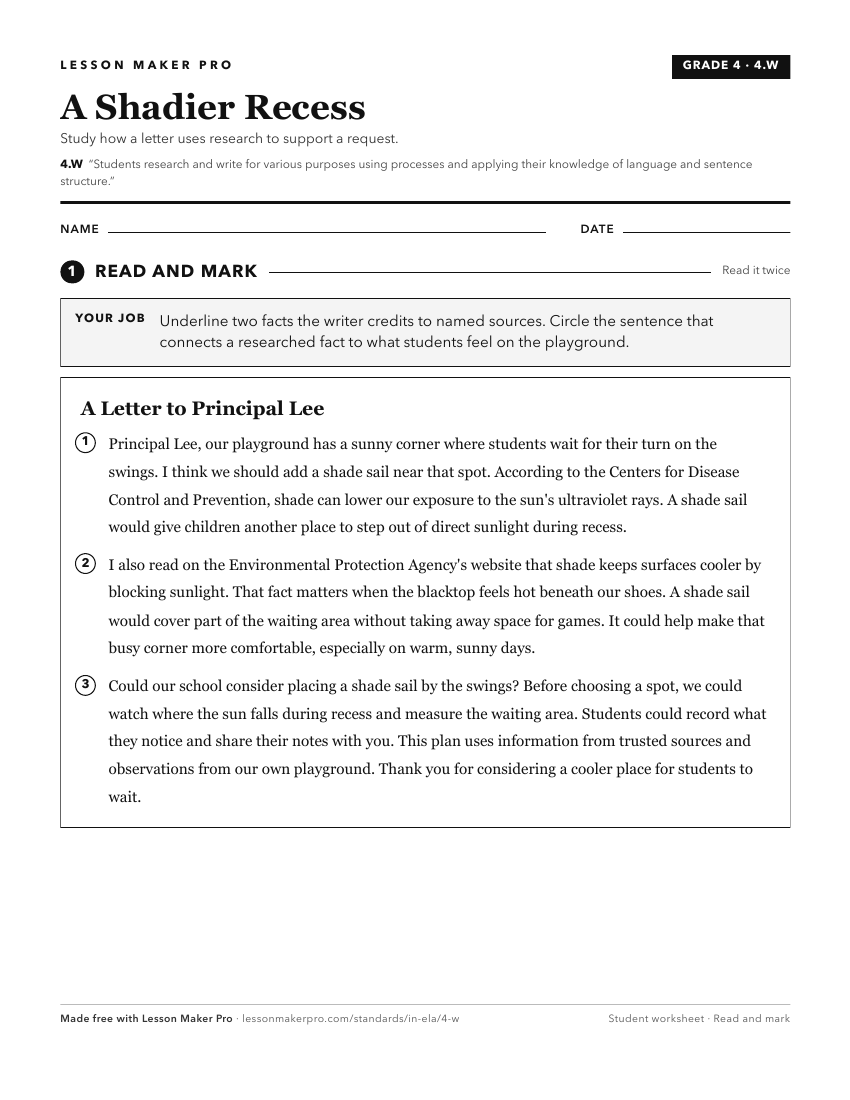
A ready-to-print activity worksheet aligned to 4.W, with an answer key for the teacher on its own page. No account needed.
PDF, US Letter, prints cleanly in black and white.
Download the worksheetKeep exploring
Related Standards
- 3.W
The 3rd Grade version of this standard.
- 5.W
The 5th Grade version of this standard.
- 1.W
Students produce writing for a variety of purposes applying their knowledge of language and sentence structure.
- 2.W
Students produce writing for a variety of purposes, applying their knowledge of language and sentence structure.
Turn this cluster into a lesson
Grade, subject, topic, and the complete cluster are prefilled. Create one free, no account needed.
Also for this cluster:Make a WorksheetMake a QuizMake a Sub Lesson