Indiana ELA 4.W.6.b.III
The Standard
- 4.W.6
- Demonstrate command of English grammar and usage, focusing on: a. Nouns/Pronouns – Writing sentences that include relative pronouns (e.g., who, which) and reflexive pronouns (e.g., myself, ourselves) and explaining their functions in the sentence. b. Verbs – I. Writing sentences that use progressive verb tenses. II. Recognizing and correcting inappropriate shifts in verb tense. III. Using modal auxiliaries (e.g., can, may, must). c. Adjectives/Adverbs – Writing sentences using relative adverbs (e.g., where, when), explaining their functions in the sentence. d. Prepositions – Writing sentences that include prepositions, explaining their functions in the sentence. e. Usage – Writing complete simple, compound, and complex declarative, interrogative, imperative, and exclamatory sentences, using coordinating and subordinating conjunctions (e.g., yet, nor, so) correctly. (E)
Using modal auxiliaries (e.g., can, may, must).
Indiana Academic Standards for English/Language Arts (2023) · Demonstrate command of English grammar and usage, focusing on:
Teacher's field guide
What This Standard Means
What Students Need to Do
- Students choose helping verbs to show ability, permission, possibility, or a rule. They put the helping verb before the main verb so the sentence says what they mean.
What Mastery Looks Like
- A student can explain why “We must wear helmets” states a rule, while “We might wear helmets” does not. They can change the helping verb when a sentence gives the wrong message.
Common Misconceptions
- Students may use can and may as if ability and permission mean the same thing. They may write “must to go” instead of “must go,” or use must when something is only possible.
How to Assess It
- Exit ticket: Fill in each blank with can, may, or must: “I ___ ride a bike because I learned last summer.” “You ___ borrow my pencil if you ask.” “Riders ___ wear helmets because it is the law.” Explain one choice.
Lesson moves
Ways to Teach It
Give pairs sentence strips and can, may, and must cards; have them swap cards and explain how the meaning changes.
Ask students to write two sentences explaining the difference between “You may rest” and “You must rest.”
Play a matching game with situation cards, such as a school rule or a possible storm, and helping verb cards.
Show students a field trip permission slip and ask what changes if “You must return this form” becomes “You may return this form.”
Free download
Printable 4.W.6.b.III Worksheet
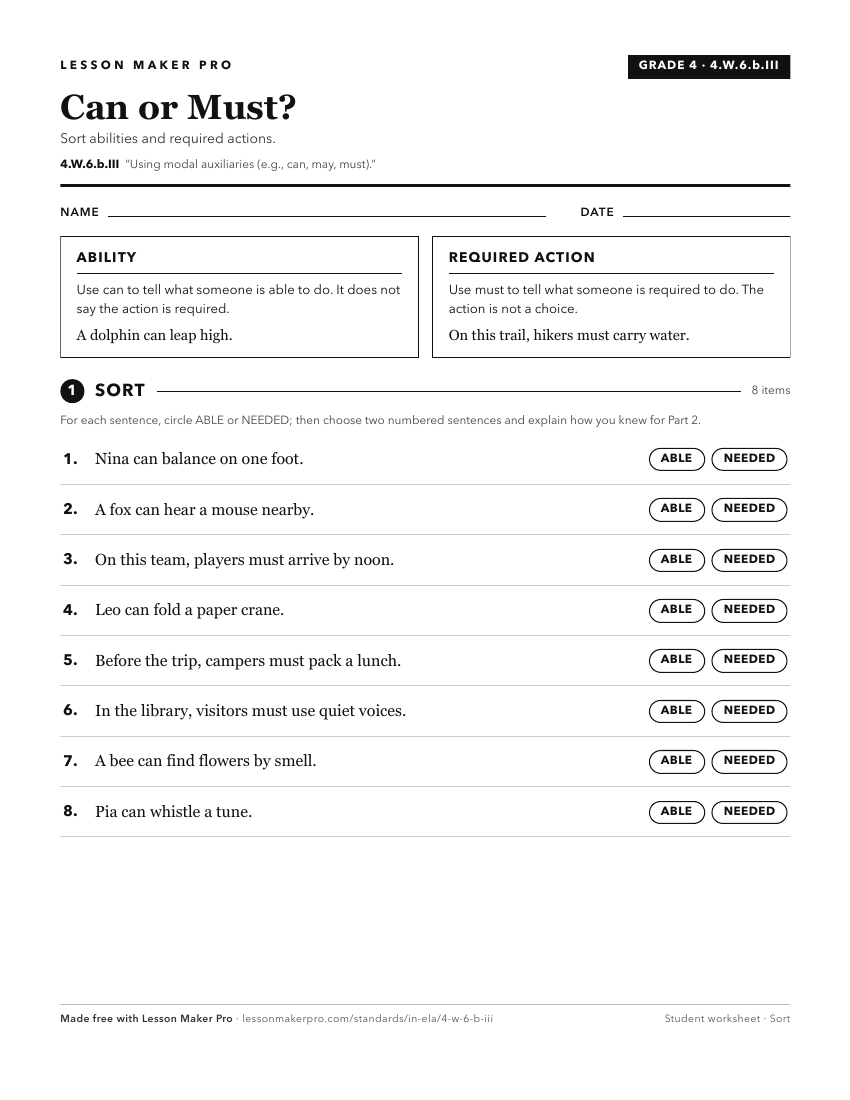
A ready-to-print activity worksheet aligned to 4.W.6.b.III, with an answer key for the teacher on its own page. No account needed.
PDF, US Letter, prints cleanly in black and white.
Download the worksheetKeep exploring
Related Standards
- 3.W.7.d
Usage – Writing complete simple, compound, and complex declarative, interrogative, imperative, and exclamatory sentences, using coordinating and subordinating c...
- 2.W.7.d
Usage – Using complete simple and compound declarative, interrogative, imperative, and exclamatory sentences correctly. (E)
- 2.W.7.b.I
Using sentences that use the past tense of frequently occurring irregular verbs.
Turn this exact standard into a lesson
Grade, subject, topic, and the complete standard are prefilled. Create one free, no account needed.
Also for this standard:Make a WorksheetMake a QuizMake a Sub Lesson