Indiana ELA 2.W.7.d
The Standard
- 2.W
- Students produce writing for a variety of purposes, applying their knowledge of language and sentence structure.
- 2.W.7
- Demonstrate command of English grammar and usage, when writing or speaking, focusing on: a. Nouns/Pronouns – Using sentences that include common, proper, possessive, and collective nouns, irregular plural nouns, and personal and possessive pronouns. b. Verbs – I. Using sentences that use the past tense of frequently occurring irregular verbs. II. Understanding the functions of different types of verbs (e.g., action, linking) in sentences. c. Adjectives/Adverbs – Using sentences that use adjectives and adverbs. d. Usage – Using complete simple and compound declarative, interrogative, imperative, and exclamatory sentences correctly. (E)
Usage – Using complete simple and compound declarative, interrogative, imperative, and exclamatory sentences correctly.
Indiana Academic Standards for English/Language Arts (2023)
Teacher's field guide
What This Standard Means
What Students Need to Do
- Students write and say complete statements, questions, commands, and exclamations. They write simple sentences and join two complete thoughts to make compound sentences. They use end marks that fit.
What Mastery Looks Like
- A student writes all four sentence types about one picture. Each expresses a complete thought and has the right end mark. The student can join two complete thoughts with and or but, then fix a fragment or run-on.
Common Misconceptions
- Students may mistake “Please pass the paper.” for a question because it asks someone to do something. They may treat “Because it rained.” as a complete sentence. They may join thoughts with and even when one side is incomplete.
How to Assess It
- Exit ticket: Write a statement, question, command, and exclamation about a rainy day. Make the statement compound by joining two complete thoughts with and or but, then add the right end marks.
Lesson moves
Ways to Teach It
Give pairs word and punctuation cards; have them build four sentence types, then combine two statement cards with but.
Show “Close the door.” and “Will you close the door?” Ask partners how each sentence changes what the listener should do.
Play sentence sort with 12 sentence strips; students sort by purpose, mark simple or compound, and correct missing end marks.
Have students write a four-line note for a class visitor: a welcome statement, a question, a direction, and an excited reaction.
Free download
Printable 2.W.7.d Worksheet
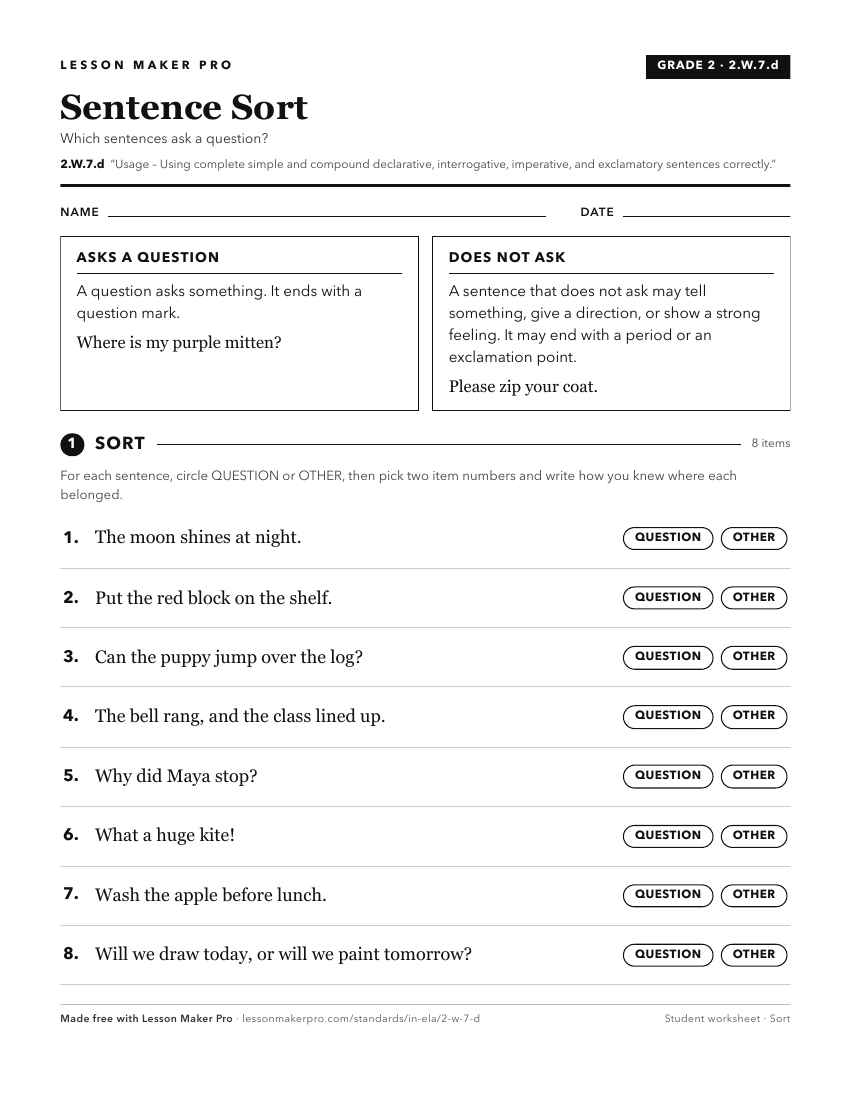
A ready-to-print activity worksheet aligned to 2.W.7.d, with an answer key for the teacher on its own page. No account needed.
PDF, US Letter, prints cleanly in black and white.
Download the worksheetKeep exploring
Related Standards
- 3.W.7.d
Usage – Writing complete simple, compound, and complex declarative, interrogative, imperative, and exclamatory sentences, using coordinating and subordinating c...
- 4.W.6.e
Usage – Writing complete simple, compound, and complex declarative, interrogative, imperative, and exclamatory sentences, using coordinating and subordinating c...
- 1.W.7.c
Usage – Using complete simple declarative, interrogative, imperative, and exclamatory sentences in response to prompts.
- 5.W.6.c
Usage – Writing correctly simple, compound, and complex declarative, interrogative, imperative, and exclamatory sentences, using correlative conjunctions (e.g.,...
Turn this exact standard into a lesson
Grade, subject, topic, and the complete standard are prefilled. Create one free, no account needed.
Also for this standard:Make a WorksheetMake a QuizMake a Sub Lesson