Indiana ELA 4.W.6.e
The Standard
- 4.W
- Students research and write for various purposes using processes and applying their knowledge of language and sentence structure.
- 4.W.6
- Demonstrate command of English grammar and usage, focusing on: a. Nouns/Pronouns – Writing sentences that include relative pronouns (e.g., who, which) and reflexive pronouns (e.g., myself, ourselves) and explaining their functions in the sentence. b. Verbs – I. Writing sentences that use progressive verb tenses. II. Recognizing and correcting inappropriate shifts in verb tense. III. Using modal auxiliaries (e.g., can, may, must). c. Adjectives/Adverbs – Writing sentences using relative adverbs (e.g., where, when), explaining their functions in the sentence. d. Prepositions – Writing sentences that include prepositions, explaining their functions in the sentence. e. Usage – Writing complete simple, compound, and complex declarative, interrogative, imperative, and exclamatory sentences, using coordinating and subordinating conjunctions (e.g., yet, nor, so) correctly. (E)
Usage – Writing complete simple, compound, and complex declarative, interrogative, imperative, and exclamatory sentences, using coordinating and subordinating conjunctions (e.g., yet, nor, so) correctly.
Indiana Academic Standards for English/Language Arts (2023)
Teacher's field guide
What This Standard Means
What Students Need to Do
- Students write complete sentences that state, ask, give a command, or show strong feeling. They write one complete thought, join two complete thoughts, or add a dependent thought. They choose joining words and punctuation that fit.
What Mastery Looks Like
- A student can write, 'The path was muddy, so we wore boots' and 'Because the path was muddy, we wore boots.' They can turn the idea into a question or command without leaving a fragment.
Common Misconceptions
- Students may treat 'Because it rained' as a complete sentence. They may join two complete thoughts with only a comma. Some use nor without a negative first clause, as if it means or.
How to Assess It
- Ask students to write four sentences about a storm: a simple statement, a compound exclamation with so, a complex question with because, and a command.
Lesson moves
Ways to Teach It
Give pairs clause strips and because, yet, and so cards; have them build three complete sentences and explain each joining word.
Ask students to write two sentences about missing the bus, one with yet and one with so, then explain the different outcomes.
Hand out 12 sentence cards; have teams sort them by purpose and label each simple, compound, or complex.
Have students write a field trip notice with a statement, a command, and a question, including one sentence with because.
Free download
Printable 4.W.6.e Worksheet
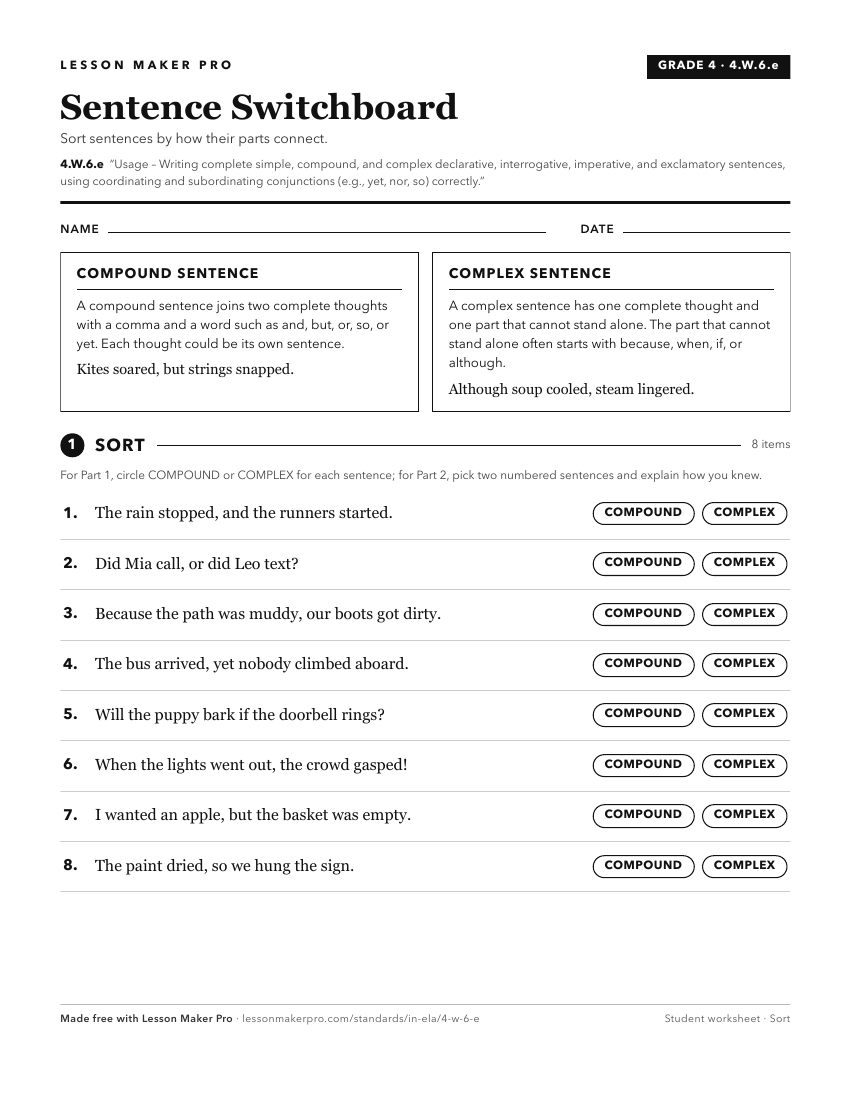
A ready-to-print activity worksheet aligned to 4.W.6.e, with an answer key for the teacher on its own page. No account needed.
PDF, US Letter, prints cleanly in black and white.
Download the worksheetKeep exploring
Related Standards
- 3.W.7.d
Usage – Writing complete simple, compound, and complex declarative, interrogative, imperative, and exclamatory sentences, using coordinating and subordinating c...
- 5.W.6.c
Usage – Writing correctly simple, compound, and complex declarative, interrogative, imperative, and exclamatory sentences, using correlative conjunctions (e.g.,...
- 2.W.7.d
Usage – Using complete simple and compound declarative, interrogative, imperative, and exclamatory sentences correctly. (E)
- 6.W.6.b
Usage – Writing simple, compound, complex, and compound-complex sentences; recognizing sentence fragments and run-ons. (E)
Turn this exact standard into a lesson
Grade, subject, topic, and the complete standard are prefilled. Create one free, no account needed.
Also for this standard:Make a WorksheetMake a QuizMake a Sub Lesson