Indiana ELA 1.W
Standard Cluster
Students produce writing for a variety of purposes applying their knowledge of language and sentence structure.
Indiana Academic Standards for English/Language Arts (2023)
Cluster contents
Standards in This Cluster
1.W is a cluster heading. These are the individual standards under it.
- 1.W.1
Write all uppercase (capital) and lowercase letters legibly, and space letters, words, and sentences appropriately.
- 1.W.2
Produce (when writing or speaking) logically connected sentences to make a proposal to a particular audience (e.g., a parent, classmate), and give reasons why t...
- 1.W.3
Produce (when writing or speaking) a topic sentence or main idea, provide some facts or details about the topic, and provide a concluding statement. (E)
- 1.W.4
Produce (when writing or speaking) narratives using precise words to describe characters and actions and temporal words to signal event order, with ideas organi...
- 1.W.5.a
Plan by generating ideas for writing through oral discussions and drawings
- 1.W.5.b
Develop drafts in pictorial or written form by organizing ideas
- 1.W.5.c
Revise writing to add details in pictures or words (e.g., sentence structure); edit writing for conventions (e.g., correct spelling of frequently used words, ba...
- 1.W.5.d
Use available technology to produce and publish legible documents.
- 1.W.6
With support, conduct research on a topic.
- 1.W.6.a
Identify several sources of information and indicate the sources.
- 1.W.6.b
Organize information, using graphic organizers or other aids.
- 1.W.6.c
Make informal presentations on information gathered.
- 1.W.7.a
Nouns/Pronouns – Using sentences that include common and proper nouns and personal pronouns.
- 1.W.7.c
Usage – Using complete simple declarative, interrogative, imperative, and exclamatory sentences in response to prompts.
- 1.W.8.a
Capitalization – Capitalizing the first word of a sentence, dates, names of people, and the pronoun I .
- 1.W.8.b
Punctuation –
- 1.W.8.b.I
Correctly using a period, question mark, and exclamation mark at the end of a sentence.
- 1.W.8.b.II
Using commas in dates and to separate items in a series.
- 1.W.8.c
Encoding –
- 1.W.8.c.II
Correctly spelling words with common spelling patterns.
- 1.W.8.c.III
Correctly spelling common irregularly-spelled, grade-appropriate words (e.g., said, does, gone). (E)
- 1.W.1aWrite most uppercase (capital) and lowercase letters legibly and space letters and words appropriately.
- 1.W.2aProduce (when writing or speaking) one to two sentences to make a proposal or request to a particular audience (e.g., teacher, parents, classmates) and give at least one reason why the proposal should be considered. (E)
- 1.W.3aProduce (when writing or speaking) a simple sentence that identifies a topic and provides a fact or detail about the topic. (E)
- 1.W.3bProduce a concluding statement. (E)
- 1.W.4aProduce (when writing or speaking) a simple narrative that identifies a topic (e.g., event, experience) and at least one character and includes temporal words (e.g., first, then, next) to signal event order. (E)
- 1.W.5With support, apply the writing process to: a. Plan by generating ideas for writing through oral discussions and drawings; b. Develop drafts in pictorial or written form by organizing ideas; c. Revise writing to add details in pictures or words (e.g., sentence structure); edit writing for conventions (e.g., correct spelling of frequently used words, basic capitalization, end punctuation); and d. Use available technology to produce and publish legible documents.
- 1.W.5aWith support, apply the writing process to: a. Plan by generating ideas for writing through collaborative, oral discussion and/or drawings about a topic or experience. b. Develop drafts in pictorial and/or written form by organizing or sequencing ideas using a graphic organizer. c. Use varied forms of provided feedback (e.g., questions related to sequence or details, adding words or ideas and/or pictures) to revise writing by adding events and/or details using pictures or words. d. Edit writing for conventions including: I. capitalization of the first word in a sentence, the word I, names of people, and dates; II. end punctuation; III. spelling of high frequency words or words with common spelling patterns. e. Use available and familiar technology to produce and publish writing.
- 1.W.6aWith support, participate in shared research on a topic. a. Identify, from provided sources, information related to a topic, and use the information to answer simple questions. b. Identify different sources that can be used to gather information or to answer questions about a topic (e.g., books, discussions, posters, pictures, photographs, Internet). c. Organize information using graphic organizers or other aids. d. Present information that has been gathered using different formats (e.g., text, labeled diagrams, drawings, photographs, posters).
- 1.W.7Demonstrate command of English grammar and usage, when writing or speaking, focusing on: a. Nouns/Pronouns – Using sentences that include common and proper nouns and personal pronouns. b. Verbs – Using sentences with verbs to convey a sense of past, present, and future. c. Usage – Using complete simple declarative, interrogative, imperative, and exclamatory sentences in response to prompts.
- 1.W.7aCorrectly apply English grammar and usage when writing or speaking, focusing on: a. Nouns/Pronouns – Use sentences that include singular and/or plural nouns (e.g., dog/dogs, cat/cats) and personal pronouns (e.g., I, me, my, he, she, they, them). b. Verbs – Use sentences that include verbs to convey a sense of past, present, or future. c. Usage – Use complete simple declarative, interrogative, imperative, and/or exclamatory sentences in response to prompts.
- 1.W.8Demonstrate command of capitalization, punctuation, and spelling, focusing on: a. Capitalization – Capitalizing the first word of a sentence, dates, names of people, and the pronoun I. b. Punctuation – I. Correctly using a period, question mark, and exclamation mark at the end of a sentence. II. Using commas in dates and to separate items in a series. c. Encoding – I. Spelling unknown words phonetically, drawing on phonemic awareness and spelling conventions. II. Correctly spelling words with common spelling patterns. III. Correctly spelling common irregularly-spelled, grade-appropriate words (e.g., said, does, gone). (E)
- 1.W.8aApply capitalization, punctuation, and spelling conventions focusing on: a. Capitalization – Capitalize the first word in a sentence, names of people, and the pronoun I. b. Punctuation – Use end punctuation (e.g., period, question mark, and/or exclamation point). c. Encoding – Correctly spell words with common spelling patterns, and spell unknown words phonetically, drawing on phonemic awareness and spelling conventions. (E)
Teacher's field guide
What This Cluster Means
What Students Need to Do
- First graders write to tell a story, share facts, or ask for something. They choose words that fit the job and put them in an order that makes sense. They use capitals, spaces, and end marks to help a reader follow along.
What Mastery Looks Like
- A student can tell what happened in a short story, give a few facts about an animal, or make a clear request in a note. Their sentences make sense when read aloud and have capitals, spaces, and end marks.
Common Misconceptions
- Students may write a list of words instead of a sentence, or run several thoughts together. They may tell a story when asked for facts, or leave out the request in a note.
How to Assess It
- Ask students to write two sentences to the principal requesting a new playground ball. Check for a clear request, a reason, and sentences a reader can follow.
Lesson moves
Ways to Teach It
Give pairs picture cards showing a lost mitten, then have them arrange the cards and write two sentences telling what happened.
Ask students to write one sentence telling what happened at recess and one sentence asking the teacher for a new recess ball.
Play sentence repair with word cards reading 'dog the runs'; teams reorder the cards and add a capital and period.
Have students write a two-sentence thank-you note to the school custodian, naming one thing the custodian did and why it helped.
Free download
Printable 1.W Worksheet
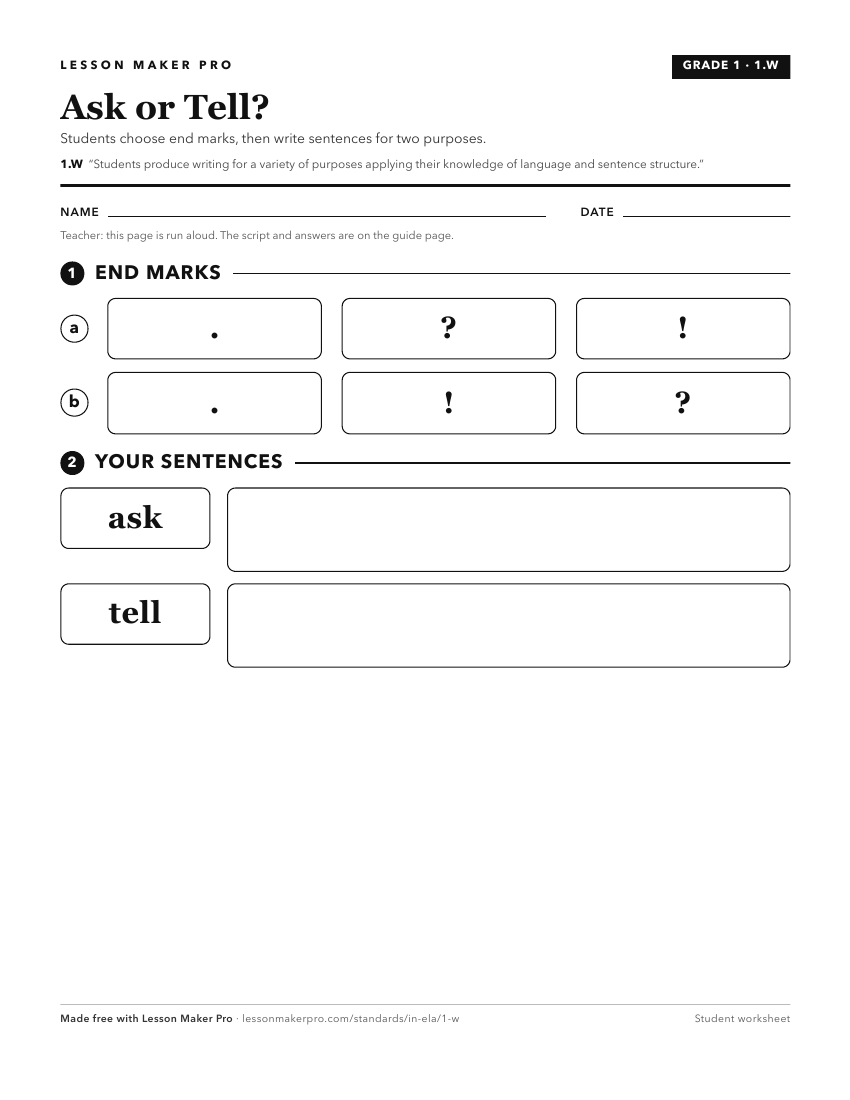
A ready-to-print activity worksheet aligned to 1.W, with an answer key for the teacher on its own page. No account needed.
PDF, US Letter, prints cleanly in black and white.
Download the worksheetKeep exploring
Related Standards
- K.W
Students produce writing for a variety of purposes, applying their knowledge of language and sentence structure.
- 2.W
Students produce writing for a variety of purposes, applying their knowledge of language and sentence structure.
- 4.W
Students research and write for various purposes using processes and applying their knowledge of language and sentence structure.
- 3.W
Students research and write for various purposes using processes and applying their knowledge of language and sentence structure.
Turn this cluster into a lesson
Grade, subject, topic, and the complete cluster are prefilled. Create one free, no account needed.
Also for this cluster:Make a WorksheetMake a QuizMake a Sub Lesson