Indiana ELA 4.W.6.a
The Standard
- 4.W
- Students research and write for various purposes using processes and applying their knowledge of language and sentence structure.
- 4.W.6
- Demonstrate command of English grammar and usage, focusing on: a. Nouns/Pronouns – Writing sentences that include relative pronouns (e.g., who, which) and reflexive pronouns (e.g., myself, ourselves) and explaining their functions in the sentence. b. Verbs – I. Writing sentences that use progressive verb tenses. II. Recognizing and correcting inappropriate shifts in verb tense. III. Using modal auxiliaries (e.g., can, may, must). c. Adjectives/Adverbs – Writing sentences using relative adverbs (e.g., where, when), explaining their functions in the sentence. d. Prepositions – Writing sentences that include prepositions, explaining their functions in the sentence. e. Usage – Writing complete simple, compound, and complex declarative, interrogative, imperative, and exclamatory sentences, using coordinating and subordinating conjunctions (e.g., yet, nor, so) correctly. (E)
Nouns/Pronouns – Writing sentences that include relative pronouns (e.g., who, which) and reflexive pronouns (e.g., myself, ourselves) and explaining their functions in the sentence.
Indiana Academic Standards for English/Language Arts (2023)
Teacher's field guide
What This Standard Means
What Students Need to Do
- Students use who or which to add a detail about a person or thing. They use myself or ourselves to point back to the subject, then explain what each pronoun does.
What Mastery Looks Like
- A student writes, 'The bike which squeaks belongs to me,' and explains that which adds detail about the bike. They write, 'I taught myself to ride,' and explain that myself points back to I.
Common Misconceptions
- Some students use which for a person or think who is only for questions. Others write 'Myself went home' instead of 'I went home,' or use ourselves when the subject is I.
How to Assess It
- Exit ticket: Write one sentence with who or which and another with myself or ourselves. Circle each pronoun and explain its job.
Lesson moves
Ways to Teach It
Give pairs word cards for 'The baker who smiled taught herself'; have them arrange the sentence and draw arrows from both pronouns to baker.
Ask: In 'The child who tripped caught herself,' what detail does who add, and who does herself point back to?
Play pronoun swap: show 'The teacher which sang taught myself'; teams replace both pronouns and explain each fix.
Write a class display caption: 'The students who built this display painted it themselves'; label what who and themselves point to.
Free download
Printable 4.W.6.a Worksheet
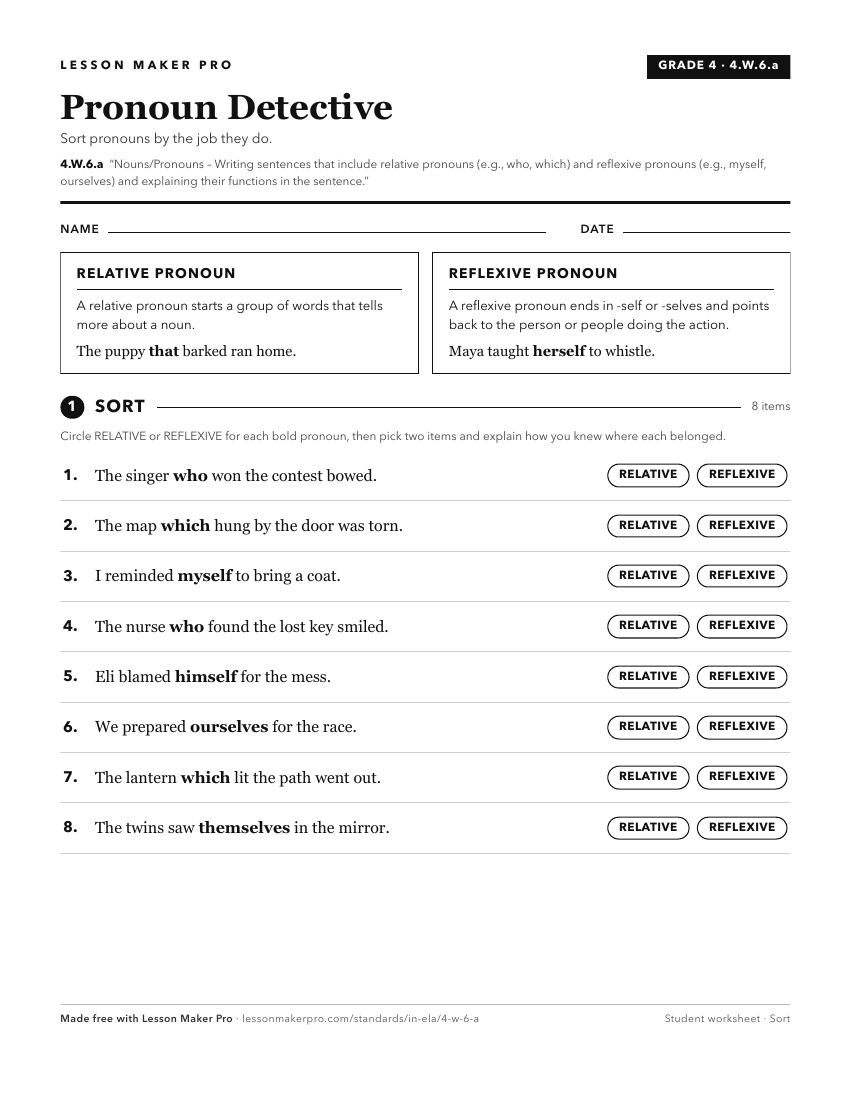
A ready-to-print activity worksheet aligned to 4.W.6.a, with an answer key for the teacher on its own page. No account needed.
PDF, US Letter, prints cleanly in black and white.
Download the worksheetKeep exploring
Related Standards
- 1.W.7.a
Nouns/Pronouns – Using sentences that include common and proper nouns and personal pronouns.
- 2.W.7.a
Nouns/Pronouns – Using sentences that include common, proper, possessive, and collective nouns, irregular plural nouns, and personal and possessive pronouns.
- 4.W.6.c
Adjectives/Adverbs – Writing sentences using relative adverbs (e.g., where, when), explaining their functions in the sentence.
- 5.W.6.b
Prepositions – Writing sentences that include prepositional phrases and explaining their functions in the sentence.
Turn this exact standard into a lesson
Grade, subject, topic, and the complete standard are prefilled. Create one free, no account needed.
Also for this standard:Make a WorksheetMake a QuizMake a Sub Lesson