Indiana ELA 3.W.8.c
Standard Cluster
- 3.W
- Students research and write for various purposes using processes and applying their knowledge of language and sentence structure.
- 3.W.8
- Demonstrate command of capitalization, punctuation, and spelling, focusing on: a. Capitalization – Capitalizing appropriate words in titles, historical periods, company names, product names, and special events. b. Punctuation – I. Correctly using apostrophes to form contractions and singular and plural possessives. II. Using quotation marks to mark direct speech. III. Using commas in locations and addresses, to mark direct speech, and for coordinating adjectives (e.g., a small, red bicycle). c. Spelling – I. Using correct spelling for irregularly spelled words (e.g., said, does, gone) and other studied words and for adding affixes to base words. II. Using spelling patterns and generalizations (e.g., word families, position-based spellings, syllable patterns, ending rules, meaningful word parts, homophones/ homographs) when writing. (E)
Spelling – Using correct spelling for irregularly spelled words (e.g., said, does, gone) and other studied words and for adding affixes to base words. Using spelling patterns and generalizations (e.g., word families, position-based spellings, syllable patterns, ending rules, meaningful word parts, homophones/ homographs) when writing.
Indiana Academic Standards for English/Language Arts (2023)
Cluster contents
Standards in This Cluster
3.W.8.c is a cluster heading. These are the individual standards under it.
Teacher's field guide
What This Cluster Means
What Students Need to Do
- Students spell familiar tricky words correctly in their writing. They use spelling patterns to add endings to words. They choose the right spelling for words that sound alike.
What Mastery Looks Like
- A student writes because and friend correctly without relying on sound alone. They turn hop into hopping and hope into hoping. They use their for belonging and there for a place.
Common Misconceptions
- Students may write frend because they spell only the sounds they hear. They may write hopeing, forget to double the p in hopping, or mix up their and there.
How to Assess It
- Dictate friend, hoping, and hopping. Then ask students to write a sentence using their and explain why hopping has two p's.
Lesson moves
Ways to Teach It
Use letter tiles to build hop, hopping, hope, and hoping, then sort the pairs by what happened to the final letters.
Write two sentences, one with their and one with there, then tell a partner which word names a place.
Give pairs a light card and two minutes to write and check words with the same ight spelling.
Write a note to the school office about a lost backpack, then check tricky words against the classroom word wall.
Free download
Printable 3.W.8.c Worksheet
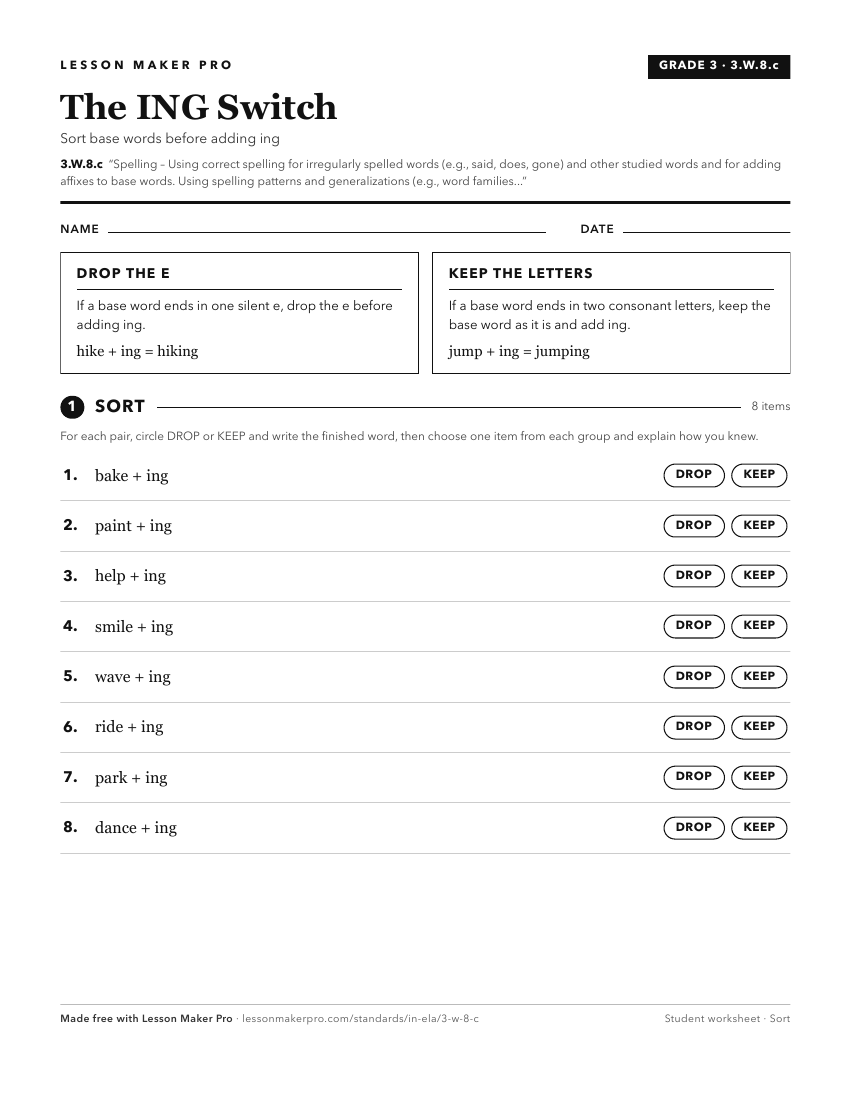
A ready-to-print activity worksheet aligned to 3.W.8.c, with an answer key for the teacher on its own page. No account needed.
PDF, US Letter, prints cleanly in black and white.
Download the worksheetKeep exploring
Related Standards
- 4.W.7.c
Spelling – Using spelling patterns and generalizations (e.g., word families, position-based spellings, syllable patterns, ending rules, meaningful word parts, h...
- 1.W.8.c.II
Correctly spelling words with common spelling patterns.
- K.W.8.c
Encoding – Spelling simple words phonetically, drawing on phonemic awareness.
Turn this cluster into a lesson
Grade, subject, and topic are prefilled; the lesson picks the standards under this heading. Create one free, no account needed.
Also for this cluster:Make a WorksheetMake a QuizMake a Sub Lesson