Indiana ELA 3.W.7.c
The Standard
- 3.W
- Students research and write for various purposes using processes and applying their knowledge of language and sentence structure.
- 3.W.7
- Demonstrate command of English grammar and usage, focusing on: a. Nouns/Pronouns – Writing sentences using abstract nouns (e.g., hope, thought). b. Verbs – Writing sentences that use regular and irregular verbs and simple verb tenses to convey various times, sequences, states, and conditions. c. Adjectives/ Adverbs – Writing sentences that include comparative and superlative adjectives and adverbs, choosing between them depending on what is being modified, and explaining their functions in the sentence. d. Usage – Writing complete simple, compound, and complex declarative, interrogative, imperative, and exclamatory sentences, using coordinating and subordinating conjunctions (e.g., and, for, but, or) correctly. (E)
Adjectives/ Adverbs – Writing sentences that include comparative and superlative adjectives and adverbs, choosing between them depending on what is being modified, and explaining their functions in the sentence.
Indiana Academic Standards for English/Language Arts (2023)
Teacher's field guide
What This Standard Means
What Students Need to Do
- Students use comparative forms to compare two things and superlative forms to compare three or more. They write sentences with adjectives that describe nouns and adverbs that describe verbs, then name the word each form describes.
What Mastery Looks Like
- A student writes “the taller plant” for two plants and “the tallest plant” for three. They write “ran more quickly” to compare actions and point to “ran” as the word being described.
Common Misconceptions
- Students may use “tallest” when comparing only two things. They may write “more faster” or use “quick” instead of “quickly” to describe how someone ran.
How to Assess It
- Show three toy cars with lengths and rolling distances: red (4 cm, 1 m), blue (6 cm, 2 m), green (8 cm, 3 m). Ask students to write one sentence using “longer” and one using “farthest,” then label the noun or verb each word describes.
Lesson moves
Ways to Teach It
Fold three paper planes, measure their lengths and flights, then write sentences using larger, largest, farther, and farthest.
Ask, “Why does tallest describe tree, while fastest describes grew in ‘The tallest tree grew fastest’?”
Give pairs three cards showing dogs of different sizes running at different speeds; partners write comparative and superlative sentences and label nouns and verbs.
Use a chart of three days’ temperatures and wind speeds; write which day was warmer and which day’s wind blew most strongly.
Free download
Printable 3.W.7.c Worksheet
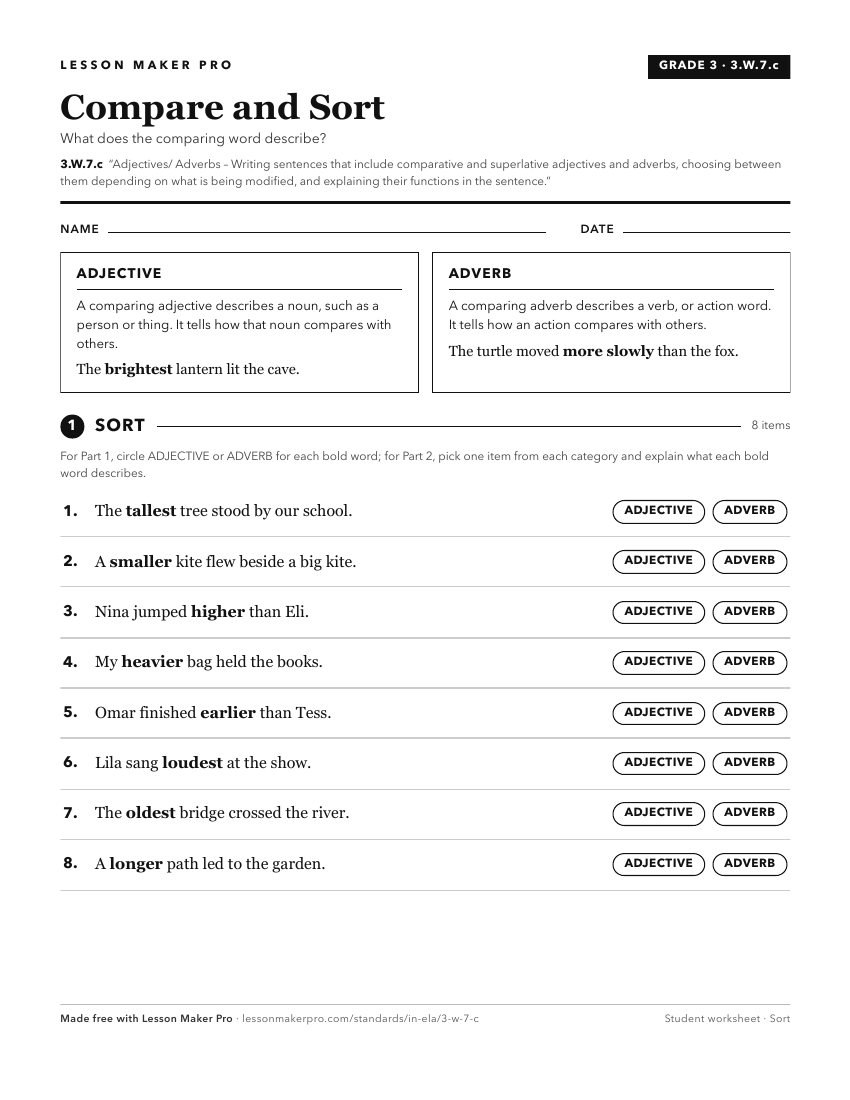
A ready-to-print activity worksheet aligned to 3.W.7.c, with an answer key for the teacher on its own page. No account needed.
PDF, US Letter, prints cleanly in black and white.
Download the worksheetKeep exploring
Related Standards
- 4.W.6.c
Adjectives/Adverbs – Writing sentences using relative adverbs (e.g., where, when), explaining their functions in the sentence.
- 2.W.7.c
Adjectives/Adverbs – Using sentences that use adjectives and adverbs.
- 4.W.6.d
Prepositions – Writing sentences that include prepositions, explaining their functions in the sentence.
- 5.W.6.b
Prepositions – Writing sentences that include prepositional phrases and explaining their functions in the sentence.
Turn this exact standard into a lesson
Grade, subject, topic, and the complete standard are prefilled. Create one free, no account needed.
Also for this standard:Make a WorksheetMake a QuizMake a Sub Lesson