Indiana ELA 3.W.8.a
The Standard
- 3.W
- Students research and write for various purposes using processes and applying their knowledge of language and sentence structure.
- 3.W.8
- Demonstrate command of capitalization, punctuation, and spelling, focusing on: a. Capitalization – Capitalizing appropriate words in titles, historical periods, company names, product names, and special events. b. Punctuation – I. Correctly using apostrophes to form contractions and singular and plural possessives. II. Using quotation marks to mark direct speech. III. Using commas in locations and addresses, to mark direct speech, and for coordinating adjectives (e.g., a small, red bicycle). c. Spelling – I. Using correct spelling for irregularly spelled words (e.g., said, does, gone) and other studied words and for adding affixes to base words. II. Using spelling patterns and generalizations (e.g., word families, position-based spellings, syllable patterns, ending rules, meaningful word parts, homophones/ homographs) when writing. (E)
Capitalization – Capitalizing appropriate words in titles, historical periods, company names, product names, and special events.
Indiana Academic Standards for English/Language Arts (2023)
Teacher's field guide
What This Standard Means
What Students Need to Do
- Students capitalize key words in titles and the names of historical periods, companies, products, and special events. They leave ordinary words lowercase when those words are not part of a name.
What Mastery Looks Like
- A student writes The Secret Garden, the Middle Ages, Target, Band-Aid, and Earth Day with the right capitals. They can explain why garden is lowercase in “a garden” but capitalized in the book title.
Common Misconceptions
- Students may capitalize every word in a title, including of in the middle. They may write “earth day” or “the renaissance” in lowercase. Others capitalize ordinary words like store and toy as if they were names.
How to Assess It
- Exit ticket: Fix the capitals in “the tale of peter rabbit,” “the renaissance,” “target,” “band-aid,” and “earth day.” Circle one word that should stay lowercase.
Lesson moves
Ways to Teach It
Give pairs lowercase name cards reading “the secret garden,” “the middle ages,” “target,” “band-aid,” and “earth day”; have them fix capitals with markers.
Ask, “Why is day capitalized in Earth Day but lowercase in a rainy day?” Have partners write one sentence explaining the difference.
Play a correction relay: teams fix “charlotte’s web,” “the ice age,” “amazon,” “play-doh,” and “thanksgiving” on the board.
Give students a grocery flyer; they copy two company or product names and write a generic label, like cereal, beside each.
Free download
Printable 3.W.8.a Worksheet
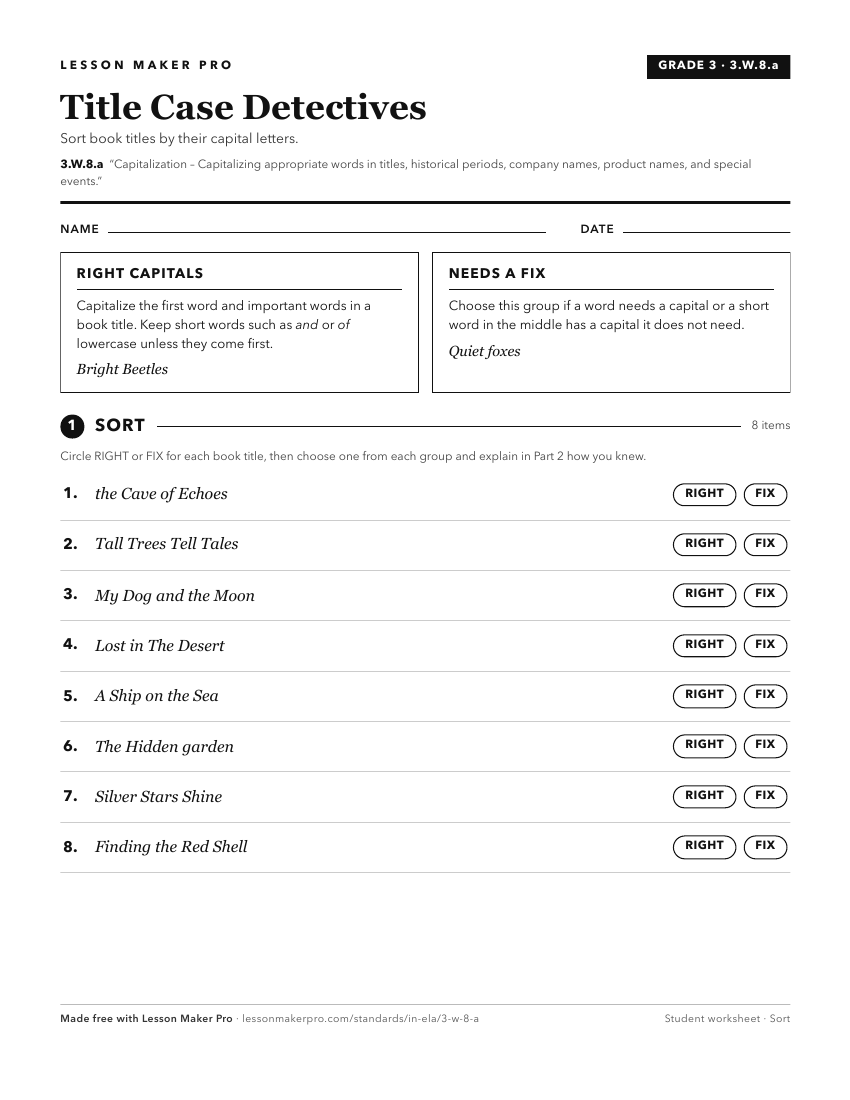
A ready-to-print activity worksheet aligned to 3.W.8.a, with an answer key for the teacher on its own page. No account needed.
PDF, US Letter, prints cleanly in black and white.
Download the worksheetKeep exploring
Related Standards
- 2.W.8.a
Capitalization – Capitalizing greetings, months and days of the week, titles and initials in names, and proper nouns, including holidays and geographic names.
- 4.W.7.a
Capitalization – Capitalizing names of magazines, newspapers, works of art, musical compositions, organizations, and the first word in quotations, when appropri...
- 1.W.8.a
Capitalization – Capitalizing the first word of a sentence, dates, names of people, and the pronoun I .
Turn this exact standard into a lesson
Grade, subject, topic, and the complete standard are prefilled. Create one free, no account needed.
Also for this standard:Make a WorksheetMake a QuizMake a Sub Lesson