Georgia S6E5
Georgia Standard (Element Cluster)
Obtain, evaluate, and communicate information to show how Earth's surface is formed.
Georgia Standards of Excellence for Science
Cluster contents
Elements in This Standard
S6E5 is a Georgia science standard. These are the elements under it.
- S6E5.a
Ask questions to compare and contrast the Earth's crust, mantle, inner and outer core, including temperature, density, thickness, and composition.
- S6E5.b
Plan and carry out an investigation of the characteristics of minerals and how minerals contribute to rock composition.
- S6E5.c
Construct an explanation of how to classify rocks by their formation and how rocks change through geologic processes in the rock cycle.
- S6E5.d
Ask questions to identify types of weathering, agents of erosion and transportation, and environments of deposition.
- S6E5.e
Develop a model to demonstrate how natural processes (weathering, erosion, and deposition) and human activity change rocks and the surface of the Earth.
- S6E5.f
Construct an explanation of how the movement of lithospheric plates, called plate tectonics, can cause major geologic events such as earthquakes and volcanic er...
- S6E5.g
Construct an argument using maps and data collected to support a claim of how fossils show evidence of the changing surface and climate of the Earth.
- S6E5.h
Plan and carry out an investigation to provide evidence that soil is composed of layers of weathered rocks and decomposed organic material.
Teacher's field guide
What This Cluster Means
What Students Need to Do
- Students gather information from maps, rock samples, diagrams, models, and reliable texts. They connect Earth's layers, plate motion, rock formation, weathering, erosion, and deposition to specific surface features. They explain those connections with evidence.
What Mastery Looks Like
- Given a landform or geologic pattern, students identify the process that produced it and cite evidence from a map, model, sample, or image. They distinguish slow and rapid changes and communicate a clear cause-and-effect explanation. They can compare sources and recognize a claim that lacks evidence.
Common Misconceptions
- Students often use weathering and erosion as if they mean the same thing. They may think tectonic plates float on liquid magma or that landforms only change during sudden events. Some treat the rock cycle as one fixed sequence.
How to Assess It
- Give students a diagram of a convergent plate boundary beside a river delta. Ask: What process formed each feature, and what evidence in the diagram supports your answer?
Lesson moves
Ways to Teach It
Build a stream table with sand and gravel, then pour water at different slopes and mark where erosion and deposition occur.
Show before-and-after landform photos and ask students to write a claim naming the process, evidence, and resulting surface change.
Play a card sort matching plate boundaries, rock clues, weathering, erosion, and deposition with the landforms each process produces.
Use maps and photos of Georgia's Appalachians or barrier islands to explain which processes shaped one selected feature.
Free download
Printable S6E5 Worksheet
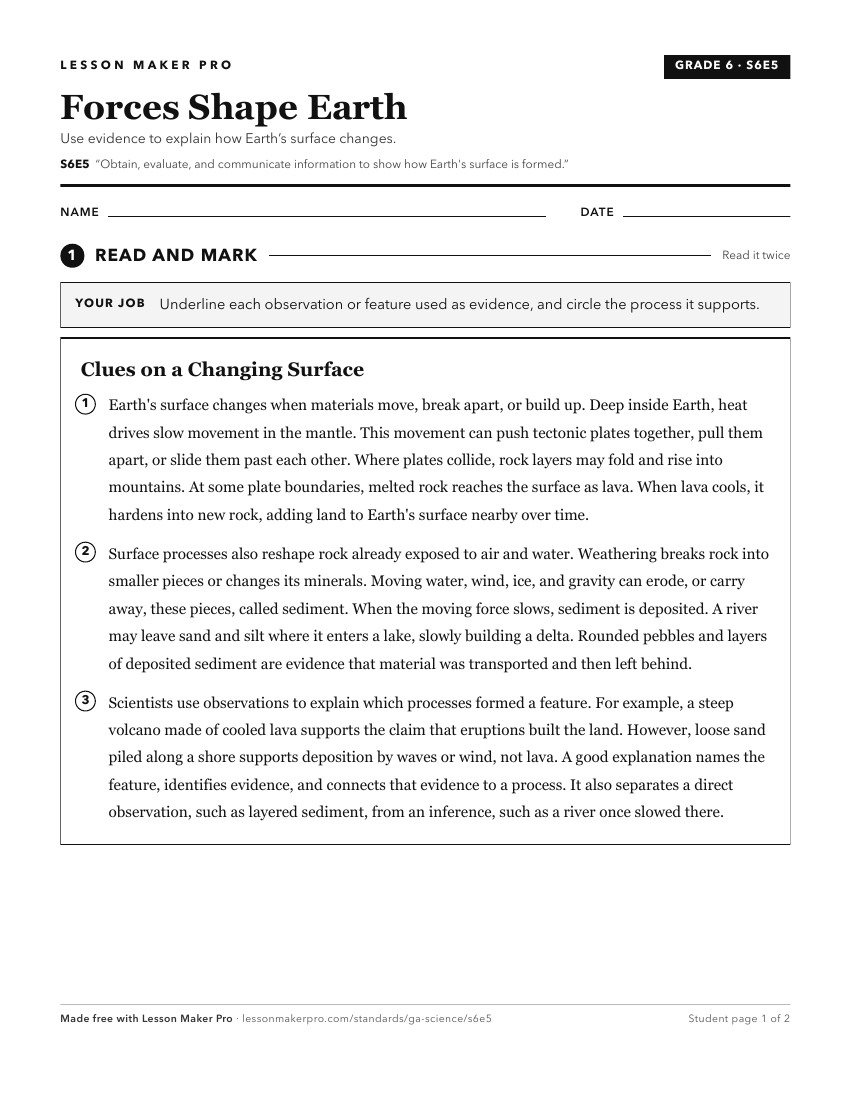
A ready-to-print activity worksheet aligned to S6E5, with an answer key for the teacher on its own page. No account needed.
PDF, US Letter, prints cleanly in black and white.
Download the worksheetKeep exploring
Related Standards
- S3E1
Obtain, evaluate, and communicate information about the physical attributes of rocks and soils.
- SKE2
Obtain, evaluate, and communicate information to describe the physical attributes of earth materials (soil, rocks, water, and air).
- S5E1
Obtain, evaluate, and communicate information to identify surface features on the Earth caused by constructive and/or destructive processes.
- S6E3
Obtain, evaluate, and communicate information to recognize the significant role of water in Earth processes.
Turn this cluster into a lesson
Grade, subject, topic, and the complete cluster are prefilled. Create one free, no account needed.
Also for this cluster:Make a WorksheetMake a QuizMake a Sub Lesson