Georgia S6E5.f
The Standard
- S6E5
- Obtain, evaluate, and communicate information to show how Earth's surface is formed.
Construct an explanation of how the movement of lithospheric plates, called plate tectonics, can cause major geologic events such as earthquakes and volcanic eruptions.
Georgia Standards of Excellence for Science · Obtain, evaluate, and communicate information to show how Earth's surface is formed.
Teacher's field guide
What This Standard Means
What Students Need to Do
- Students explain how plates colliding, separating, or sliding past each other change Earth’s surface. They connect built-up stress to earthquakes and rising magma to volcanic eruptions.
What Mastery Looks Like
- Students can use a diagram or map to identify plate movement and predict likely geologic events. They can write a clear cause-and-effect explanation using evidence from plate boundaries.
Common Misconceptions
- Students may think earthquakes move plates rather than result from plate movement. They may also think plates float on liquid magma or that every boundary produces both earthquakes and volcanoes.
How to Assess It
- Give students a diagram of two plates colliding. Ask them to explain how that movement could produce an earthquake or volcanic eruption in three sentences.
Lesson moves
Ways to Teach It
Use two graham crackers on frosting to model convergent, divergent, and transform boundaries, then record where cracks, ridges, and uplift appear.
Ask students to write: How can plate movement cause an earthquake even when the ground seems still before it happens?
Give pairs earthquake, volcano, and boundary cards, then have them match each event to a plate motion and defend their choices.
Overlay a printed earthquake map on a plate-boundary map, then identify one nearby community that could face geologic hazards.
Free download
Printable S6E5.f Worksheet
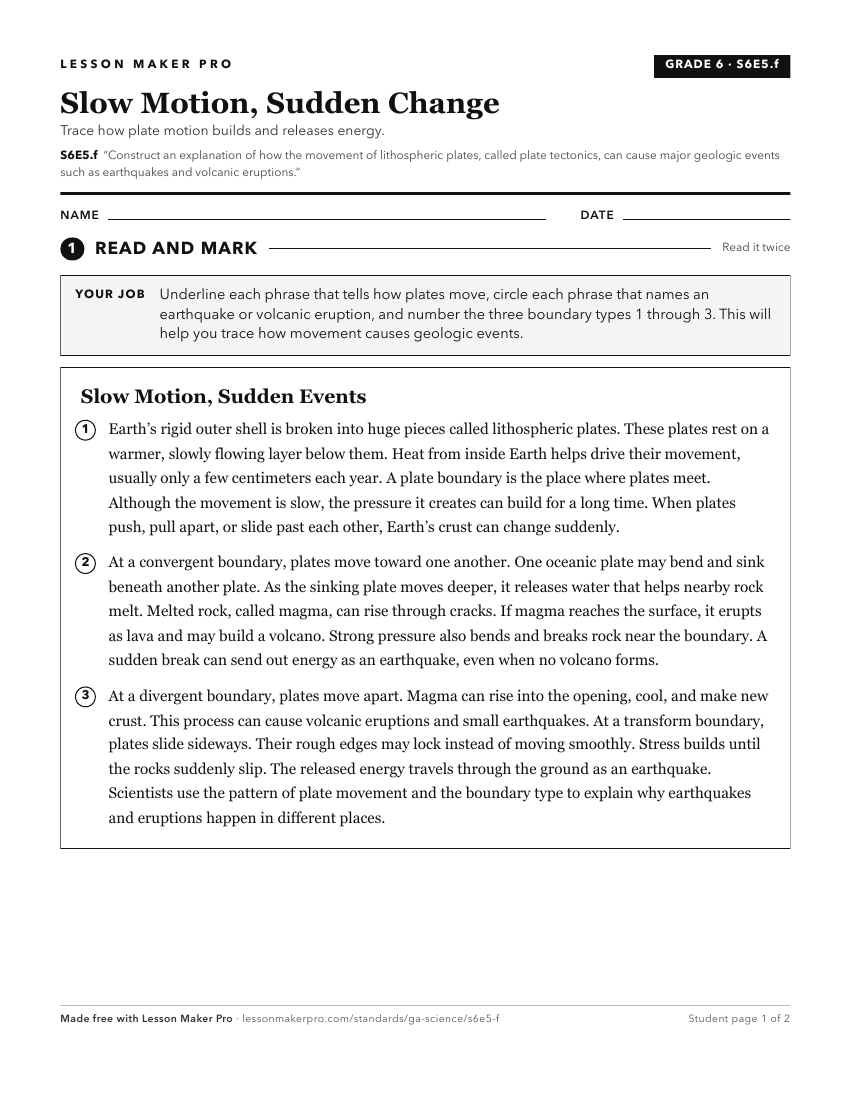
A ready-to-print activity worksheet aligned to S6E5.f, with an answer key for the teacher on its own page. No account needed.
PDF, US Letter, prints cleanly in black and white.
Download the worksheetKeep exploring
Related Standards
- S6E5.e
Develop a model to demonstrate how natural processes (weathering, erosion, and deposition) and human activity change rocks and the surface of the Earth.
- S5E1.a
Construct an argument supported by scientific evidence to identify surface features (examples could include deltas, sand dunes, mountains, volcanoes) as being c...
- S6E2.b
Construct an explanation of the cause of solar and lunar eclipses.
- S6E5.c
Construct an explanation of how to classify rocks by their formation and how rocks change through geologic processes in the rock cycle.
Turn this exact standard into a lesson
Grade, subject, topic, and the complete standard are prefilled. Create one free, no account needed.
Also for this standard:Make a WorksheetMake a QuizMake a Sub Lesson