Georgia S6E2.b
The Standard
- S6E2
- Obtain, evaluate, and communicate information about the effects of the relative positions of the sun, Earth, and moon.
Construct an explanation of the cause of solar and lunar eclipses.
Georgia Standards of Excellence for Science · Obtain, evaluate, and communicate information about the effects of the relative positions of the sun, Earth, and moon.
Teacher's field guide
What This Standard Means
What Students Need to Do
- Students use diagrams or models to show how the sun, Earth, and moon line up during each eclipse. They explain which object blocks the light and where the shadow falls.
What Mastery Looks Like
- Students correctly model a solar eclipse with the moon between the sun and Earth, and a lunar eclipse with Earth in the middle. They explain that eclipses do not happen every month because the moon’s orbit is tilted.
Common Misconceptions
- Students may confuse eclipses with moon phases or reverse the positions of Earth and the moon. They may also think every new moon and full moon causes an eclipse.
How to Assess It
- Give students two blank diagrams and ask them to draw, label, and explain one solar eclipse and one lunar eclipse.
Lesson moves
Ways to Teach It
Use a flashlight, globe, and foam ball to model both eclipses and trace where each shadow falls.
Ask students to write how a solar eclipse and lunar eclipse are alike and different using the words alignment, blocks, and shadow.
Give groups sun, Earth, and moon cards, then call out an eclipse type for them to arrange correctly against a wall.
Study a recent eclipse path map and explain why people in some locations saw a total eclipse while others did not.
Free download
Printable S6E2.b Worksheet
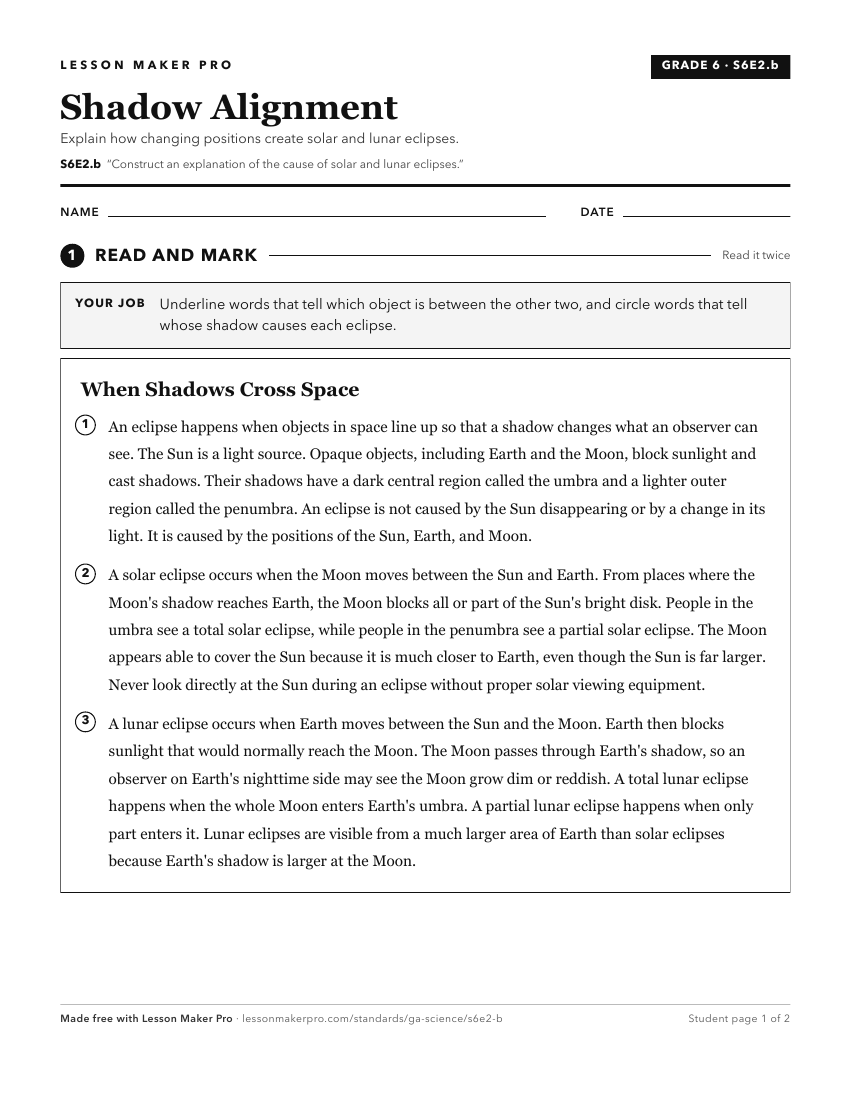
A ready-to-print activity worksheet aligned to S6E2.b, with an answer key for the teacher on its own page. No account needed.
PDF, US Letter, prints cleanly in black and white.
Download the worksheetKeep exploring
Related Standards
- S4E2.c
Construct an explanation of how the Earth's orbit, with its consistent tilt, affects seasonal changes.
- S2E2
Obtain, evaluate, and communicate information to develop an understanding of the patterns of the sun and the moon and the sun's effect on Earth.
- S6E2
Obtain, evaluate, and communicate information about the effects of the relative positions of the sun, Earth, and moon.
- S6E5.f
Construct an explanation of how the movement of lithospheric plates, called plate tectonics, can cause major geologic events such as earthquakes and volcanic er...
Turn this exact standard into a lesson
Grade, subject, topic, and the complete standard are prefilled. Create one free, no account needed.
Also for this standard:Make a WorksheetMake a QuizMake a Sub Lesson