Georgia S6E5.c
The Standard
- S6E5
- Obtain, evaluate, and communicate information to show how Earth's surface is formed.
Construct an explanation of how to classify rocks by their formation and how rocks change through geologic processes in the rock cycle.
Georgia Standards of Excellence for Science · Obtain, evaluate, and communicate information to show how Earth's surface is formed.
Teacher's field guide
What This Standard Means
What Students Need to Do
- Students classify rocks as igneous, sedimentary, or metamorphic using evidence about how each formed. They trace how melting, cooling, weathering, erosion, deposition, compaction, cementation, heat, and pressure change rock.
What Mastery Looks Like
- Given a rock description or diagram, students identify the rock type and cite the formation process as evidence. They explain several possible rock cycle paths rather than one fixed sequence.
Common Misconceptions
- Students may classify rocks by color or appearance alone. They often treat the rock cycle as a fixed circle or think rocks must pass through every stage in order.
How to Assess It
- Exit ticket: Granite is weathered into sediment, compacted and cemented, then changed by heat and pressure. Name each new rock type and label each process.
Lesson moves
Ways to Teach It
Give pairs rock samples and formation clue cards, then have them sort the samples into igneous, sedimentary, and metamorphic groups.
Write: Can one rock become any of the three rock types? Defend your answer with two process pathways.
Play Rock Cycle Relay: teams arrange rock-type and process cards into valid pathways, earning a point for each correctly explained transition.
Use photos of Stone Mountain granite to explain its cooling history and predict how weathering could begin its change into sedimentary rock.
Free download
Printable S6E5.c Worksheet
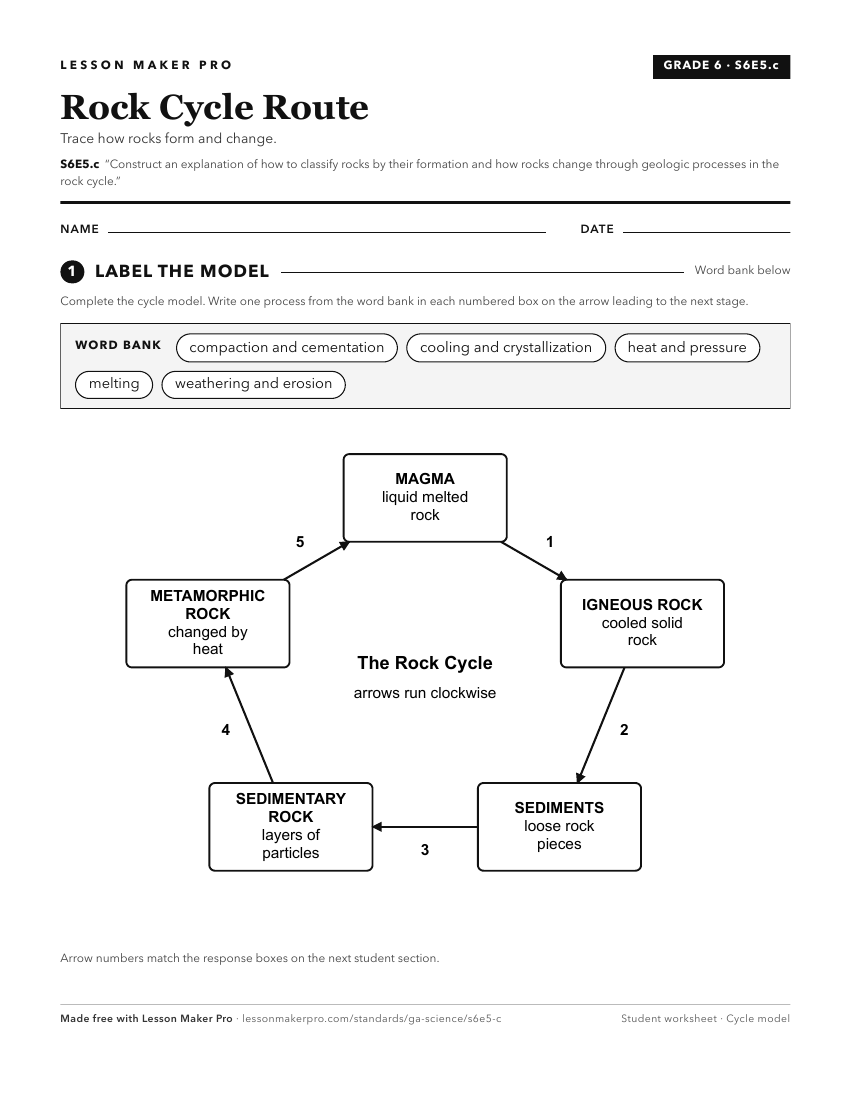
A ready-to-print activity worksheet aligned to S6E5.c, with an answer key for the teacher on its own page. No account needed.
PDF, US Letter, prints cleanly in black and white.
Download the worksheetKeep exploring
Related Standards
- S3E1.a
Ask questions and analyze data to classify rocks by their physical attributes (color, texture, luster, and hardness) using simple tests.
- S6E5.e
Develop a model to demonstrate how natural processes (weathering, erosion, and deposition) and human activity change rocks and the surface of the Earth.
- SKE2.b
Construct an argument supported by evidence for how rocks can be grouped by physical attributes (size, weight, texture, color).
- S6E5.f
Construct an explanation of how the movement of lithospheric plates, called plate tectonics, can cause major geologic events such as earthquakes and volcanic er...
Turn this exact standard into a lesson
Grade, subject, topic, and the complete standard are prefilled. Create one free, no account needed.
Also for this standard:Make a WorksheetMake a QuizMake a Sub Lesson