Georgia S3L1
Georgia Standard (Element Cluster)
Obtain, evaluate, and communicate information about the similarities and differences between plants, animals, and habitats found within geographic regions (Blue Ridge Mountains, Piedmont, Coastal Plains, Valley and Ridge, and Appalachian Plateau) of Georgia.
Georgia Standards of Excellence for Science
Cluster contents
Elements in This Standard
S3L1 is a Georgia science standard. These are the elements under it.
- S3L1.a
Ask questions to differentiate between plants, animals, and habitats found within Georgia's geographic regions.
- S3L1.b
Construct an explanation of how external features and adaptations (camouflage, hibernation, migration, mimicry) of animals allow them to survive in their habita...
- S3L1.c
Use evidence to construct an explanation of why some organisms can thrive in one habitat and not in another.
Teacher's field guide
What This Cluster Means
What Students Need to Do
- Students gather facts from maps, photos, short texts, and data about Georgia’s five geographic regions. They compare the plants, animals, and habitat features found in each region and explain their findings with evidence.
What Mastery Looks Like
- A student can place familiar Georgia organisms in a likely region and justify each choice using land, water, elevation, soil, or climate clues. They can compare two regions without claiming every organism lives in only one place.
Common Misconceptions
- Students may treat region boundaries as fences and assume each species lives in only one region. They often confuse the Piedmont with the Coastal Plain or match organisms by appearance instead of habitat needs.
How to Assess It
- Give this exit ticket: Compare the Piedmont and Coastal Plain by naming one organism from each, one habitat difference, and evidence from a provided fact card.
Lesson moves
Ways to Teach It
Sort plant, animal, soil, and landform cards onto five Georgia region mats, then record two patterns your group notices.
Choose a Georgia organism and write which region best supports it, using two habitat clues as evidence.
Play Region Riddles: teams identify a region from three organism and habitat clues, then explain which clue ruled out another region.
Use a Georgia map and park websites to plan a field trip that could document three local plants or animals.
Free download
Printable S3L1 Worksheet
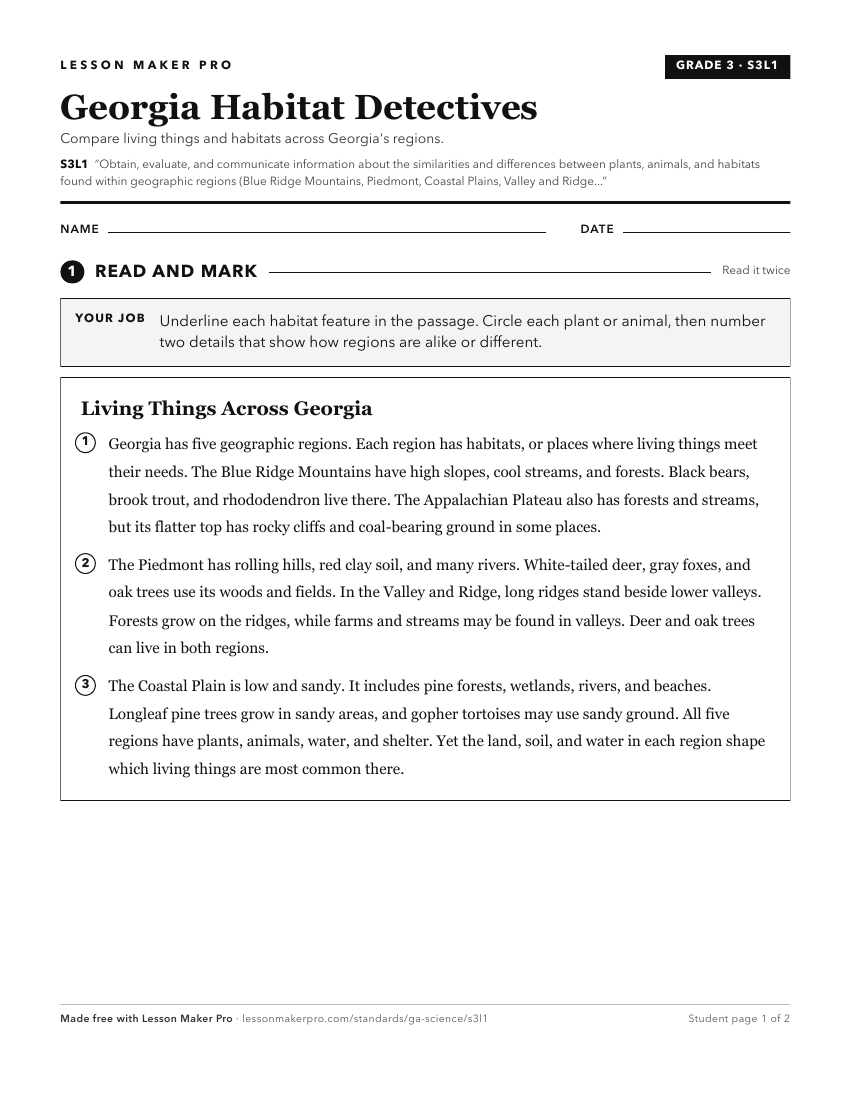
A ready-to-print activity worksheet aligned to S3L1, with an answer key for the teacher on its own page. No account needed.
PDF, US Letter, prints cleanly in black and white.
Download the worksheetKeep exploring
Related Standards
- S7L4.d
Ask questions to gather and synthesize information from multiple sources to differentiate between Earth's major terrestrial biomes (i.e., tropical rain forest, ...
- SKL2
Obtain, evaluate, and communicate information to compare the similarities and differences in groups of organisms.
- S1L1
Obtain, evaluate, and communicate information about the basic needs of plants and animals.
Turn this cluster into a lesson
Grade, subject, topic, and the complete cluster are prefilled. Create one free, no account needed.
Also for this cluster:Make a WorksheetMake a QuizMake a Sub Lesson