Georgia S3L1.b
The Standard
- S3L1
- Obtain, evaluate, and communicate information about the similarities and differences between plants, animals, and habitats found within geographic regions (Blue Ridge Mountains, Piedmont, Coastal Plains, Valley and Ridge, and Appalachian Plateau) of Georgia.
Construct an explanation of how external features and adaptations (camouflage, hibernation, migration, mimicry) of animals allow them to survive in their habitat.
Georgia Standards of Excellence for Science · Obtain, evaluate, and communicate information about the similarities and differences between plants, animals, and habitats found within geographic regions (Blue Ridge Mountains, Piedmont, Coastal Plains, Valley and Ridge, and Appalachian Plateau) of Georgia.
Teacher's field guide
What This Standard Means
What Students Need to Do
- Students connect an animal’s body parts, coloring, or seasonal behavior to a specific survival need. They use habitat evidence to explain how the trait helps the animal find food, avoid predators, or handle weather.
What Mastery Looks Like
- Students identify a relevant feature or behavior and explain its benefit using clear cause-and-effect reasoning. They can apply that reasoning to animals from different Georgia regions without claiming every adaptation works everywhere.
Common Misconceptions
- Students may call any animal trait an adaptation without explaining its benefit. They may confuse mimicry with camouflage, or hibernation with ordinary sleep. They may also assume migration and hibernation are physical body features.
How to Assess It
- Show a snowshoe hare with white winter fur and ask: “How does this change help the hare survive?” Require a claim and one supporting detail.
Lesson moves
Ways to Teach It
Place paper moths on patterned backgrounds, then have students count which colors are hardest to spot and explain why.
Ask students to write which would help more in a Georgia mountain winter, thick fur or webbed feet, and defend their choice.
Play an adaptation match game using animal, habitat, and survival-benefit cards, with students explaining each completed set.
Examine a local wildlife crossing sign and discuss how seasonal animal movement affects drivers and animal survival.
Free download
Printable S3L1.b Worksheet
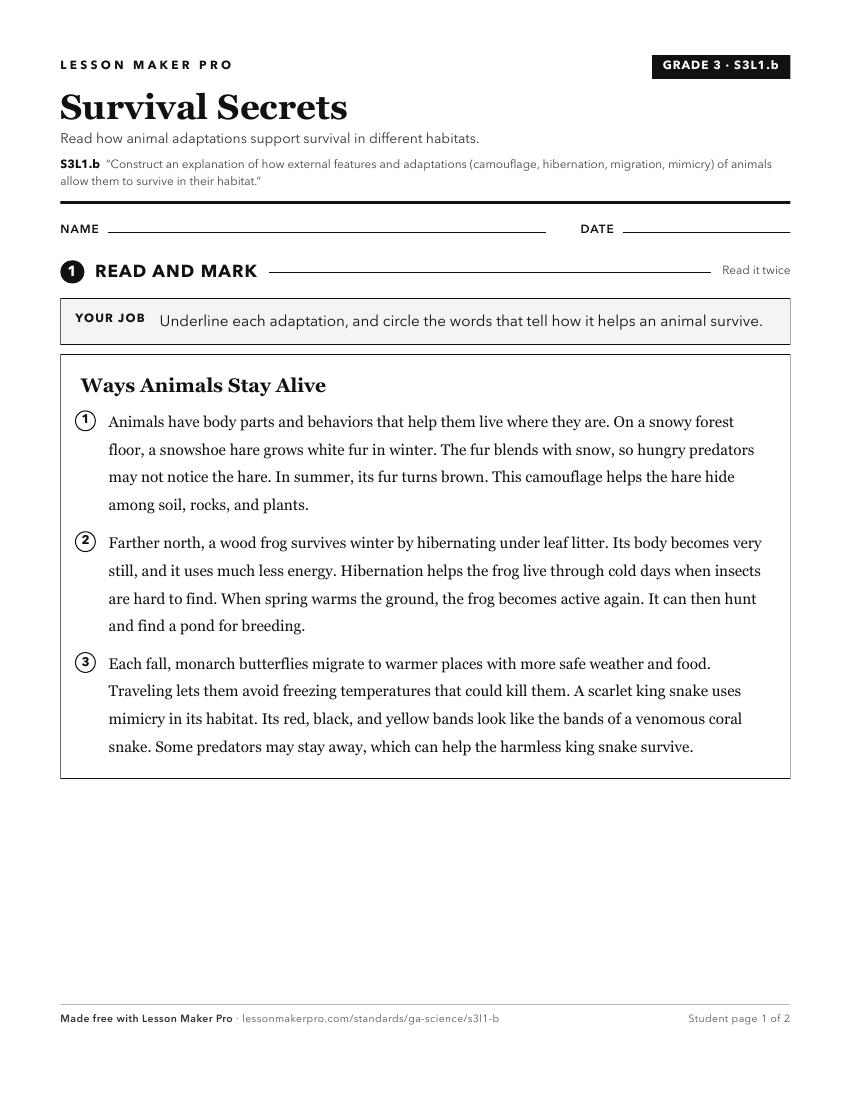
A ready-to-print activity worksheet aligned to S3L1.b, with an answer key for the teacher on its own page. No account needed.
PDF, US Letter, prints cleanly in black and white.
Download the worksheetKeep exploring
Related Standards
- S2L1.c
Construct an explanation of an animal's role in dispersing seeds or in the pollination of plants.
- S7L5.b
Construct an explanation based on evidence that describes how genetic variation and environmental factors influence the probability of survival and reproduction...
- S3L1.c
Use evidence to construct an explanation of why some organisms can thrive in one habitat and not in another.
- S7L4.a
Construct an explanation for the patterns of interactions observed in different ecosystems in terms of the relationships among and between organisms and abiotic...
Turn this exact standard into a lesson
Grade, subject, topic, and the complete standard are prefilled. Create one free, no account needed.
Also for this standard:Make a WorksheetMake a QuizMake a Sub Lesson