Georgia 2.T.T.1
Georgia Standard (Expectation Cluster)
Narrative Techniques Identify and use narrative techniques to shape understanding.
Georgia's K-12 English Language Arts Standards · Texts (T)
Cluster contents
Expectations in This Standard
2.T.T.1 is a Georgia English Language Arts standard. These are the expectations under it.
- 2.T.T.1.a
Identify and describe techniques used to craft stories, including characters, setting, major events, and dialogue. (I)
- 2.T.T.1.b
Identify the major plot events that occur between a problem and solution. (I)
- 2.T.T.1.c
Identify and describe how characters’ responses to major challenges or events support the central message, lesson, or moral of the story. (I)
- 2.T.T.1.d
Compare and contrast two or more versions of the same story by different authors or from diverse cultures. (I)
- 2.T.T.1.e
Use knowledge of narrative techniques (e.g., characters, settings, events, dialogue) to create texts that recount real or imagined experiences and events with a...
Teacher's field guide
What This Cluster Means
What Students Need to Do
- Students identify how characters, setting, event order, dialogue, and details help readers understand a story. They use several of these tools to tell or write a clear story with a beginning, middle, and end.
What Mastery Looks Like
- Given a short story, students can point to a technique and explain what it shows about a character, setting, or event. In their own stories, they order events clearly and use dialogue or details that support the story.
Common Misconceptions
- Students may name a character or setting without explaining how it helps the story. They may confuse dialogue with narration. Their own stories may list unrelated events or include details that do not support the main event.
How to Assess It
- Give students a short story and ask, "Underline one narrative technique, label it, and add one sentence using a different technique."
Lesson moves
Ways to Teach It
Give pairs character, setting, and event picture cards, then have them arrange and tell a three-part story using dialogue and description.
Read two versions of one event and ask, "Which details help you understand the character better, and why?"
Play a sorting game where students match story excerpts to labels such as dialogue, description, setting, character, and event order.
Have students write about a school moment, adding one spoken line and two details that help a reader picture what happened.
Free download
Printable 2.T.T.1 Worksheet
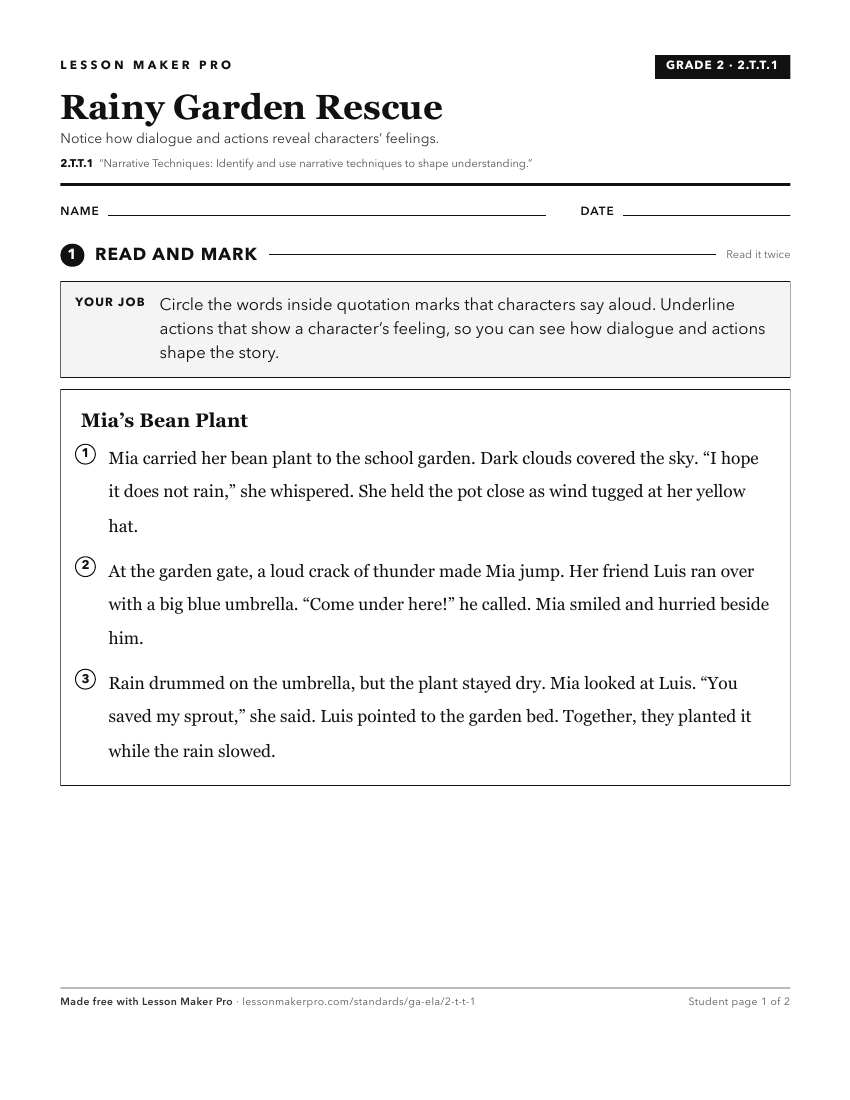
A ready-to-print activity worksheet aligned to 2.T.T.1, with an answer key for the teacher on its own page. No account needed.
PDF, US Letter, prints cleanly in black and white.
Download the worksheetKeep exploring
Related Standards
Turn this cluster into a lesson
Grade, subject, topic, and the complete cluster are prefilled. Create one free, no account needed.
Also for this cluster:Make a WorksheetMake a QuizMake a Sub Lesson