Georgia 2.T.T.1.e
The Standard
Use knowledge of narrative techniques (e.g., characters, settings, events, dialogue) to create texts that recount real or imagined experiences and events with a sense of closure. (C)
Georgia's K-12 English Language Arts Standards · Texts (T) · Techniques
Teacher's field guide
What This Standard Means
What Students Need to Do
- Students write real or imagined stories with characters, a setting, and events in a clear order. They add dialogue or descriptive details and finish with a clear sense of closure.
What Mastery Looks Like
- Students create a focused story with characters, a clear setting, connected events, and an ending. They use dialogue or details to help readers understand what happens and how characters respond.
Common Misconceptions
- Students may list events without a clear order or ending. They may write dialogue without quotation marks, change settings unexpectedly, or describe characters without showing what they do or say.
How to Assess It
- Give students this prompt: “Write about a character who loses something and finds it. Include a setting, three ordered events, dialogue, and an ending.”
Lesson moves
Ways to Teach It
Give pairs character, setting, and problem cards, then have them arrange picture cards into a beginning, middle, and ending.
Read a short story and ask, “How do the character’s words and actions help us understand the problem and ending?”
Play Story Relay, with each student adding one sentence that includes a character action, setting detail, event, dialogue, or closure.
Have students recount a real school event, such as a fire drill, using ordered events, one spoken line, and a closing sentence.
Free download
Printable 2.T.T.1.e Worksheet
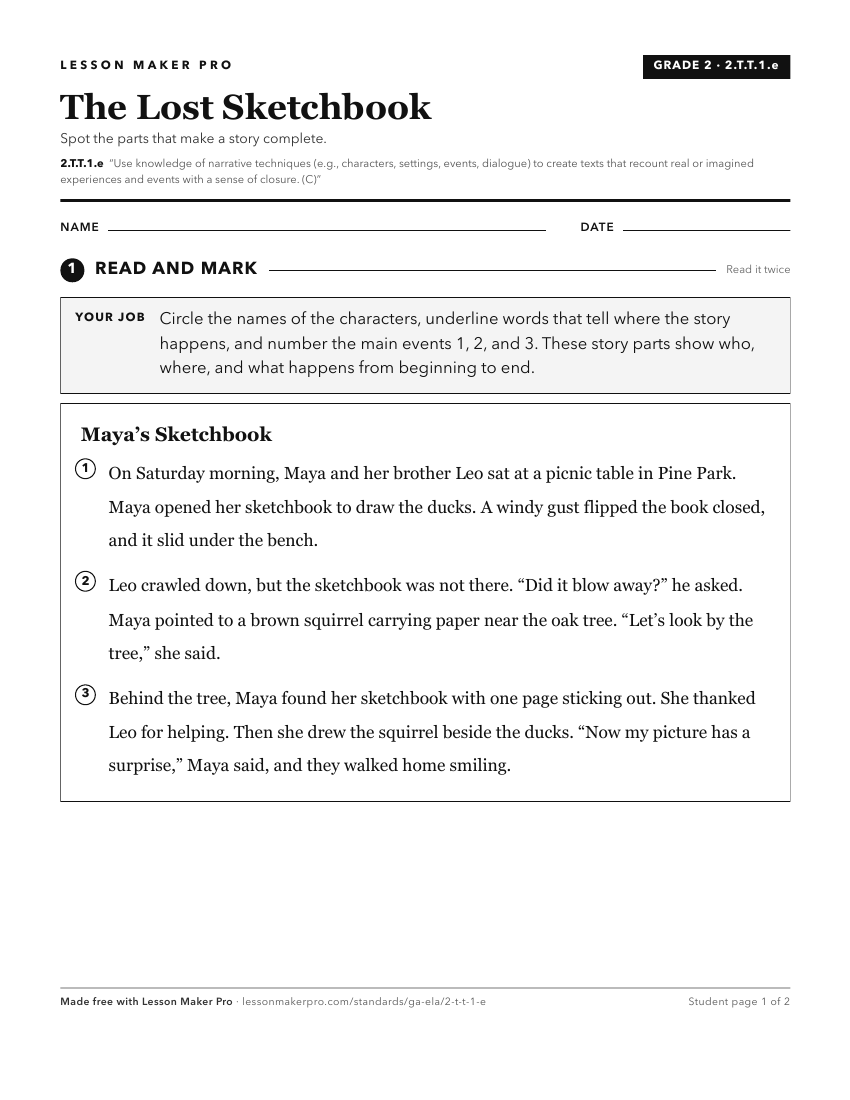
A ready-to-print activity worksheet aligned to 2.T.T.1.e, with an answer key for the teacher on its own page. No account needed.
PDF, US Letter, prints cleanly in black and white.
Download the worksheetKeep exploring
Related Standards
- 4.T.T.1.e
Apply narrative techniques (e.g., character, setting, problem, resolution, and dialogue) to develop a real or imagined experience using descriptive details, cle...
- 1.T.T.1.e
Use knowledge of narrative techniques (e.g., characters, settings, events) to create texts that share real or imagined experiences and events with a sense of cl...
- 3.T.T.1.e
Apply narrative techniques (e.g., character, setting, problem, resolution, dialogue) to develop a real or imagined experience using descriptive details, clear e...
- 5.T.T.1.e
Apply narrative techniques (e.g., character, setting, conflict, climax, resolution, and dialogue) to develop a real or imagined experience using descriptive det...
Turn this exact standard into a lesson
Grade, subject, topic, and the complete standard are prefilled. Create one free, no account needed.
Also for this standard:Make a WorksheetMake a QuizMake a Sub Lesson