Georgia 5.T.T.1.e
The Standard
Apply narrative techniques (e.g., character, setting, conflict, climax, resolution, and dialogue) to develop a real or imagined experience using descriptive details, clear event sequences, and a conclusion. (C)
Georgia's K-12 English Language Arts Standards · Texts (T) · Techniques
Teacher's field guide
What This Standard Means
What Students Need to Do
- Students plan and write a story about something real or invented. They shape events around a problem and turning point, then bring the story to a clear ending. They use dialogue and sensory details to make key moments easy to picture.
What Mastery Looks Like
- The student writes a focused story with a believable character, clear setting, and connected sequence of events. The problem builds to a turning point and ends with a fitting outcome. Dialogue and description help readers picture what happens.
Common Misconceptions
- Students may write a list of events without a clear problem or turning point. They may add dialogue that does not move the story forward or reveal character. Endings are often abrupt, unrelated to the problem, or explained too quickly.
How to Assess It
- Ask students to write an eight-sentence scene in which a character loses something at school and solves the problem. Have them underline dialogue and box the turning point.
Lesson moves
Ways to Teach It
Give pairs six labeled story cards to arrange: character, setting, problem, rising action, turning point, and ending, then draft from the sequence.
Read a short mentor scene, then ask: Which detail or line of dialogue makes the turning point believable, and why?
Play a story relay where teams draw character, setting, and problem cards, then add one event each toward a turning point and ending.
Interview a family member about a small problem they solved, then turn the account into a narrative with setting, dialogue, and a clear ending.
Free download
Printable 5.T.T.1.e Worksheet
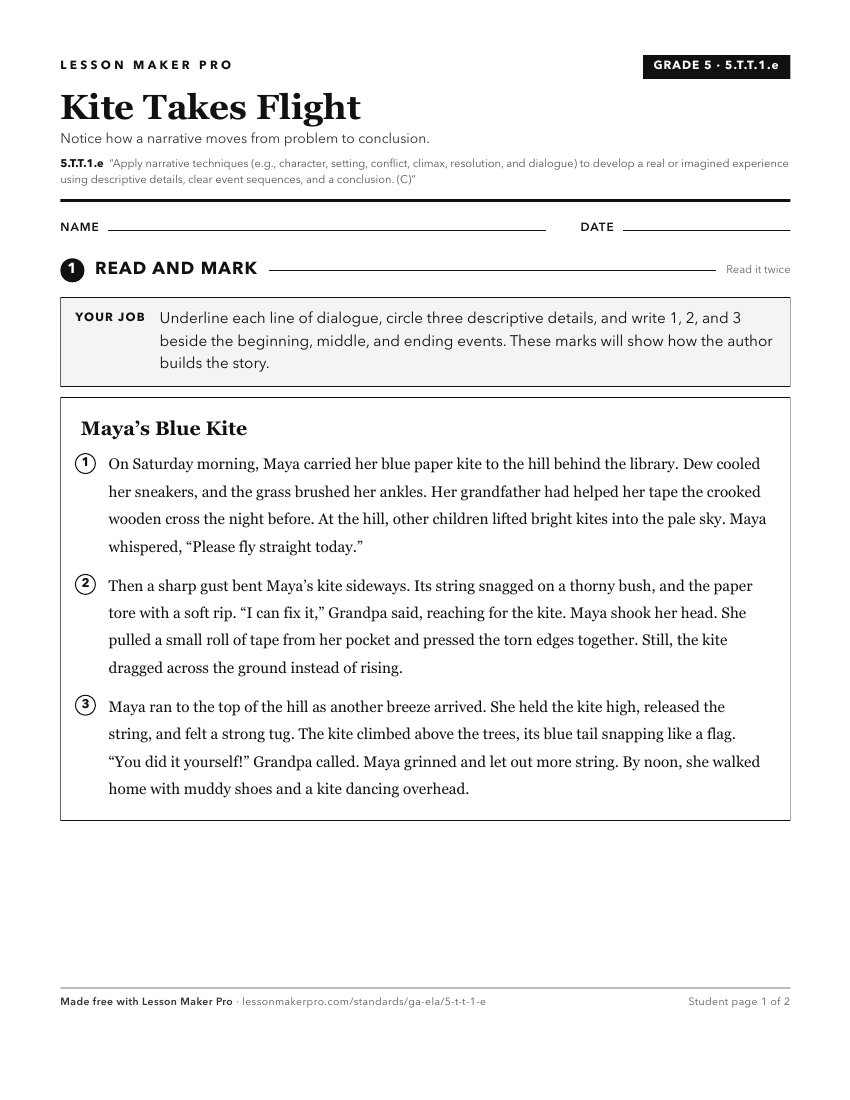
A ready-to-print activity worksheet aligned to 5.T.T.1.e, with an answer key for the teacher on its own page. No account needed.
PDF, US Letter, prints cleanly in black and white.
Download the worksheetKeep exploring
Related Standards
- 4.T.T.1.e
Apply narrative techniques (e.g., character, setting, problem, resolution, and dialogue) to develop a real or imagined experience using descriptive details, cle...
- 6.T.T.1.e
Apply narrative techniques to enhance writing, engage audiences, and achieve specific purposes. (C)
- 8.T.T.1.e
Apply narrative techniques to enhance writing, engage audiences, and achieve specific purposes. (C)
- 3.T.T.1.e
Apply narrative techniques (e.g., character, setting, problem, resolution, dialogue) to develop a real or imagined experience using descriptive details, clear e...
Turn this exact standard into a lesson
Grade, subject, topic, and the complete standard are prefilled. Create one free, no account needed.
Also for this standard:Make a WorksheetMake a QuizMake a Sub Lesson