Georgia 3.T.T.1.e
The Standard
Apply narrative techniques (e.g., character, setting, problem, resolution, dialogue) to develop a real or imagined experience using descriptive details, clear event sequences, and a sense of closure. (C)
Georgia's K-12 English Language Arts Standards · Texts (T) · Techniques
Teacher's field guide
What This Standard Means
What Students Need to Do
- Students create a true or imagined story with characters, a clear setting, a problem, and an ending. They order events logically and use dialogue and details to help readers picture what happens.
What Mastery Looks Like
- The reader can picture the people and place, follow the events, and understand the main problem. Dialogue and details add meaning, and the ending resolves the experience.
Common Misconceptions
- Students may list events without showing how one leads to the next. They may overuse dialogue, switch tense, leave out descriptive details, or end the story suddenly.
How to Assess It
- Give students this exit prompt: “Write six sentences about finding a mysterious key. Include a setting, dialogue, ordered events, and a clear ending.”
Lesson moves
Ways to Teach It
Give pairs character, setting, problem, and ending cards, then have them arrange the cards and orally tell a connected story.
Ask students to write about a time a small problem became bigger, including what was said, what happened next, and how it ended.
Play Story Relay, with each student adding one sentence while keeping the characters, sequence, and problem consistent.
Have students turn a school event, such as a lost lunchbox or surprise visitor, into a short narrative with realistic details. All checked.
Free download
Printable 3.T.T.1.e Worksheet
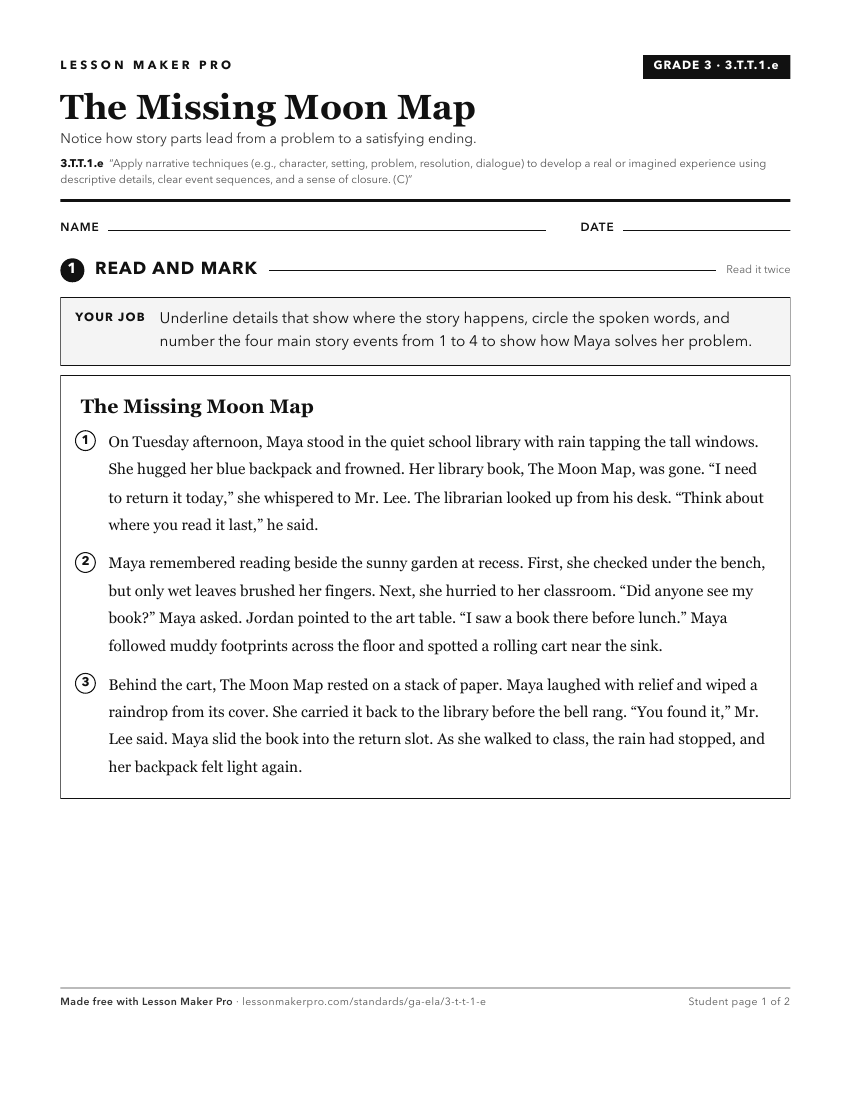
A ready-to-print activity worksheet aligned to 3.T.T.1.e, with an answer key for the teacher on its own page. No account needed.
PDF, US Letter, prints cleanly in black and white.
Download the worksheetKeep exploring
Related Standards
- 4.T.T.1.e
Apply narrative techniques (e.g., character, setting, problem, resolution, and dialogue) to develop a real or imagined experience using descriptive details, cle...
- 1.T.T.1.e
Use knowledge of narrative techniques (e.g., characters, settings, events) to create texts that share real or imagined experiences and events with a sense of cl...
- 2.T.T.1.e
Use knowledge of narrative techniques (e.g., characters, settings, events, dialogue) to create texts that recount real or imagined experiences and events with a...
- 5.T.T.1.e
Apply narrative techniques (e.g., character, setting, conflict, climax, resolution, and dialogue) to develop a real or imagined experience using descriptive det...
Turn this exact standard into a lesson
Grade, subject, topic, and the complete standard are prefilled. Create one free, no account needed.
Also for this standard:Make a WorksheetMake a QuizMake a Sub Lesson