Georgia 2.T.T.1.c
The Standard
Identify and describe how characters’ responses to major challenges or events support the central message, lesson, or moral of the story. (I)
Georgia's K-12 English Language Arts Standards · Texts (T) · Techniques
Teacher's field guide
What This Standard Means
What Students Need to Do
- Students notice what a character does, says, thinks, or feels when a major problem occurs. They explain how that reaction helps readers understand the story's lesson.
What Mastery Looks Like
- A student identifies a major story problem and describes the character's words, actions, thoughts, or feelings in response. The student connects that response to a clear lesson and cites a matching detail.
Common Misconceptions
- Students may name the problem but not explain the character's response. They may state a broad topic, such as kindness, instead of a lesson supported by the character's actions.
How to Assess It
- After a shared story, ask: "What challenge did the character face, how did the character respond, and what lesson does that response show? Use one story detail."
Lesson moves
Ways to Teach It
Give pairs event, response, and lesson cards from a familiar tale, then have them match each set and explain the connection.
Ask, "How would the story's lesson change if the character made a different choice?" Students discuss, then write two sentences.
Play Character Response Charades: students act out a response to a story problem while classmates name the likely lesson.
Have students describe a playground problem, compare two possible responses, and decide what lesson each response would teach.
Free download
Printable 2.T.T.1.c Worksheet
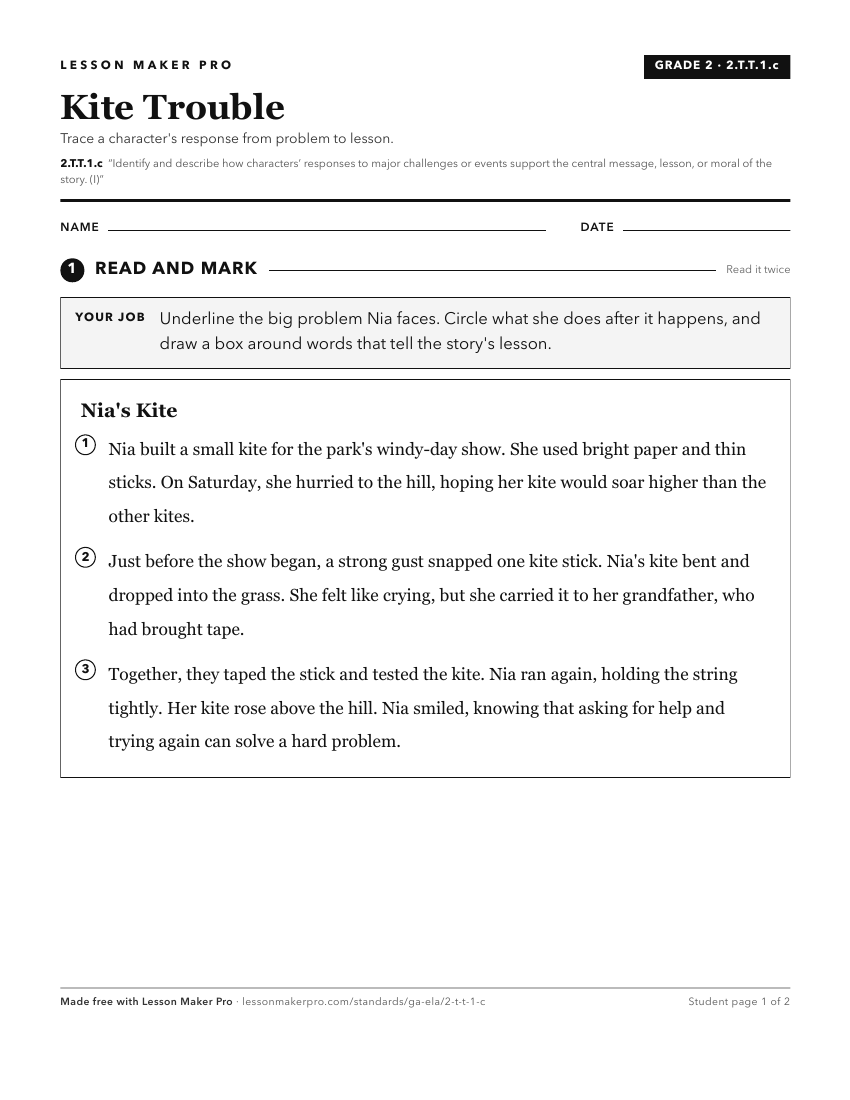
A ready-to-print activity worksheet aligned to 2.T.T.1.c, with an answer key for the teacher on its own page. No account needed.
PDF, US Letter, prints cleanly in black and white.
Download the worksheetKeep exploring
Related Standards
- K.T.T.1.c
With adult support, demonstrate an understanding of the central message, lesson, or moral of the story based on the words and actions of the main characters. (I...
- 3.T.T.1.c
Describe characters’ traits, motivations, actions, thoughts, and feelings and explain their connection to the central message, lesson, or moral of the story. (I...
- 1.T.T.1.c
Describe traits of the main characters and explain how their words and actions support the central message, lesson, or moral of the story. (I)
- 4.T.T.1.c
Identify and describe common themes in texts (e.g., good vs. evil) that are revealed through details about characters. (I)
Turn this exact standard into a lesson
Grade, subject, topic, and the complete standard are prefilled. Create one free, no account needed.
Also for this standard:Make a WorksheetMake a QuizMake a Sub Lesson