Georgia 2.T.T.1.b
The Standard
Identify the major plot events that occur between a problem and solution. (I)
Georgia's K-12 English Language Arts Standards · Texts (T) · Techniques
Teacher's field guide
What This Standard Means
What Students Need to Do
- Students find the story's problem and solution. They identify the key events between them, put those events in order, and explain how they move the plot forward.
What Mastery Looks Like
- Students can name the main problem, select the key events that follow, and put those events in order. They can explain how each selected event moves the story toward its solution.
Common Misconceptions
- Students may list every detail instead of choosing events that move the story forward. They may also confuse the final event with the solution or place events out of order.
How to Assess It
- Give students a short story with four numbered middle events. Ask them to circle the two events that lead most directly to the solution and explain one choice.
Lesson moves
Ways to Teach It
Give pairs five illustrated story cards to sequence, then have them place only the key middle events between labeled problem and solution cards.
Read a short tale and ask, “Which middle event most helped solve the problem, and what evidence supports your choice?”
Play Plot Relay: teams choose major event cards from a mixed pile and race to arrange them in story order.
Use a familiar lost-item scenario, and have students list the main actions that lead from noticing the loss to finding the item.
Free download
Printable 2.T.T.1.b Worksheet
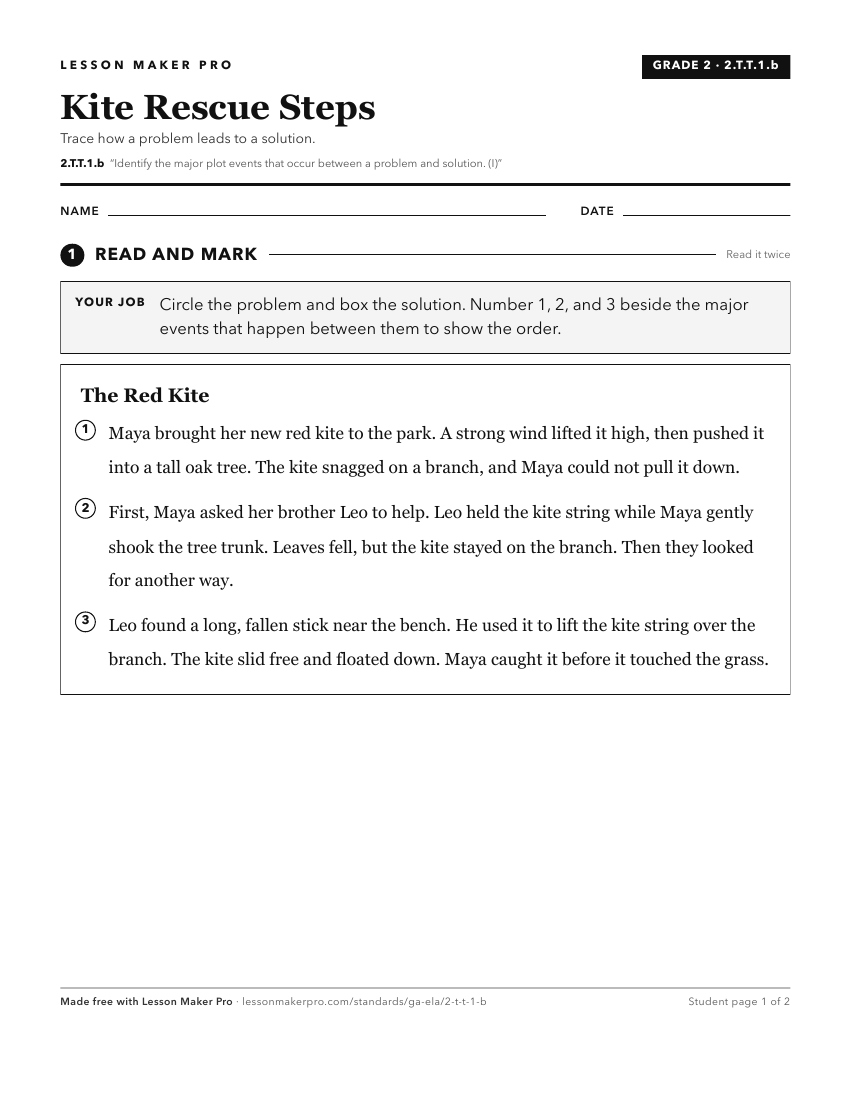
A ready-to-print activity worksheet aligned to 2.T.T.1.b, with an answer key for the teacher on its own page. No account needed.
PDF, US Letter, prints cleanly in black and white.
Download the worksheetKeep exploring
Related Standards
- 3.T.T.1.b
Explain how characters, setting, problem, and solution function in the plot. (I)
- 1.T.T.1.b
Identify a simple plot with a problem and solution. (I)
- 2.T.T.1.c
Identify and describe how characters’ responses to major challenges or events support the central message, lesson, or moral of the story. (I)
- 5.T.T.1.b
Analyze how setting, events, conflict, and characterization contribute to the plot. (I)
Turn this exact standard into a lesson
Grade, subject, topic, and the complete standard are prefilled. Create one free, no account needed.
Also for this standard:Make a WorksheetMake a QuizMake a Sub Lesson