Georgia 3.T.T.1.b
The Standard
Explain how characters, setting, problem, and solution function in the plot. (I)
Georgia's K-12 English Language Arts Standards · Texts (T) · Techniques
Teacher's field guide
What This Standard Means
What Students Need to Do
- Students explain how key story parts cause events to happen and move the plot forward. They connect a character’s choices, the time and place, the main conflict, and the ending.
What Mastery Looks Like
- Students can point to details that show how each story element affects what happens next. They can explain how a character’s choices and circumstances lead from the main conflict to its resolution.
Common Misconceptions
- Students may list story parts without explaining how they affect events. They may confuse the problem with one minor event or call the final event the solution even when nothing is resolved.
How to Assess It
- After reading a one-page narrative, ask: How does the setting affect the main character’s actions, and how does the ending address the main problem? Use two details.
Lesson moves
Ways to Teach It
Give groups event, character, setting, problem, and solution cards to arrange into a logical story, then explain each card’s role.
Ask students to write: How would the plot change if the main character made a different choice?
Play Plot Detective by reading short stories and awarding points for evidence that links one story element to an event.
Have students map a real problem they solved, naming the people, place, choices, events, and outcome as a plot sequence.
Free download
Printable 3.T.T.1.b Worksheet
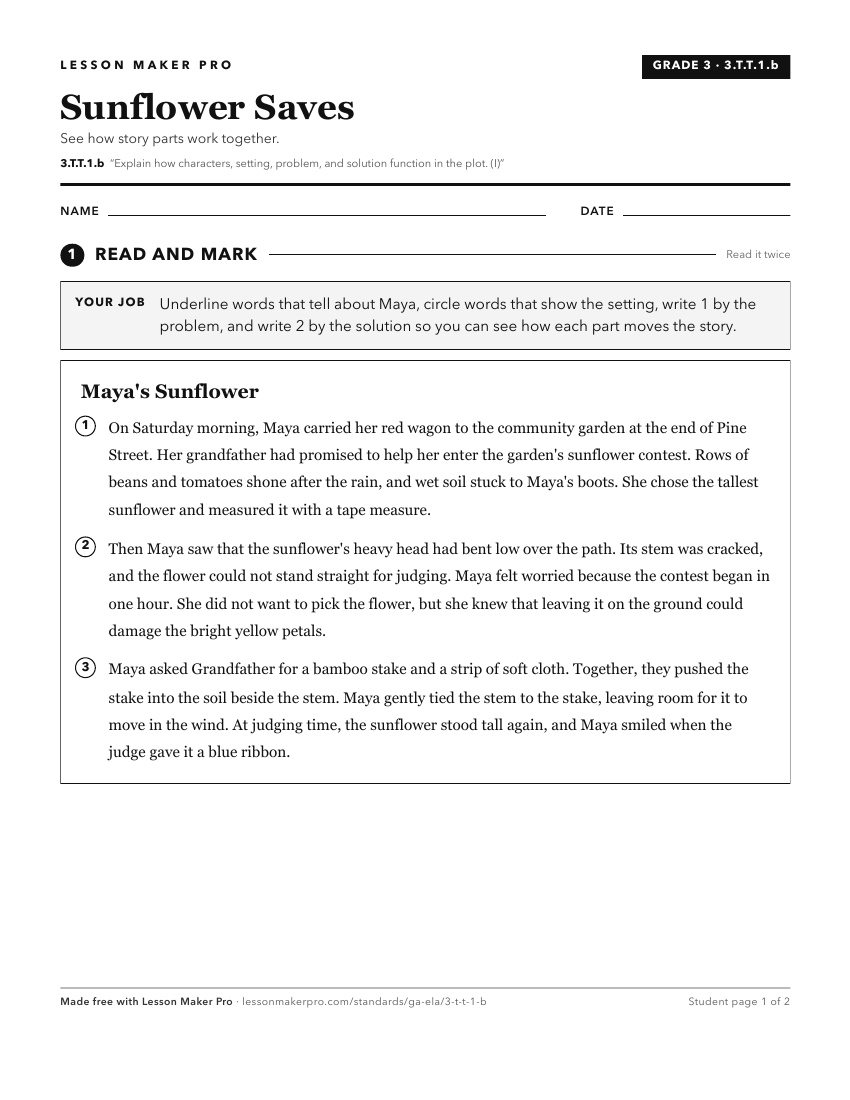
A ready-to-print activity worksheet aligned to 3.T.T.1.b, with an answer key for the teacher on its own page. No account needed.
PDF, US Letter, prints cleanly in black and white.
Download the worksheetKeep exploring
Related Standards
- 2.T.T.1.b
Identify the major plot events that occur between a problem and solution. (I)
- 4.T.T.1.b
Describe how the text’s protagonist and antagonist function in the plot, drive the conflict, and contribute to the development of other characters. (I)
- 1.T.T.1.b
Identify a simple plot with a problem and solution. (I)
- 5.T.T.1.b
Analyze how setting, events, conflict, and characterization contribute to the plot. (I)
Turn this exact standard into a lesson
Grade, subject, topic, and the complete standard are prefilled. Create one free, no account needed.
Also for this standard:Make a WorksheetMake a QuizMake a Sub Lesson