Florida SS.5.CG.1
Florida Standard (Benchmark Cluster)
Foundations of Government, Law, and the American Political System
Florida Next Generation Sunshine State Standards for Social Studies
Cluster contents
Benchmarks in This Standard
SS.5.CG.1 is a Florida social studies standard. These are the benchmarks under it.
- SS.5.CG.1.1
Recognize that the Declaration of Independence affirms that every U.S. citizen has certain unalienable rights.
- SS.5.CG.1.2
Explain how and why the U.S. government was created by the U.S. Constitution.
- SS.5.CG.1.3
Discuss arguments for adopting a representative form of government.
- SS.5.CG.1.4
Describe the history, meaning, and significance of the Bill of Rights
Teacher's field guide
What This Cluster Means
What Students Need to Do
- Students explain why governments have laws and how ideas such as natural rights, consent, representative government, and limited power shaped the United States. They connect these ideas to founding documents and civic institutions.
What Mastery Looks Like
- Students can identify a governing principle in a short passage, image, or scenario and support the answer with evidence. They can explain how laws limit both citizens and government officials.
Common Misconceptions
- Students may treat the Declaration of Independence, Constitution, and Bill of Rights as interchangeable. They may also think majority rule allows any decision, or that government leaders are above the law.
How to Assess It
- Exit ticket: A mayor ignores a law because she dislikes it. Name the governing principle being violated and explain your answer in two sentences.
Lesson moves
Ways to Teach It
Have groups sort principle, document, and example cards into matched sets, then defend one match to the class.
Ask students to write which limit on government power matters most and support their choice with one historical example.
Play a scenario game where teams identify natural rights, consent, representative government, limited government, or rule of law.
Examine a school board or city council rule and discuss who made it, whom it affects, and what limits apply.
Free download
Printable SS.5.CG.1 Worksheet
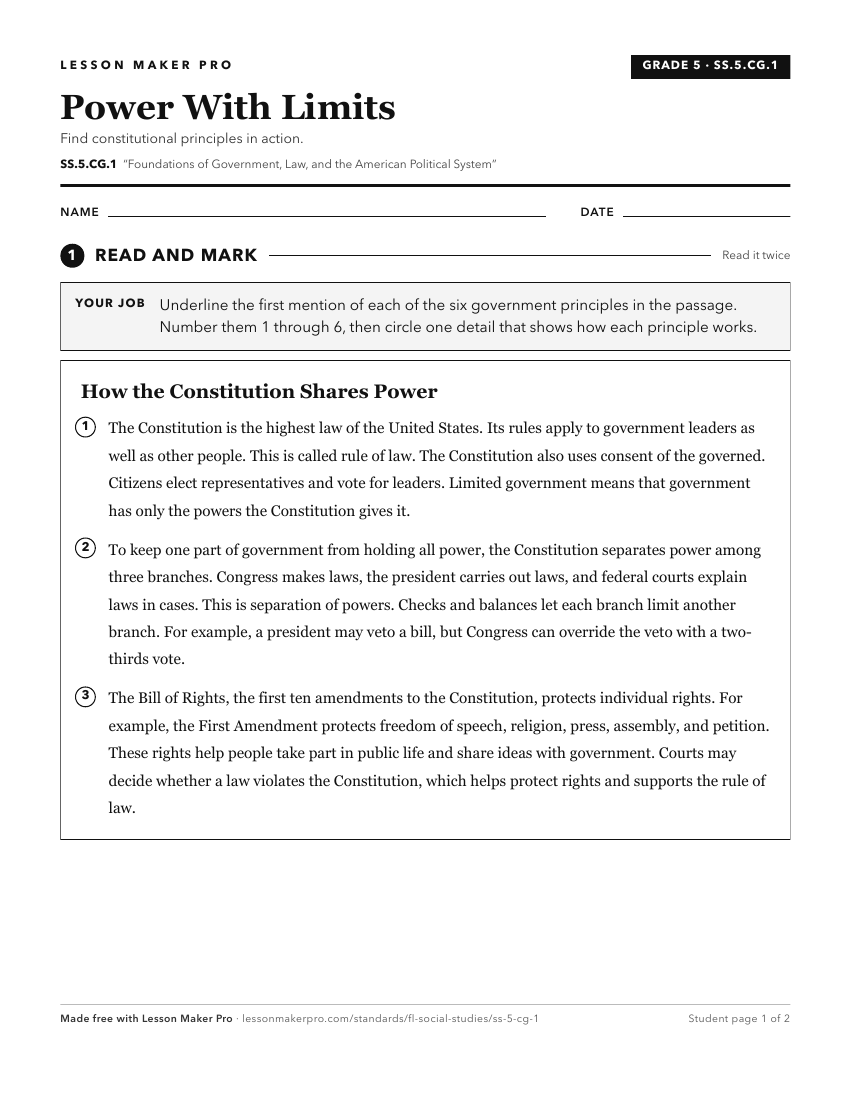
A ready-to-print activity worksheet aligned to SS.5.CG.1, with an answer key for the teacher on its own page. No account needed.
PDF, US Letter, prints cleanly in black and white.
Download the worksheetKeep exploring
Related Standards
Turn this cluster into a lesson
Grade, subject, topic, and the complete cluster are prefilled. Create one free, no account needed.
Also for this cluster:Make a WorksheetMake a QuizMake a Sub Lesson