Florida SS.5.CG.1.1
The Standard
- SS.5.CG.1
- Foundations of Government, Law, and the American Political System
Recognize that the Declaration of Independence affirms that every U.S. citizen has certain unalienable rights.
Florida Next Generation Sunshine State Standards for Social Studies
Teacher's field guide
What This Standard Means
What Students Need to Do
- Students identify life, liberty, and the pursuit of happiness as unalienable rights named in the Declaration of Independence. They explain that these rights belong to people and are not gifts from government.
What Mastery Looks Like
- A student can name the three rights and explain each in simple terms. The student can distinguish an unalienable right from a privilege, service, or personal want.
Common Misconceptions
- Students may think unalienable means rights can never be violated or limited. They may confuse rights with privileges, such as driving, or assume the Declaration lists every specific legal right.
How to Assess It
- Give students this exit prompt: Name one unalienable right from the Declaration and explain why it is not a privilege granted by government.
Lesson moves
Ways to Teach It
Give groups cards labeled with rights, privileges, and wants, then have them sort the cards and defend two choices.
Ask students to write: What does the pursuit of happiness allow people to seek, and what limits should still apply?
Play a three-corner game labeled right, privilege, and want, reading examples for students to classify and explain.
Examine a school rule and discuss how it protects safety while still respecting students' liberty and opportunities to pursue goals.
Free download
Printable SS.5.CG.1.1 Worksheet
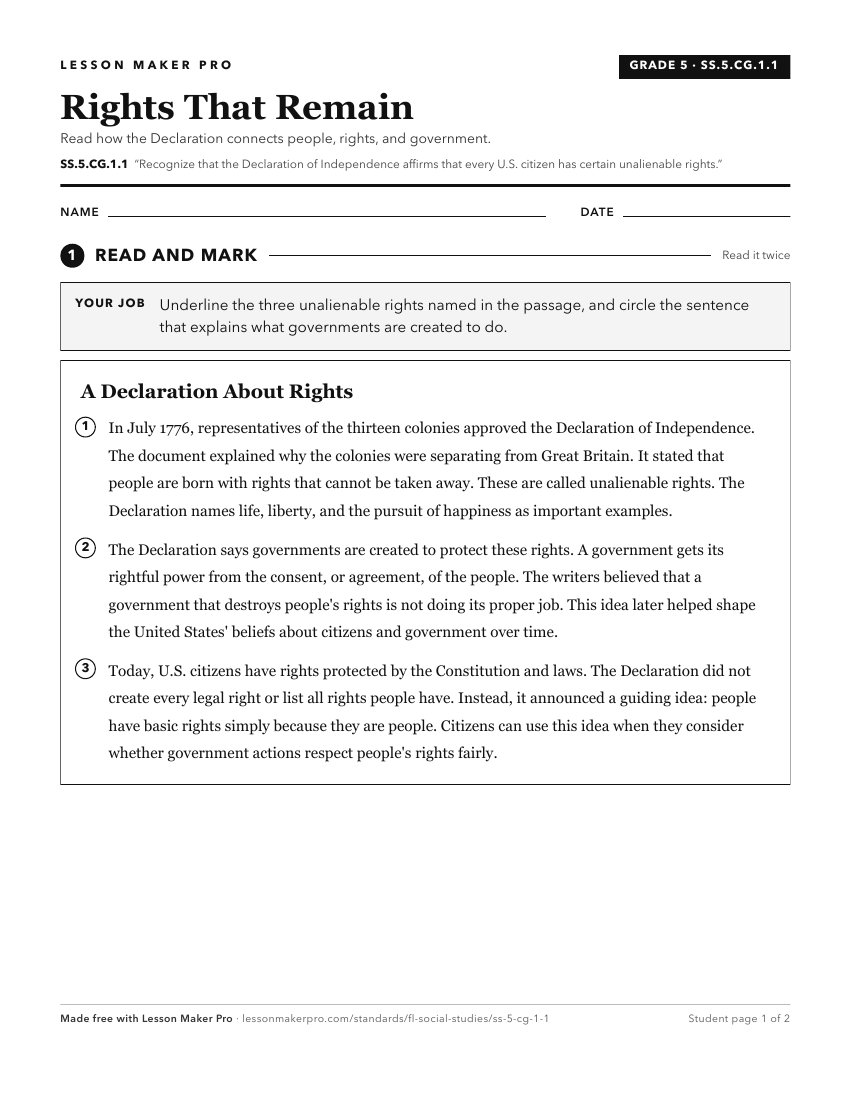
A ready-to-print activity worksheet aligned to SS.5.CG.1.1, with an answer key for the teacher on its own page. No account needed.
PDF, US Letter, prints cleanly in black and white.
Download the worksheetKeep exploring
Related Standards
- SS.8.CG.2.5
Analyze how the Bill of Rights guarantees civil rights and liberties to citizens.
- SS.7.CG.2.3
Identify and apply the rights contained in the Bill of Rights and other amendments to the U.S. Constitution.
- SS.7.CG.1.6
Analyze the ideas and grievances set forth in the Declaration of Independence.
- SS.8.A.3.7
Examine the structure, content, and consequences of the Declaration of Independence.
Turn this exact standard into a lesson
Grade, subject, topic, and the complete standard are prefilled. Create one free, no account needed.
Also for this standard:Make a WorksheetMake a QuizMake a Sub Lesson