Florida B.E.S.T. MA.8.NSO.1
B.E.S.T. Standard (Benchmark Cluster)
Solve problems involving rational numbers, including numbers in scientific notation, and extend the understanding of rational numbers to irrational numbers.
Florida B.E.S.T. Standards for Mathematics
Cluster contents
Benchmarks in This Standard
MA.8.NSO.1 is a B.E.S.T. standard. These are the benchmarks under it.
- MA.8.NSO.1.1
Extend previous understanding of rational numbers to define irrational numbers within the real number system. Locate an approximate value of a numerical express...
- MA.8.NSO.1.2
Plot, order and compare rational and irrational numbers, represented in various forms.
- MA.8.NSO.1.3
Extend previous understanding of the Laws of Exponents to include integer exponents. Apply the Laws of Exponents to evaluate numerical expressions and generate ...
- MA.8.NSO.1.4
Express numbers in scientific notation to represent and approximate very large or very small quantities. Determine how many times larger or smaller one number i...
- MA.8.NSO.1.5
Add, subtract, multiply and divide numbers expressed in scientific notation with procedural fluency.
- MA.8.NSO.1.6
Solve real-world problems involving operations with numbers expressed in scientific notation.
- MA.8.NSO.1.7
Solve multi-step mathematical and real-world problems involving the order of operations with rational numbers including exponents and radicals.
Teacher's field guide
What This Cluster Means
What Students Need to Do
- Students calculate with positive and negative fractions, decimals, and numbers in scientific notation to solve problems. They distinguish rational from irrational numbers and estimate irrational values on a number line.
What Mastery Looks Like
- A student accurately performs rational-number operations, including scientific notation, and uses units and signs correctly in context. The student classifies numbers and places values such as √7 between nearby integers or decimals.
Common Misconceptions
- Students may think every nonterminating decimal is irrational, overlooking repeating decimals. They often mishandle negative signs or add exponents when adding numbers in scientific notation. They may label every square root irrational, including √49.
How to Assess It
- Exit ticket: compute (-3/4 + 1.2) ÷ 0.3 and (3 × 10⁵)(2 × 10⁻³). Then classify 0.272727... and √18, and place √18 between consecutive integers.
Lesson moves
Ways to Teach It
Give pairs cards showing -3/4, 0.6, √2, and π, then have them place and justify each on a taped number line.
Ask students to explain why 0.125 is rational but √5 is irrational, using fractions, decimals, and number-line estimates.
Run a card-sort relay where teams match rational expressions, scientific-notation products, and irrational values to their simplified forms or estimates.
Have students compare two telescope distances written in scientific notation, find the difference, and state which distance is greater.
Free download
Printable MA.8.NSO.1 Worksheet
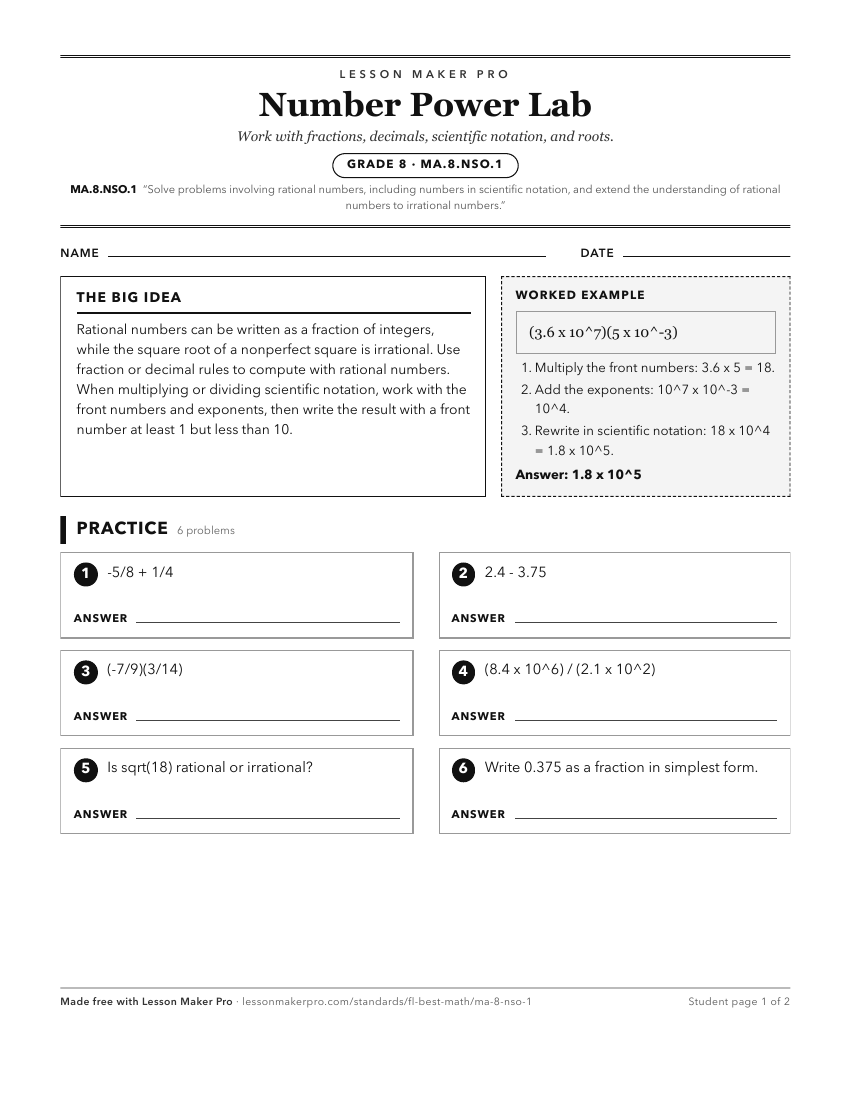
A ready-to-print activity worksheet aligned to MA.8.NSO.1, with an answer key for the teacher on its own page. No account needed.
PDF, US Letter, prints cleanly in black and white.
Download the worksheetKeep exploring
Related Standards
- MA.7.NSO.2.1
Solve mathematical problems using multi-step order of operations with rational numbers including grouping symbols, whole-number exponents and absolute value.
- MA.7.NSO.2.3
Solve real-world problems involving any of the four operations with rational numbers.
- MA.6.NSO.1.1
Extend previous understanding of numbers to define rational numbers. Plot, order and compare rational numbers.
Turn this cluster into a lesson
Grade, subject, topic, and the complete cluster are prefilled. Create one free, no account needed.
Also for this cluster:Make a WorksheetMake a QuizMake a Sub Lesson