Alabama Social Studies SS24.USG.6
Standard Cluster
Summarize the functions and duties of the judicial branch, including the power of judicial review and interpretation of laws. 6a Explain the structure, jurisdiction, and processes of civil and criminal courts in the United States, including courts with original and appellate jurisdiction. 6b Outline and explain the process of appointing Supreme Court Justices and other federal judges. 6c Contrast strict and loose constructionist views of the Constitution of the United States. 6d Explain how landmark United States Supreme Court cases have shaped the constitutional interpretation and expansion of civil liberties and civil rights. 6e Describe the significance of Alabama landmark cases that impacted American society and governance.
2024 Alabama Course of Study: Social Studies
Cluster contents
Standards in This Cluster
SS24.USG.6 is a cluster heading. These are the individual standards under it.
- SS24.USG.6a
Explain the structure, jurisdiction, and processes of civil and criminal courts in the United States, including courts with original and appellate jurisdiction.
- SS24.USG.6b
Outline and explain the process of appointing Supreme Court Justices and other federal judges.
- SS24.USG.6c
Contrast strict and loose constructionist views of the Constitution of the United States.
- SS24.USG.6d
Explain how landmark United States Supreme Court cases have shaped the constitutional interpretation and expansion of civil liberties and civil rights.
- SS24.USG.6e
Describe the significance of Alabama landmark cases that impacted American society and governance.
Teacher's field guide
What This Cluster Means
What Students Need to Do
- Students explain how courts interpret laws and use judicial review to reject laws that conflict with the Constitution. They trace civil and criminal cases through trial and appeals courts, and explain how federal judges are appointed. They compare strict and loose readings of the Constitution and explain how court rulings have changed rights.
What Mastery Looks Like
- A student can distinguish a civil lawsuit from a criminal prosecution and identify which court hears a case first and which reviews an appeal. They can put presidential nomination and Senate confirmation in order and explain how Marbury v. Madison established judicial review. They can compare strict and loose readings and explain how Brown v. Board of Education and Alabama's Gomillion v. Lightfoot affected civil rights.
Common Misconceptions
- Students may think appeals courts retry cases with new witnesses or that every case starts in the Supreme Court. They may confuse civil lawsuits with criminal charges or think presidents appoint federal judges without Senate approval. Some think judicial review lets judges write new laws.
How to Assess It
- On an exit ticket, give this scenario: “Alabama redraws a city boundary to exclude Black voters, and residents sue in federal district court.” Ask students to name the court with original jurisdiction, the next court on appeal, and the power a court could use to strike down the law.
Lesson moves
Ways to Teach It
Give groups a lawsuit card and an indictment card; have them build each path through federal district court, appeals court, and possible Supreme Court review.
Give students the Equal Protection Clause and a school segregation rule; ask them to write one strict and one loose interpretation.
Hand out nomination, Senate hearing, committee vote, Senate confirmation, and commission cards; have teams race to order the appointment steps.
Show a local voting district map and Tuskegee's redrawn boundary from Gomillion v. Lightfoot; ask how boundary changes affect voters.
Free download
Printable SS24.USG.6 Worksheet
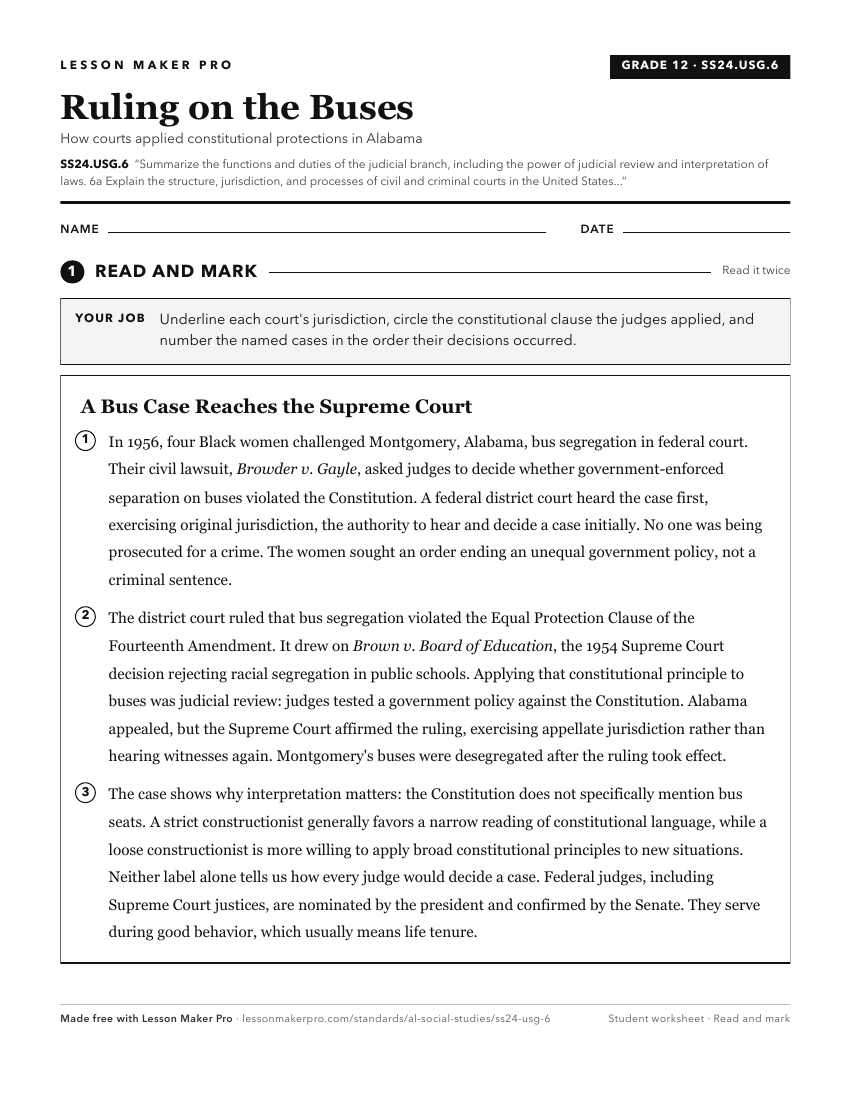
A ready-to-print activity worksheet aligned to SS24.USG.6, with an answer key for the teacher on its own page. No account needed.
PDF, US Letter, prints cleanly in black and white.
Download the worksheetKeep exploring
Related Standards
- SS24.USG.3a
Summarize and explain the underlying principles of the Constitution, including checks and balances, federalism, limited government, popular sovereignty, republi...
- SS24.USG.4
Describe the role and responsibilities of the legislative branch, including the process of lawmaking, the power of the purse, and the system of checks and balan...
- SS24.6.16
Compare duties and functions of the legislative, executive, and judicial branches at various levels of government.
- SS24.6.16a
Illustrate and explain the relationship among the three branches, including checks and balances and separation of powers.
Turn this cluster into a lesson
Grade, subject, topic, and the complete cluster are prefilled. Create one free, no account needed.
Also for this cluster:Make a WorksheetMake a QuizMake a Sub Lesson