Alabama Social Studies SS24.USG.4
Standard Cluster
Describe the role and responsibilities of the legislative branch, including the process of lawmaking, the power of the purse, and the system of checks and balances within Congress. 4a Compare and contrast the leadership roles within Congress, including the Speaker of the House, the Senate President Pro Tempore, majority and minority leaders, and party whips. 4b Identify the types of congressional committees and explain their roles in policy-making. 4c Outline the process by which a bill becomes a law, including introduction, committee review, floor debate, lobbyist actions, voting in both chambers, and presidential action.
2024 Alabama Course of Study: Social Studies
Cluster contents
Standards in This Cluster
SS24.USG.4 is a cluster heading. These are the individual standards under it.
- SS24.USG.4a
Compare and contrast the leadership roles within Congress, including the Speaker of the House, the Senate President Pro Tempore, majority and minority leaders, ...
- SS24.USG.4b
Identify the types of congressional committees and explain their roles in policy-making.
- SS24.USG.4c
Outline the process by which a bill becomes a law, including introduction, committee review, floor debate, lobbyist actions, voting in both chambers, and presid...
Teacher's field guide
What This Cluster Means
What Students Need to Do
- Students compare congressional leaders and explain what standing, select, joint, and conference committees do. They track a bill from introduction through lobbyist input, committee review, floor debate, votes in both chambers, and presidential action. They explain how spending votes, oversight, and veto overrides check the president.
What Mastery Looks Like
- A student can explain that the Speaker directs House business, while the president pro tempore presides over the Senate when the vice president is absent. They distinguish majority and minority leaders, who guide party strategy, from whips, who count votes. They can show why both chambers must agree on a bill and how a funding vote can limit an agency.
Common Misconceptions
- Students may think the president introduces bills or that one chamber can pass a law alone. They may think lobbyists vote on bills or that every committee is permanent. They may confuse party whips with the leaders who preside over each chamber.
How to Assess It
- Exit ticket: A bill funds new buses. List its steps from introduction to presidential action, mark where lobbyists may weigh in, and explain how the funding vote gives Congress power.
Lesson moves
Ways to Teach It
Hand groups step cards and a bus-funding bill; have them sequence committee review, lobbyist input, debates, votes, a possible conference, and presidential action.
Ask: How do the Speaker, president pro tempore, majority and minority leaders, and whips differ when a funding bill reaches the floor?
Set four corners labeled standing, select, joint, and conference; read tax-writing, investigation, shared study, and bill-reconciliation cards for students to match.
Open an enacted spending bill on Congress.gov; students find both chambers' votes, the president's action, and one agency affected by its funding.
Free download
Printable SS24.USG.4 Worksheet
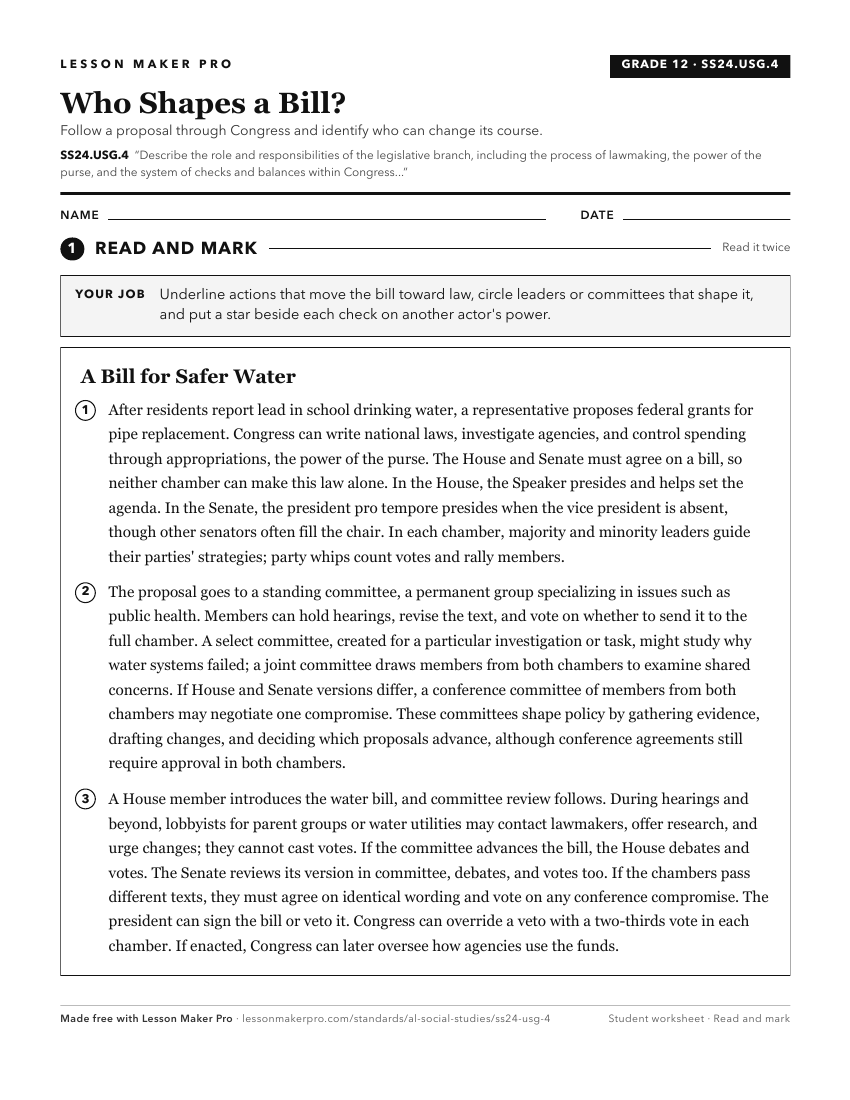
A ready-to-print activity worksheet aligned to SS24.USG.4, with an answer key for the teacher on its own page. No account needed.
PDF, US Letter, prints cleanly in black and white.
Download the worksheetKeep exploring
Related Standards
Turn this cluster into a lesson
Grade, subject, topic, and the complete cluster are prefilled. Create one free, no account needed.
Also for this cluster:Make a WorksheetMake a QuizMake a Sub Lesson