Alabama Social Studies SS24.6.16
Standard Cluster
Compare duties and functions of the legislative, executive, and judicial branches at various levels of government. 16a Illustrate and explain the relationship among the three branches, including checks and balances and separation of powers. 16b Identify key positions in each branch and describe their responsibilities.
2024 Alabama Course of Study: Social Studies
Cluster contents
Standards in This Cluster
SS24.6.16 is a cluster heading. These are the individual standards under it.
Teacher's field guide
What This Cluster Means
What Students Need to Do
- Students identify who makes laws, who carries them out, and who interprets them in federal, state, and local government. They name people or groups in each branch, such as legislators, governors, mayors, and judges. They explain how a veto, override, or court ruling can limit another branch.
What Mastery Looks Like
- A student can place Congress, the president, and federal courts in the right branches, then do the same for state and city officials. Given a bill, they can explain who passes it, who may veto it, and who may decide whether it follows the constitution.
Common Misconceptions
- Students may think a president or governor makes laws alone, or that judges vote on bills. They may put a mayor in state government. Some think a veto ends a bill, missing the legislature's chance to override it.
How to Assess It
- Exit ticket: Label Congress, the president, federal courts, a state legislature, a governor, state courts, a city council, a mayor, and a municipal court by branch. Then explain who can veto and override a federal bill.
Lesson moves
Ways to Teach It
Give groups cards for Congress, president, federal court, state legislature, governor, state court, city council, mayor, and municipal court to sort by branch.
Ask, 'If a governor vetoes a bill, should state lawmakers be able to override it?' Have students name both branches in their answers.
Play branch bingo: read 'confirms a judge,' 'vetoes a bill,' and 'rules on a law'; students mark Senate, president, or court.
Show a city council agenda and a mayor's budget proposal; have students label each branch and explain where a municipal court fits.
Free download
Printable SS24.6.16 Worksheet
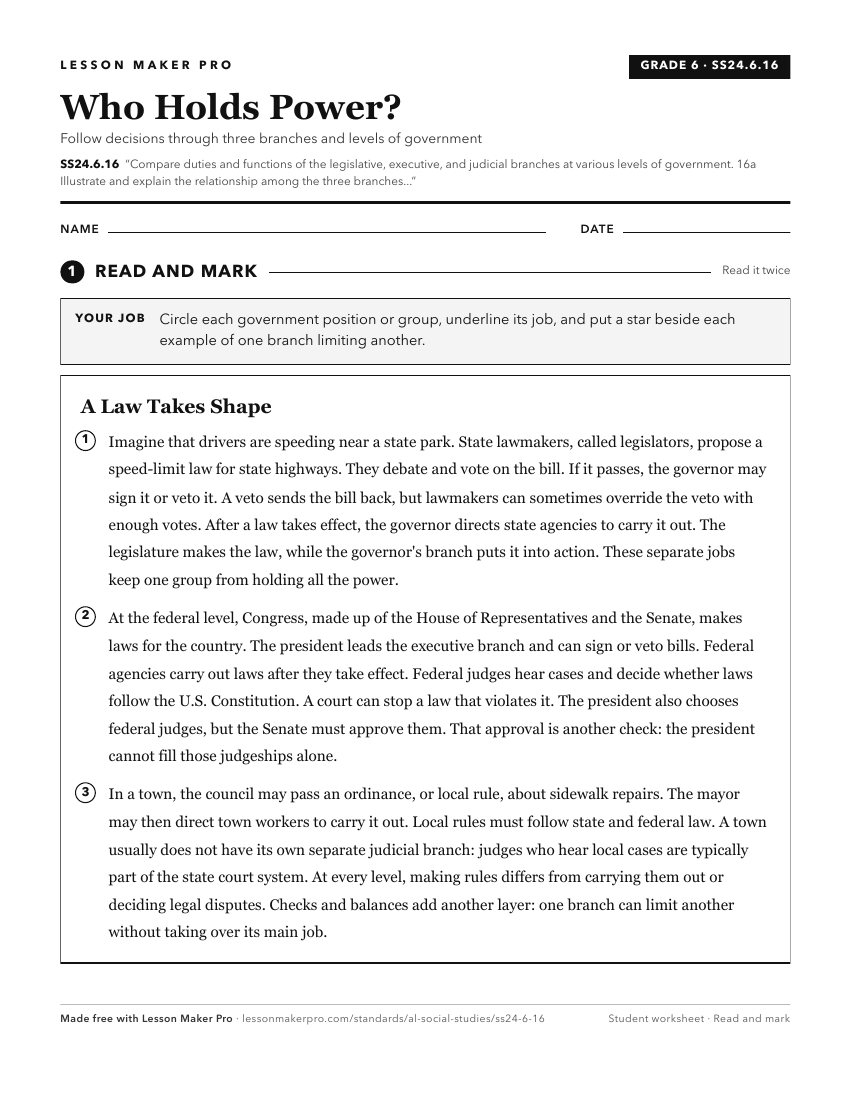
A ready-to-print activity worksheet aligned to SS24.6.16, with an answer key for the teacher on its own page. No account needed.
PDF, US Letter, prints cleanly in black and white.
Download the worksheetKeep exploring
Related Standards
- SS24.2.2
Identify the three branches of government and describe their roles.
- SS24.6.10a
Compare and contrast the division of power among levels of government in unitary, federal, and confederate styles of governance.
- SS24.USG.13a
Compare specific functions, organizations, and purposes of local and state governments.
Turn this cluster into a lesson
Grade, subject, topic, and the complete cluster are prefilled. Create one free, no account needed.
Also for this cluster:Make a WorksheetMake a QuizMake a Sub Lesson