Alabama Social Studies SS24.US2.14
Standard Cluster
Explain shifts in the scope of the Civil Rights Movement from the mid-1960s into the 1970s, including geographic regions, issues of focus, and participation. 14a Explain how the Civil Rights Movement inspired other movements for civil and human rights, and describe the contributions of groups and individuals to these movements. 14b Evaluate the social and political significance of the women’s rights movement from the 1960s to the 1980s on the lives of women in the United States. 14c Compare and contrast major Supreme Court decisions from the 1960s through the 1980s and explain how they reflect an ongoing national debate regarding the expansion and limits of civil liberties, civil rights, and constitutional protections.
2024 Alabama Course of Study: Social Studies
Cluster contents
Standards in This Cluster
SS24.US2.14 is a cluster heading. These are the individual standards under it.
- SS24.US2.14a
Explain how the Civil Rights Movement inspired other movements for civil and human rights, and describe the contributions of groups and individuals to these mov...
- SS24.US2.14b
Evaluate the social and political significance of the women’s rights movement from the 1960s to the 1980s on the lives of women in the United States.
- SS24.US2.14c
Compare and contrast major Supreme Court decisions from the 1960s through the 1980s and explain how they reflect an ongoing national debate regarding the expans...
Teacher's field guide
What This Cluster Means
What Students Need to Do
- Trace how civil rights campaigns spread beyond the South and took up housing, jobs, and policing. Explain how farmworkers, Native Americans, and women organized for rights. Weigh gains and setbacks for women and compare court rulings that expanded or limited legal protections.
What Mastery Looks Like
- Students can locate Chicago housing protests and the Delano grape strike on a map and explain each goal. They link César Chávez to farmworker organizing and NOW to women's rights, including Title IX gains and the ERA's failure. They explain that Roe protected abortion access, while Bakke barred racial quotas but allowed race as one factor in admissions.
Common Misconceptions
- Students may think civil rights activism ended after the Voting Rights Act or stayed in the South. They may think Title IX only covered sports or that the Equal Rights Amendment passed. They may assume every court ruling expanded rights, missing Bakke's restriction on quotas and Bowers's refusal to protect same-sex intimacy.
How to Assess It
- Exit ticket: "How did Chicago housing protests differ from Southern voting drives? Name one related rights group and its work, one gain and one setback for women, and one difference between Roe and Bakke."
Lesson moves
Ways to Teach It
Give pairs a blank U.S. map and event cards for Selma, Chicago, Delano, and Wounded Knee; have them mark each place and campaign goal.
Ask: "Did Title IX change women's lives more than the campaign for the ERA? Defend your answer with one specific example."
Run a case-card sort: match Roe, Bakke, and Bowers to their rulings, then mark which protections each expanded or limited.
Print your school's girls' and boys' sports schedules; have students spot a possible access gap and draft a Title IX question for the principal.
Free download
Printable SS24.US2.14 Worksheet
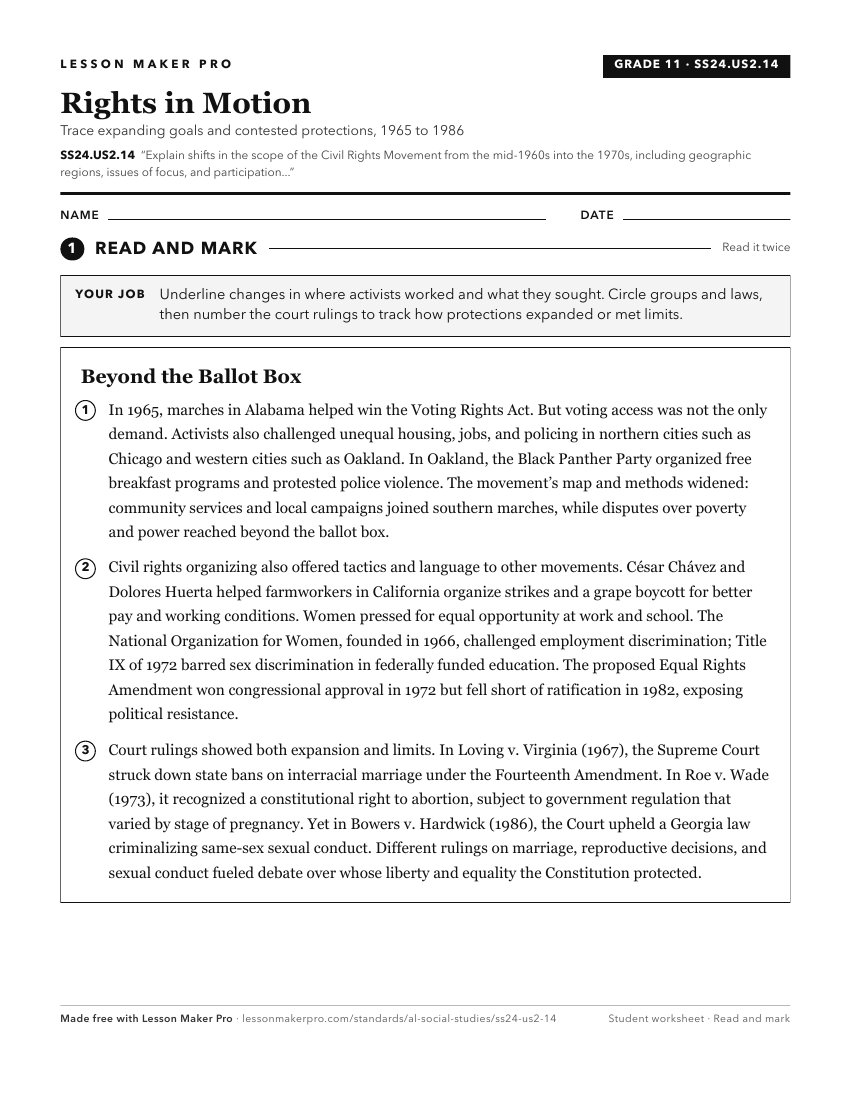
A ready-to-print activity worksheet aligned to SS24.US2.14, with an answer key for the teacher on its own page. No account needed.
PDF, US Letter, prints cleanly in black and white.
Download the worksheetKeep exploring
Related Standards
- SS24.5.12a
Describe ways in which the Civil Rights Movement sought to create change.
- SS24.US2.10
Evaluate the influence of events, organizations, and individual actions on the expansion of the Civil Rights Movement nationally.
- SS24.US2.10b
Analyze the extent to which the actions and campaigns of civil rights activists and organizations from 1954 to 1965 prompted federal measures to advance civil a...
- SS24.US2.10a
Identify and explain key events from 1945 to 1955 that brought about the emergence of a large-scale movement for civil rights.
Turn this cluster into a lesson
Grade, subject, topic, and the complete cluster are prefilled. Create one free, no account needed.
Also for this cluster:Make a WorksheetMake a QuizMake a Sub Lesson