Alabama Social Studies SS24.US2.14c
The Standard
- SS24.US2.14
- Explain shifts in the scope of the Civil Rights Movement from the mid-1960s into the 1970s, including geographic regions, issues of focus, and participation.
Compare and contrast major Supreme Court decisions from the 1960s through the 1980s and explain how they reflect an ongoing national debate regarding the expansion and limits of civil liberties, civil rights, and constitutional protections.
2024 Alabama Course of Study: Social Studies
Teacher's field guide
What This Standard Means
What Students Need to Do
- Students compare what the Court protected and what it allowed schools or governments to limit. They use facts from cases in the 1960s, 1970s, and 1980s to explain debates about rights.
What Mastery Looks Like
- A student can explain why Tinker protected protest armbands while Hazelwood allowed a principal to remove school newspaper articles. They can explain how Miranda protected suspects and how Bakke rejected fixed racial quotas in admissions.
Common Misconceptions
- Students may think Tinker protects all student speech, including school-sponsored publications. Some think Bakke banned all consideration of race in admissions, or that every ruling from this period expanded rights.
How to Assess It
- Exit ticket: Compare Tinker and Hazelwood. Why did the Court treat protest armbands and a school newspaper differently?
Lesson moves
Ways to Teach It
Give pairs case cards for Miranda, Tinker, Bakke, and Hazelwood; have them sort the cards by right, ruling, and limit.
Ask students to write: Why did Tinker protect armbands but Hazelwood allow a principal to remove newspaper articles? Use one fact from each case.
Read a case ruling aloud and have teams hold up the matching case name, then explain one limit on that ruling.
Hand students a sample school newspaper article and a protest armband scenario; ask which ruling applies to each and why.
Free download
Printable SS24.US2.14c Worksheet
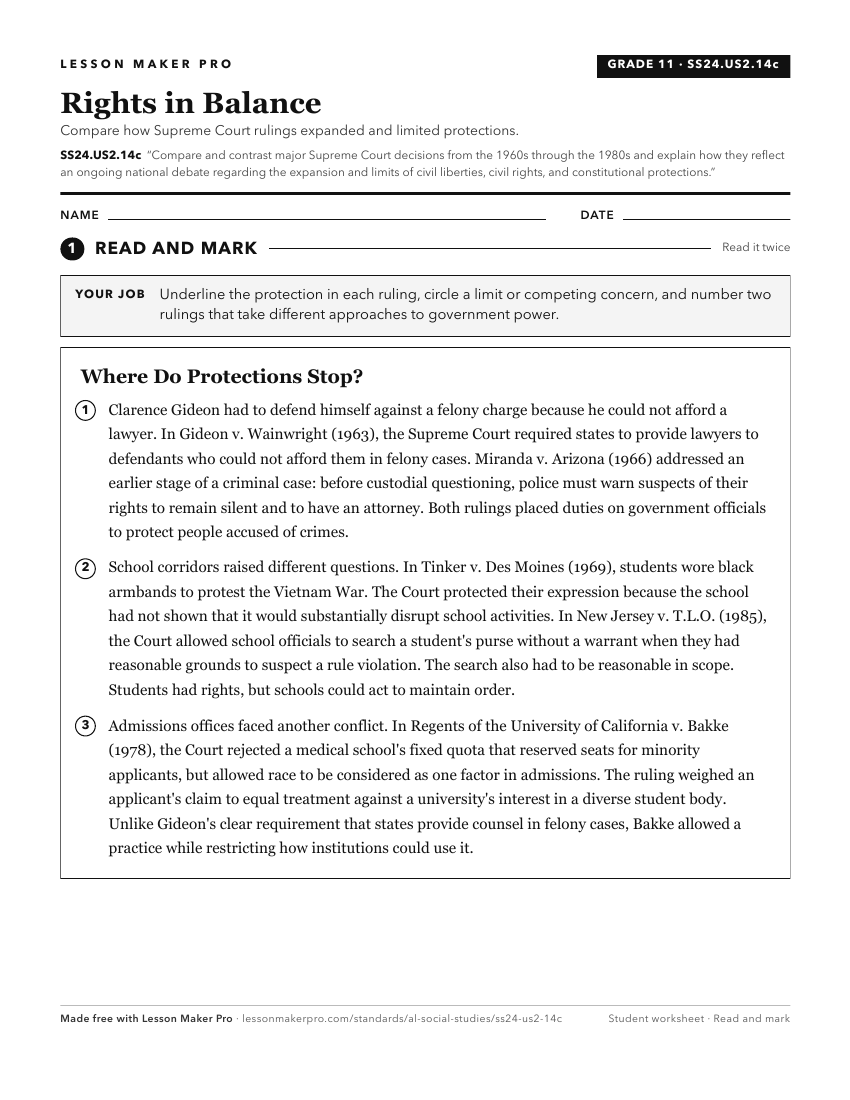
A ready-to-print activity worksheet aligned to SS24.US2.14c, with an answer key for the teacher on its own page. No account needed.
PDF, US Letter, prints cleanly in black and white.
Download the worksheetKeep exploring
Related Standards
- SS24.US2.10
Evaluate the influence of events, organizations, and individual actions on the expansion of the Civil Rights Movement nationally.
- SS24.US2.10b
Analyze the extent to which the actions and campaigns of civil rights activists and organizations from 1954 to 1965 prompted federal measures to advance civil a...
- SS24.US2.14b
Evaluate the social and political significance of the women’s rights movement from the 1960s to the 1980s on the lives of women in the United States.
- SS24.USG.6d
Explain how landmark United States Supreme Court cases have shaped the constitutional interpretation and expansion of civil liberties and civil rights.
Turn this exact standard into a lesson
Grade, subject, topic, and the complete standard are prefilled. Create one free, no account needed.
Also for this standard:Make a WorksheetMake a QuizMake a Sub Lesson