Alabama Social Studies SS24.US2.14b
The Standard
- SS24.US2.14
- Explain shifts in the scope of the Civil Rights Movement from the mid-1960s into the 1970s, including geographic regions, issues of focus, and participation.
Evaluate the social and political significance of the women’s rights movement from the 1960s to the 1980s on the lives of women in the United States.
2024 Alabama Course of Study: Social Studies
Teacher's field guide
What This Standard Means
What Students Need to Do
- Students explain how organizing and new laws changed women's access to education, jobs, and political power. They weigh those gains against goals that went unmet and differences in women's experiences.
What Mastery Looks Like
- A student can explain how Title IX opened school programs to more girls and women. They can explain why the failure to ratify the federal Equal Rights Amendment mattered, without claiming that all women benefited equally.
Common Misconceptions
- Students may think the federal Equal Rights Amendment was ratified or that Title IX covered only sports. They may also assume that new legal rights immediately ended unequal pay and discrimination.
How to Assess It
- On an exit ticket, ask: What did Title IX change for women, and what did the failure to ratify the federal Equal Rights Amendment leave unresolved? Use one specific example for each.
Lesson moves
Ways to Teach It
Give groups excerpts from Title VII and Title IX plus an ERA campaign flyer; have them sort each under school, work, or politics.
Ask students to write how Title IX might change a girl's school day in 1975 and what barriers she might still face.
Play a claim-check game with cards stating 'The federal ERA was ratified' and 'Title IX covered only sports'; students correct each claim.
Have students find their district's Title IX notice online and name one school opportunity it protects.
Free download
Printable SS24.US2.14b Worksheet
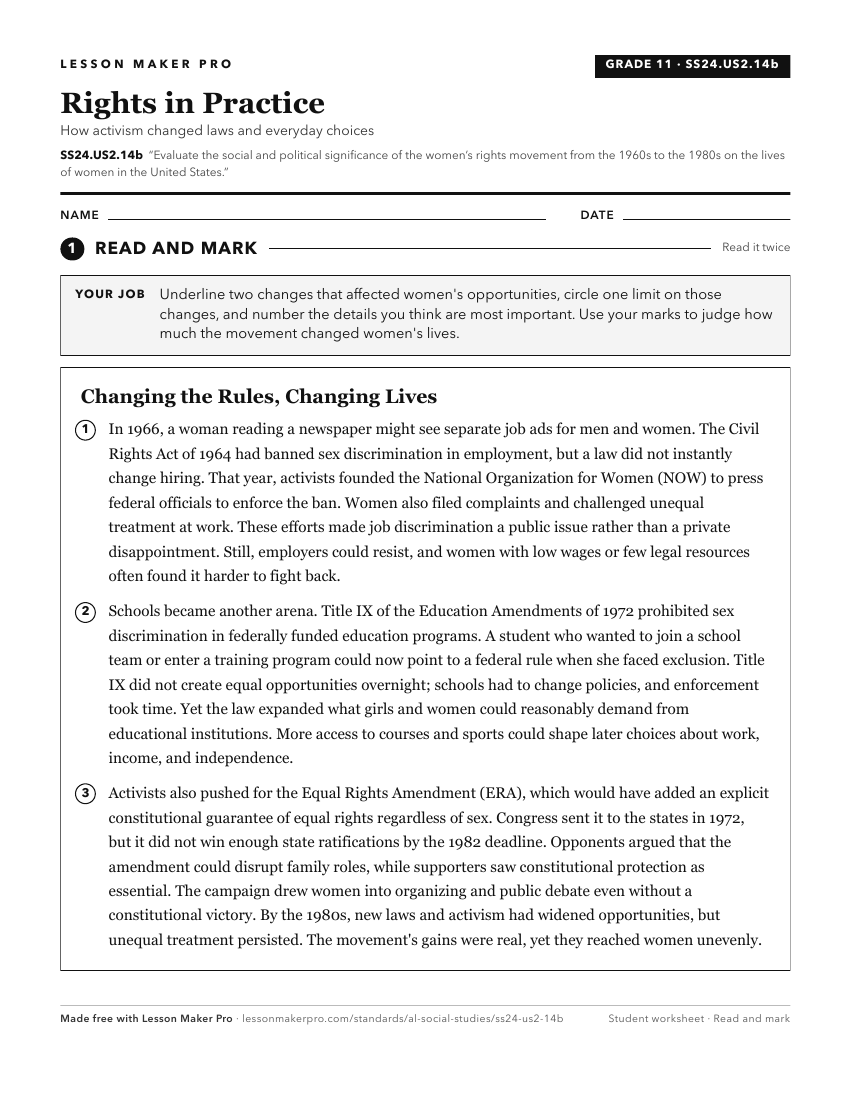
A ready-to-print activity worksheet aligned to SS24.US2.14b, with an answer key for the teacher on its own page. No account needed.
PDF, US Letter, prints cleanly in black and white.
Download the worksheetKeep exploring
Related Standards
- SS24.US2.10
Evaluate the influence of events, organizations, and individual actions on the expansion of the Civil Rights Movement nationally.
- SS24.US2.10b
Analyze the extent to which the actions and campaigns of civil rights activists and organizations from 1954 to 1965 prompted federal measures to advance civil a...
- SS24.US1.7
Assess how women challenged their societal roles under the Cult of Domesticity through their participation in social movements prior to the Civil War.
- SS24.US1.18d
Analyze the roles and differing viewpoints of female reformers and women’s organizations in guiding the women’s suffrage and temperance movements.
Turn this exact standard into a lesson
Grade, subject, topic, and the complete standard are prefilled. Create one free, no account needed.
Also for this standard:Make a WorksheetMake a QuizMake a Sub Lesson