Alabama Social Studies SS24.US1.18d
The Standard
- SS24.US1.18
- Describe the emergence of the Populist and Progressive movements and explain changes brought about by individual reformers and organizations.
Analyze the roles and differing viewpoints of female reformers and women’s organizations in guiding the women’s suffrage and temperance movements.
2024 Alabama Course of Study: Social Studies
Teacher's field guide
What This Standard Means
What Students Need to Do
- Students explain how women and their organizations worked for voting rights and limits on alcohol. They compare arguments and tactics, including lobbying and public protest. They also examine how exclusion shaped Black women's organizing.
What Mastery Looks Like
- A student can explain why Frances Willard's WCTU backed voting rights as a way to fight alcohol abuse. They can contrast Carrie Chapman Catt's lobbying with Alice Paul's picketing and explain why Mary Church Terrell helped organize Black women.
Common Misconceptions
- Students may treat suffrage and temperance as the same goal, though one sought voting rights and the other sought to reduce or ban alcohol. They may assume all reformers used the same tactics or that Black women had equal standing in white-led groups.
How to Assess It
- Use this exit ticket: “Why did Willard's WCTU support voting rights, and how was its approach different from Paul's White House pickets?”
Lesson moves
Ways to Teach It
Give pairs brief source cards for Catt, Paul, Willard, and Terrell; have them place each on a suffrage and temperance chart with one tactic.
Ask students to write: “Why did Willard link voting rights to alcohol reform, while Paul used public protests to demand the vote?”
Run a card match with reformers, organizations, and tactics; require pairs to explain each match before checking the answer key.
Show a school board agenda and a protest photo; ask students which tactic resembles Catt's lobbying and which resembles Paul's picketing.
Free download
Printable SS24.US1.18d Worksheet
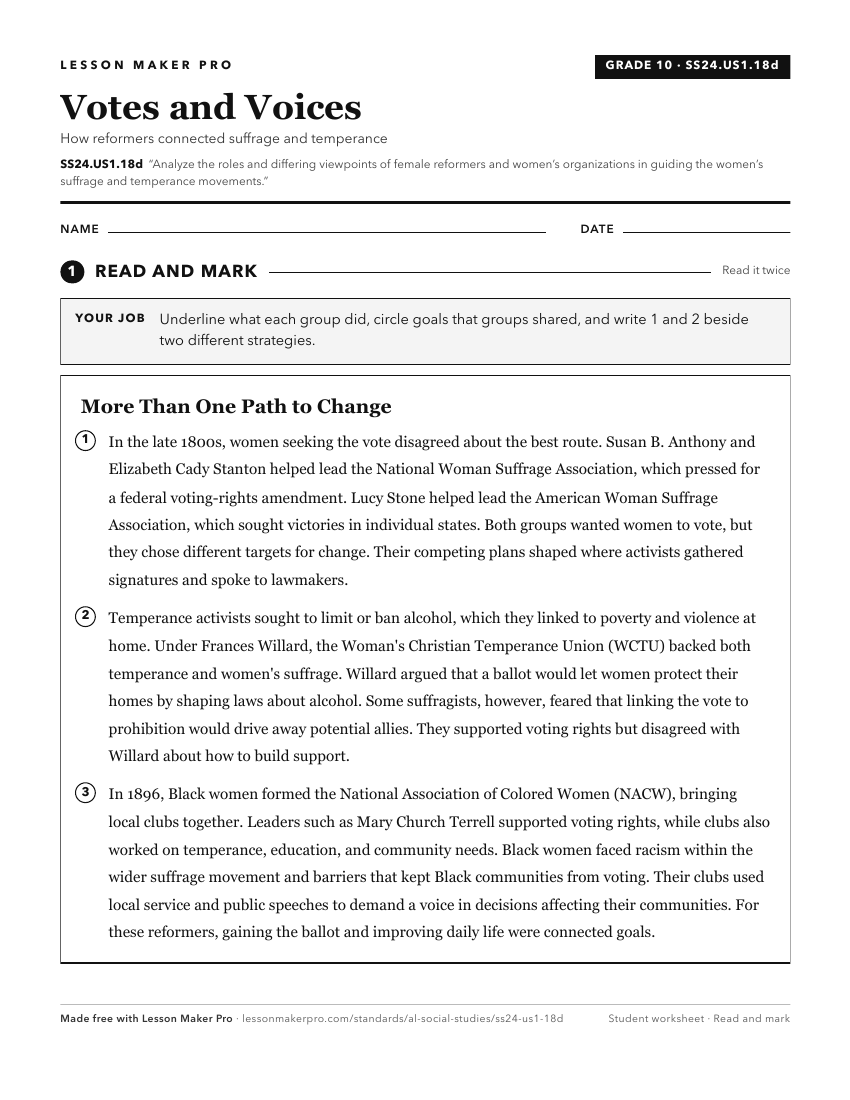
A ready-to-print activity worksheet aligned to SS24.US1.18d, with an answer key for the teacher on its own page. No account needed.
PDF, US Letter, prints cleanly in black and white.
Download the worksheetKeep exploring
Related Standards
- SS24.AS.15a
Describe the role of women reformers in promoting reform, including Margaret Murray Washington and Julia Tutwiler.
- SS24.US2.14b
Evaluate the social and political significance of the women’s rights movement from the 1960s to the 1980s on the lives of women in the United States.
- SS24.US1.7a
Summarize the contributions of women reformers in the early to mid-nineteenth century who sought to expand political and educational opportunities for women.
- SS24.US1.7
Assess how women challenged their societal roles under the Cult of Domesticity through their participation in social movements prior to the Civil War.
Turn this exact standard into a lesson
Grade, subject, topic, and the complete standard are prefilled. Create one free, no account needed.
Also for this standard:Make a WorksheetMake a QuizMake a Sub Lesson