Alabama Social Studies SS24.US1.10
Standard Cluster
Trace the evolution and expansion of abolitionism, examining the contributions of key abolitionist figures and analyzing the reactions of both southern and northern communities to this campaign. 10a Describe forms of resistance to slavery demonstrated by enslaved and free Black Americans, and assess the impact of resistance on southern states’ slave codes. 10b Describe the rise of religious opposition to slavery during the Second Great Awakening, including the objections of Quakers, and how this fostered schisms within American churches. 10c Identify leading abolitionists, including Frederick Douglass and William Lloyd Garrison, and summarize the arguments they made in opposition to slavery and in rebuttal to pro-slavery rhetoric. 10d Evaluate how the Underground Railroad and its leaders shaped the national discussion over slavery, including the passage of the Fugitive Slave Act and publication of Harriet Beecher Stowe’s Uncle Tom’s Cabin.
2024 Alabama Course of Study: Social Studies
Cluster contents
Standards in This Cluster
SS24.US1.10 is a cluster heading. These are the individual standards under it.
- SS24.US1.10a
Describe forms of resistance to slavery demonstrated by enslaved and free Black Americans, and assess the impact of resistance on southern states’ slave codes.
- SS24.US1.10b
Describe the rise of religious opposition to slavery during the Second Great Awakening, including the objections of Quakers, and how this fostered schisms withi...
- SS24.US1.10c
Identify leading abolitionists, including Frederick Douglass and William Lloyd Garrison, and summarize the arguments they made in opposition to slavery and in r...
- SS24.US1.10d
Evaluate how the Underground Railroad and its leaders shaped the national discussion over slavery, including the passage of the Fugitive Slave Act and publicati...
Teacher's field guide
What This Cluster Means
What Students Need to Do
- Students trace how the campaign to end slavery grew through churches, newspapers, speeches, and escape networks. They describe resistance by enslaved and free Black Americans. They compare abolitionists’ arguments with northern and southern reactions.
What Mastery Looks Like
- Students can explain how Douglass’s firsthand account and Garrison’s call for immediate abolition challenged claims that slavery helped enslaved people. They can connect escape and revolt to tighter slave codes and explain how the Fugitive Slave Act and Stowe’s novel widened the debate. They can identify Quaker opposition, church splits, southern crackdowns, and divided northern opinion.
Common Misconceptions
- Students may assume everyone in the North opposed slavery or that resistance always meant armed revolt. They may think Quakers first opposed slavery during the Second Great Awakening, or that the Fugitive Slave Act created the Underground Railroad.
How to Assess It
- Exit ticket: Name one way enslaved or free Black people resisted slavery and one law or reaction that followed. Then explain how Douglass, Garrison, or Tubman brought slavery into national debate.
Lesson moves
Ways to Teach It
Give pairs an Underground Railroad map and a Fugitive Slave Act excerpt; have them mark escape routes and circle risks in northern states.
Read short Douglass and Garrison excerpts, then ask: How does each rebut the claim that slavery benefited enslaved people?
Sort cards labeled Quaker petition, Black-led escape, church split, slave code, northern meeting, and southern censorship into causes and reactions.
Compare an abolitionist petition with a petition to change a school rule; have students identify each audience and requested action.
Free download
Printable SS24.US1.10 Worksheet
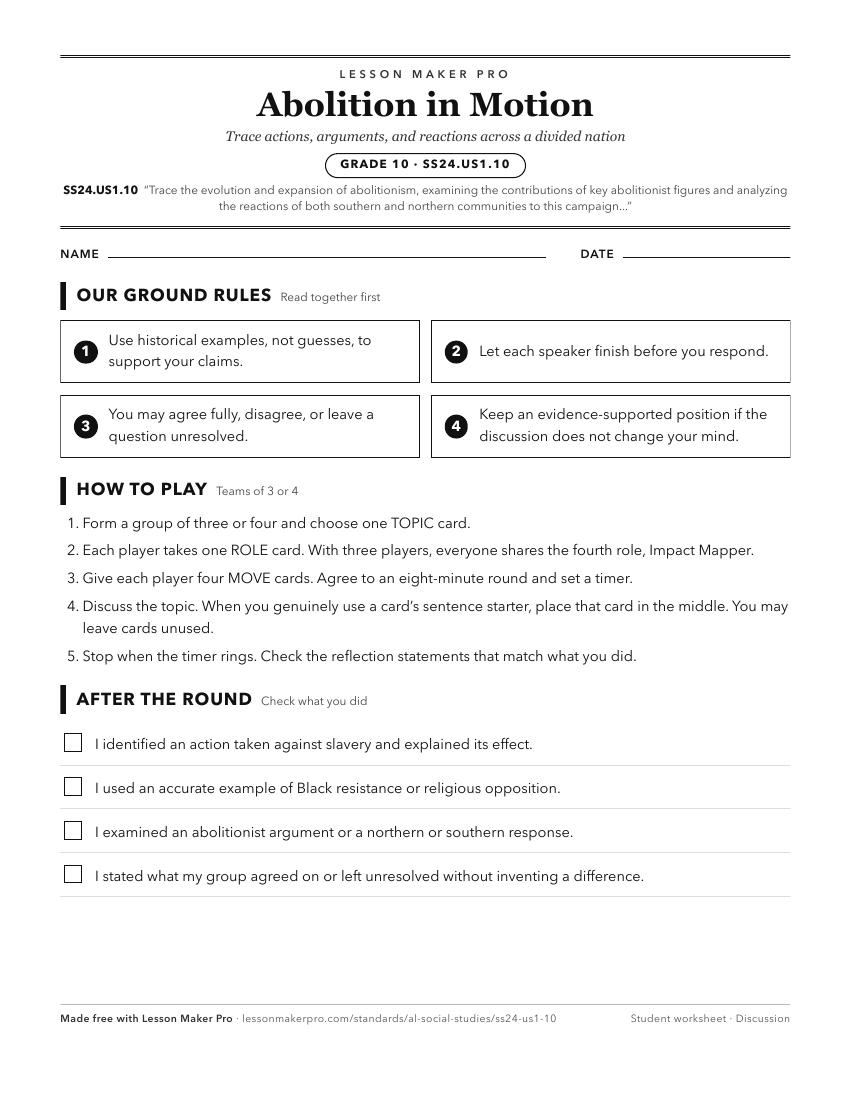
A ready-to-print activity worksheet aligned to SS24.US1.10, with an answer key for the teacher on its own page. No account needed.
PDF, US Letter, prints cleanly in black and white.
Download the worksheetKeep exploring
Related Standards
- SS24.US1.12
Explain the progression of the Civil War, analyzing the events and the decisions by key figures that led to United States victory and the abolition of slavery.
- SS24.4.13b
Describe the influence of abolitionists, including enslaved persons and self-liberated Black Americans, on efforts to end slavery in the United States.
- SS24.US1.4a
Describe the growth of an anti-slavery movement in northern states through the founding of the first abolitionist societies, passage of gradual emancipation law...
Turn this cluster into a lesson
Grade, subject, topic, and the complete cluster are prefilled. Create one free, no account needed.
Also for this cluster:Make a WorksheetMake a QuizMake a Sub Lesson