Alabama Social Studies SS24.US1.10c
The Standard
- SS24.US1.10
- Trace the evolution and expansion of abolitionism, examining the contributions of key abolitionist figures and analyzing the reactions of both southern and northern communities to this campaign.
Identify leading abolitionists, including Frederick Douglass and William Lloyd Garrison, and summarize the arguments they made in opposition to slavery and in rebuttal to pro-slavery rhetoric.
2024 Alabama Course of Study: Social Studies
Teacher's field guide
What This Standard Means
What Students Need to Do
- Name Frederick Douglass and William Lloyd Garrison as abolitionists. Explain Douglass’s criticism of American freedom under slavery and Garrison’s demand for immediate abolition. Show how their arguments challenged claims that slavery was justified or beneficial.
What Mastery Looks Like
- A student can match each man to an excerpt and explain his argument. They can name a pro-slavery claim and answer it with a specific point from Douglass or Garrison.
Common Misconceptions
- Students may mix up the two men or assume they made the same argument. Some may repeat claims that enslaved people were well treated without recognizing those claims as arguments abolitionists challenged.
How to Assess It
- Exit ticket: Name Douglass and Garrison, give one argument each made against slavery, then use one argument to answer the claim that slavery benefited enslaved people.
Lesson moves
Ways to Teach It
Print excerpts from Douglass’s 1852 speech and Garrison’s 1831 editorial; pairs sort quote cards by speaker and underline each argument against slavery.
Ask, 'How would Douglass answer the claim that slavery protected enslaved people?' Have students cite a detail from his speech.
Play 'Who said it?': read six argument cards; teams name Douglass or Garrison and point to a matching line in the excerpts.
Project a local newspaper opinion column; students mark its claim and rebuttal, then compare that move with Garrison’s editorial.
Free download
Printable SS24.US1.10c Worksheet
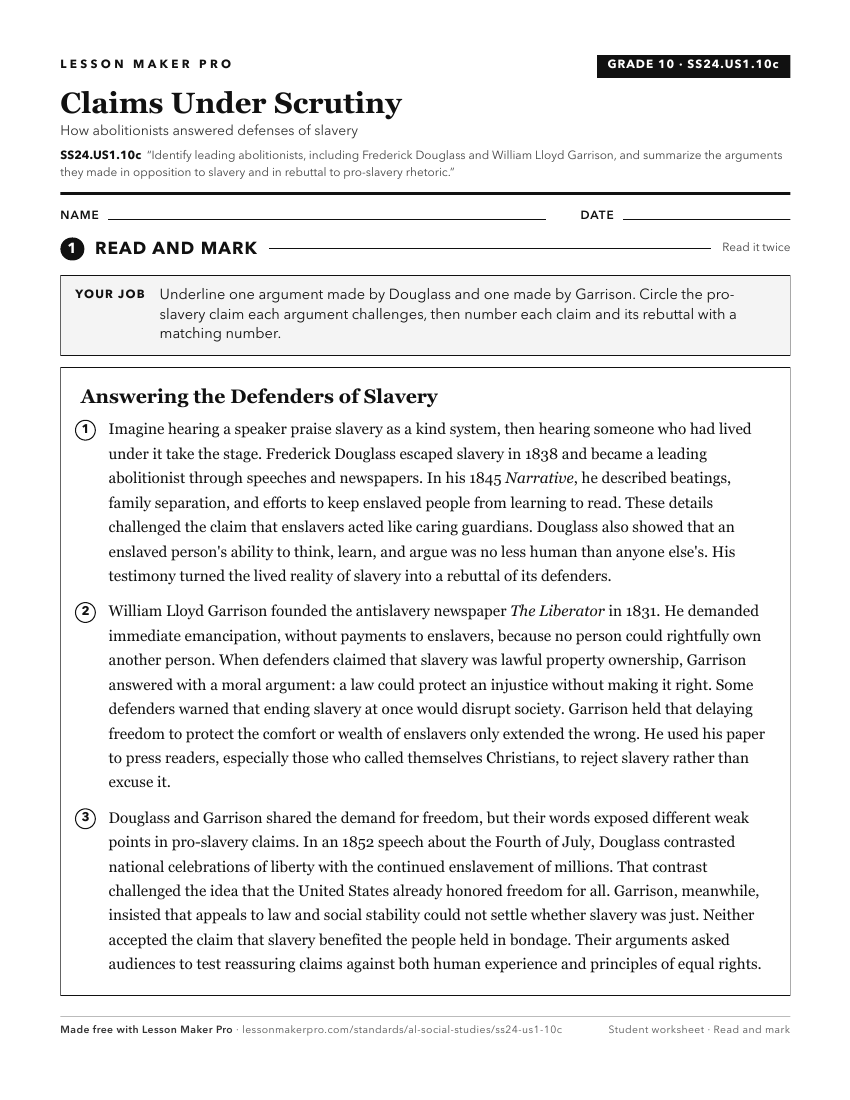
A ready-to-print activity worksheet aligned to SS24.US1.10c, with an answer key for the teacher on its own page. No account needed.
PDF, US Letter, prints cleanly in black and white.
Download the worksheetKeep exploring
Related Standards
- SS24.US1.10
Trace the evolution and expansion of abolitionism, examining the contributions of key abolitionist figures and analyzing the reactions of both southern and nort...
- SS24.6.6c
Describe how enslaved people and abolitionists sought to oppose slavery in colonial America.
- SS24.4.13b
Describe the influence of abolitionists, including enslaved persons and self-liberated Black Americans, on efforts to end slavery in the United States.
- SS24.US1.4
Assess how the American Revolution and its rhetoric affected the status of slavery in the newly formed United States.
Turn this exact standard into a lesson
Grade, subject, topic, and the complete standard are prefilled. Create one free, no account needed.
Also for this standard:Make a WorksheetMake a QuizMake a Sub Lesson