Alabama Social Studies SS24.6.6c
The Standard
- SS24.6.6
- Trace the economic and cultural interactions across continents and the colonies resulting from the triangular trade routes, including the forced migration of Africans through the transatlantic slave trade and experiences of the Middle Passage.
Describe how enslaved people and abolitionists sought to oppose slavery in colonial America.
2024 Alabama Course of Study: Social Studies
Teacher's field guide
What This Standard Means
What Students Need to Do
- Students describe how enslaved people opposed slavery by escaping, slowing forced labor, or petitioning for freedom. They explain how opponents of slavery, including some Quakers, used petitions and public arguments to seek change.
What Mastery Looks Like
- Given a colonial escape notice and an antislavery petition, a student can identify who acted and what each person wanted. They can explain why opposing slavery carried different risks for enslaved people and free petitioners.
Common Misconceptions
- Students may think resistance meant only rebellion, missing escapes, work slowdowns, and freedom petitions. They may assume all colonists opposed slavery or overlook the actions enslaved people took themselves.
How to Assess It
- Exit ticket: Name one action an enslaved person took and one action an antislavery petitioner took in colonial America. Explain what each hoped to change.
Lesson moves
Ways to Teach It
Give pairs excerpts from the 1688 Germantown petition and a colonial escape notice; have them circle evidence of opposition to slavery.
Ask students to write two sentences comparing the risks of escaping with the risks of signing an antislavery petition.
Play a card match with escape, freedom petition, and antislavery petition cards, plus cards naming who used each approach.
Open a colonial escape notice on Freedom on the Move; ask what the notice reveals about the person who escaped.
Free download
Printable SS24.6.6c Worksheet
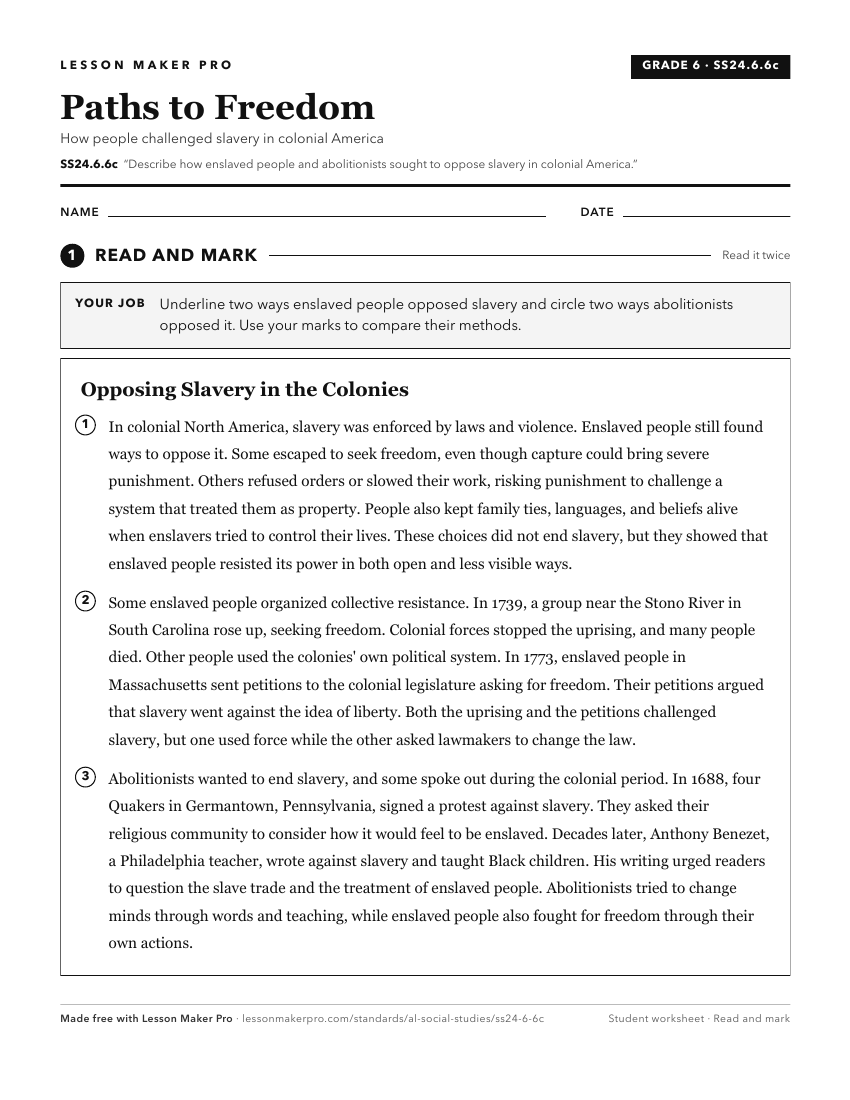
A ready-to-print activity worksheet aligned to SS24.6.6c, with an answer key for the teacher on its own page. No account needed.
PDF, US Letter, prints cleanly in black and white.
Download the worksheetKeep exploring
Related Standards
- SS24.US1.10c
Identify leading abolitionists, including Frederick Douglass and William Lloyd Garrison, and summarize the arguments they made in opposition to slavery and in r...
- SS24.US1.10a
Describe forms of resistance to slavery demonstrated by enslaved and free Black Americans, and assess the impact of resistance on southern states’ slave codes.
- SS24.4.13b
Describe the influence of abolitionists, including enslaved persons and self-liberated Black Americans, on efforts to end slavery in the United States.
- SS24.US1.4
Assess how the American Revolution and its rhetoric affected the status of slavery in the newly formed United States.
Turn this exact standard into a lesson
Grade, subject, topic, and the complete standard are prefilled. Create one free, no account needed.
Also for this standard:Make a WorksheetMake a QuizMake a Sub Lesson