Alabama Social Studies SS24.US1.4
Standard Cluster
Assess how the American Revolution and its rhetoric affected the status of slavery in the newly formed United States. 4a Describe the growth of an anti-slavery movement in northern states through the founding of the first abolitionist societies, passage of gradual emancipation laws, court cases, and actions of individuals. 4b Explain why the Northwest Ordinance's ban on slavery in new states north of the Ohio River (1787) was significant.
2024 Alabama Course of Study: Social Studies
Cluster contents
Standards in This Cluster
SS24.US1.4 is a cluster heading. These are the individual standards under it.
Teacher's field guide
What This Cluster Means
What Students Need to Do
- Students explain how revolutionary claims about liberty gave people arguments against slavery. They trace northern abolition efforts and explain why the 1787 ban on slavery in the Northwest Territory mattered.
What Mastery Looks Like
- Students can use Pennsylvania's abolition society and gradual emancipation law, Quock Walker's lawsuits, and the Northwest Ordinance as evidence. They explain that gradual emancipation left people enslaved for years and that the territorial ban did not end slavery nationwide.
Common Misconceptions
- Some students think the Revolution freed everyone who was enslaved. Others think northern emancipation laws freed people immediately, or that the Northwest Ordinance banned slavery in every northern state.
How to Assess It
- Exit ticket: Name one northern action against slavery after the Revolution. Explain how the Northwest Ordinance limited slavery and where its ban applied.
Lesson moves
Ways to Teach It
Give pairs four event cards dated 1775, 1780, 1783, and 1787; have them build a timeline and label each change.
Ask students to write two sentences: Who could use revolutionary claims about liberty to challenge slavery, and who remained enslaved?
Play a matching game with cards for Pennsylvania's society, its gradual emancipation law, Quock Walker's lawsuits, and the Northwest Ordinance.
On a current U.S. map, shade Ohio, Indiana, Illinois, Michigan, and Wisconsin, then mark the territory affected by the 1787 ban.
Free download
Printable SS24.US1.4 Worksheet
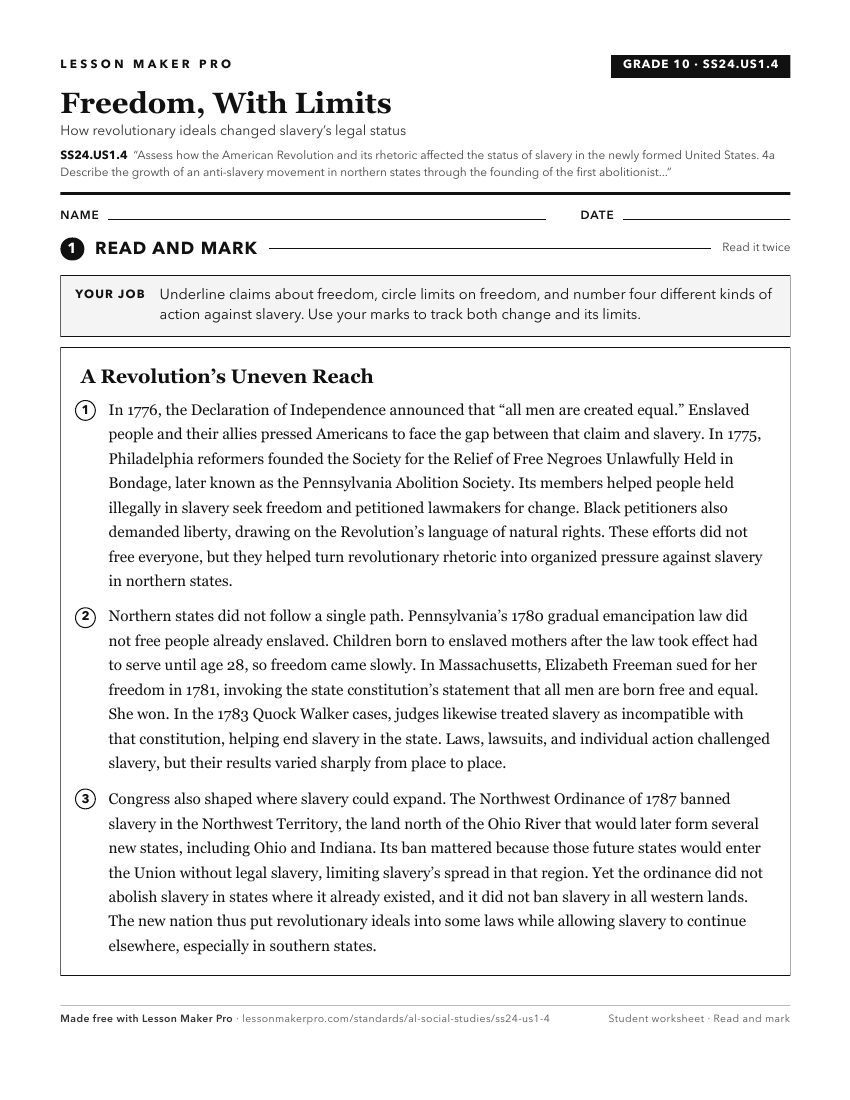
A ready-to-print activity worksheet aligned to SS24.US1.4, with an answer key for the teacher on its own page. No account needed.
PDF, US Letter, prints cleanly in black and white.
Download the worksheetKeep exploring
Related Standards
- SS24.US1.11
Analyze how government policies and events related to slavery led to increased sectionalism throughout the United States prior to the Civil War.
- SS24.US1.10a
Describe forms of resistance to slavery demonstrated by enslaved and free Black Americans, and assess the impact of resistance on southern states’ slave codes.
- SS24.6.6c
Describe how enslaved people and abolitionists sought to oppose slavery in colonial America.
- SS24.8.13
Analyze the economic, political, and social effects of the transatlantic slave trade on African societies and American colonies.
Turn this cluster into a lesson
Grade, subject, topic, and the complete cluster are prefilled. Create one free, no account needed.
Also for this cluster:Make a WorksheetMake a QuizMake a Sub Lesson