Alabama Social Studies SS24.US1.4a
The Standard
- SS24.US1.4
- Assess how the American Revolution and its rhetoric affected the status of slavery in the newly formed United States.
Describe the growth of an anti-slavery movement in northern states through the founding of the first abolitionist societies, passage of gradual emancipation laws, court cases, and actions of individuals.
2024 Alabama Course of Study: Social Studies
Teacher's field guide
What This Standard Means
What Students Need to Do
- Students trace how antislavery efforts grew across northern states after independence. They explain how societies, laws, lawsuits, and individuals worked for change, and why freedom often came slowly.
What Mastery Looks Like
- A student can use dates and examples to explain how an abolitionist society, a gradual emancipation law, and Elizabeth Freeman's lawsuit each worked differently. They can explain why Pennsylvania's 1780 law did not free everyone immediately.
Common Misconceptions
- Students may think gradual emancipation laws freed every enslaved person at once. They may also assume one court victory ended slavery across the North, or that every northern state changed its laws at the same time.
How to Assess It
- On an exit ticket, ask: How did Pennsylvania's 1780 law and Elizabeth Freeman's 1781 lawsuit work differently, and why did the law leave some people enslaved?
Lesson moves
Ways to Teach It
Give pairs dated cards for the Pennsylvania Abolition Society, Pennsylvania's 1780 law, Elizabeth Freeman's lawsuit, and New York's 1799 law; build a timeline.
Ask students to compare Elizabeth Freeman's lawsuit with an abolitionist society's petitions: Who could each help, and what limits remained?
Play a matching game with cards labeled society, law, lawsuit, and individual; students pair each with an action and explain their choice.
Give students an excerpt from Pennsylvania's 1780 law; have them write a 30-word museum label explaining why freedom was delayed.
Free download
Printable SS24.US1.4a Worksheet
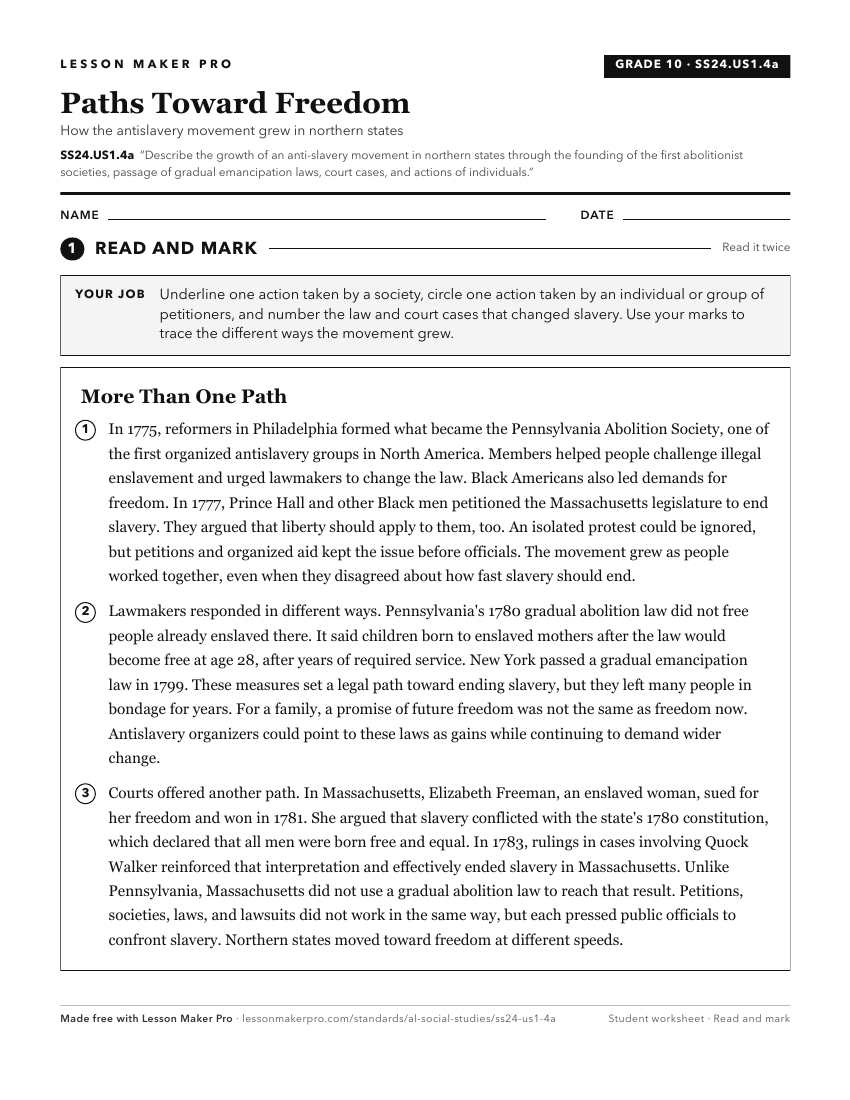
A ready-to-print activity worksheet aligned to SS24.US1.4a, with an answer key for the teacher on its own page. No account needed.
PDF, US Letter, prints cleanly in black and white.
Download the worksheetKeep exploring
Related Standards
- SS24.US1.10
Trace the evolution and expansion of abolitionism, examining the contributions of key abolitionist figures and analyzing the reactions of both southern and nort...
- SS24.US1.10c
Identify leading abolitionists, including Frederick Douglass and William Lloyd Garrison, and summarize the arguments they made in opposition to slavery and in r...
- SS24.6.6c
Describe how enslaved people and abolitionists sought to oppose slavery in colonial America.
- SS24.4.13b
Describe the influence of abolitionists, including enslaved persons and self-liberated Black Americans, on efforts to end slavery in the United States.
Turn this exact standard into a lesson
Grade, subject, topic, and the complete standard are prefilled. Create one free, no account needed.
Also for this standard:Make a WorksheetMake a QuizMake a Sub Lesson