Alabama Social Studies SS24.4.13b
The Standard
- SS24.4.13
- Describe how slavery contributed to sectional disagreements, divisions over states’ rights, and economic disputes resulting in the Civil War.
Describe the influence of abolitionists, including enslaved persons and self-liberated Black Americans, on efforts to end slavery in the United States.
2024 Alabama Course of Study: Social Studies
Teacher's field guide
What This Standard Means
What Students Need to Do
- Students explain how enslaved people resisted slavery, including by escaping or helping others escape. They describe how Frederick Douglass's writing and Harriet Tubman's rescue trips helped build opposition to slavery.
What Mastery Looks Like
- A student can explain how an enslaved person helping someone escape challenged slavery. They can also explain how Douglass used his newspaper to persuade readers and how Tubman guided people to freedom.
Common Misconceptions
- Students may think only white leaders opposed slavery, or that Lincoln ended it without pressure from Black Americans. Some picture the Underground Railroad as a train rather than a secret network of people and routes.
How to Assess It
- Exit ticket: Name one way an enslaved person resisted slavery and one way Tubman or Douglass worked against it after escaping. Explain how each action helped.
Lesson moves
Ways to Teach It
Give pairs a Maryland and Pennsylvania map. Have them mark Tubman's home state, a free state, and her work guiding people out.
Ask: Why did Douglass keep speaking against slavery after escaping? Have students write two sentences using a detail from his life.
Play match-and-explain: students pair Douglass with newspaper writing, Tubman with rescue trips, and enslaved helpers with aid given to people escaping.
Pair a short Douglass newspaper excerpt with a current letter to the editor. Ask how each writer tries to persuade readers.
Free download
Printable SS24.4.13b Worksheet
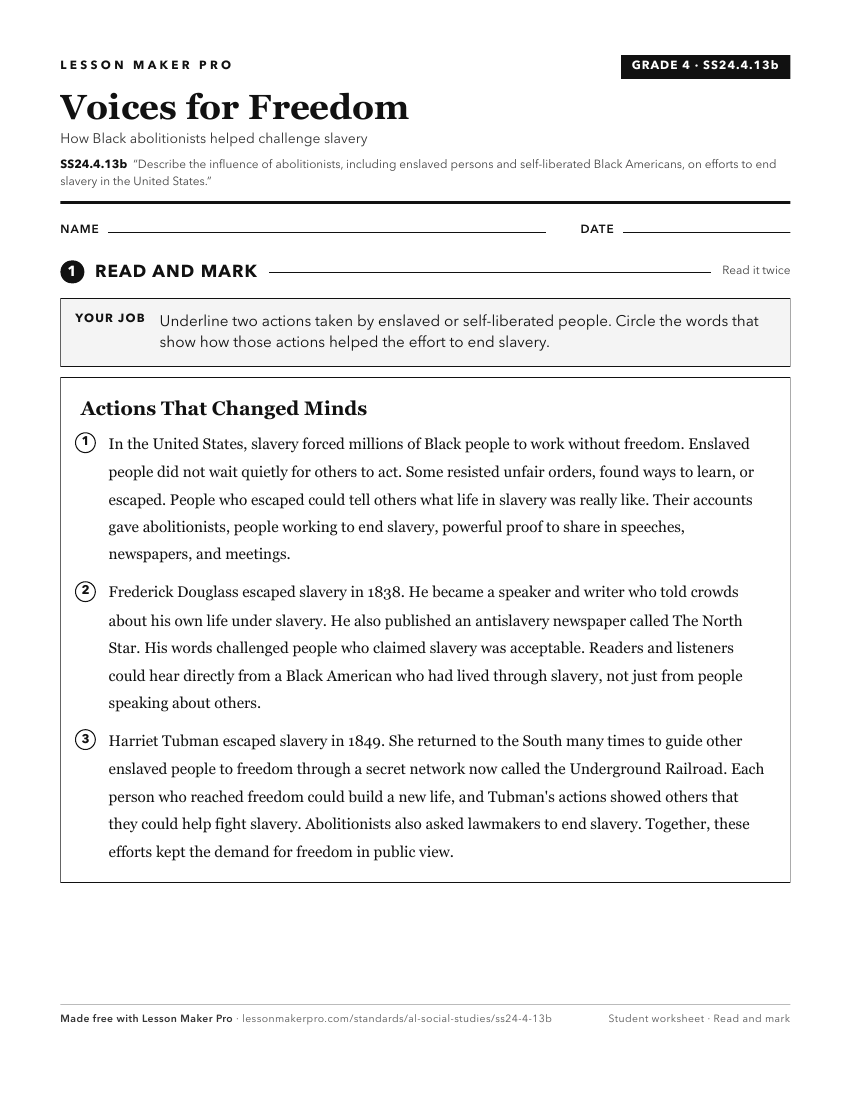
A ready-to-print activity worksheet aligned to SS24.4.13b, with an answer key for the teacher on its own page. No account needed.
PDF, US Letter, prints cleanly in black and white.
Download the worksheetKeep exploring
Related Standards
- SS24.US1.10
Trace the evolution and expansion of abolitionism, examining the contributions of key abolitionist figures and analyzing the reactions of both southern and nort...
- SS24.US1.10c
Identify leading abolitionists, including Frederick Douglass and William Lloyd Garrison, and summarize the arguments they made in opposition to slavery and in r...
- SS24.US1.10a
Describe forms of resistance to slavery demonstrated by enslaved and free Black Americans, and assess the impact of resistance on southern states’ slave codes.
- SS24.6.6c
Describe how enslaved people and abolitionists sought to oppose slavery in colonial America.
Turn this exact standard into a lesson
Grade, subject, topic, and the complete standard are prefilled. Create one free, no account needed.
Also for this standard:Make a WorksheetMake a QuizMake a Sub Lesson