Alabama Social Studies SS24.US1.11
Standard Cluster
Analyze how government policies and events related to slavery led to increased sectionalism throughout the United States prior to the Civil War. 11a Summarize major legislation and court decisions from 1820 to 1861 that sought to address the issue of slavery, and describe the sectional responses to these government actions. 11b Develop an argument to show how the causes and consequences of the Texas Revolution and Mexican-American War escalated sectional tension in the debate over slavery and expansion. 11c Describe how Alabamians were impacted by growing sectionalism from 1832 to 1861, including the reliance on cotton and slave labor, the Second Creek War, and secession. 11d Analyze the effect of sectionalism and debate over slavery on United States political parties in the 1850s and how this led to Abraham Lincoln’s 1860 election and the secession of southern states.
2024 Alabama Course of Study: Social Studies
Cluster contents
Standards in This Cluster
SS24.US1.11 is a cluster heading. These are the individual standards under it.
- SS24.US1.11a
Summarize major legislation and court decisions from 1820 to 1861 that sought to address the issue of slavery, and describe the sectional responses to these gov...
- SS24.US1.11b
Develop an argument to show how the causes and consequences of the Texas Revolution and Mexican-American War escalated sectional tension in the debate over slav...
- SS24.US1.11c
Describe how Alabamians were impacted by growing sectionalism from 1832 to 1861, including the reliance on cotton and slave labor, the Second Creek War, and sec...
- SS24.US1.11d
Analyze the effect of sectionalism and debate over slavery on United States political parties in the 1850s and how this led to Abraham Lincoln’s 1860 election a...
Teacher's field guide
What This Cluster Means
What Students Need to Do
- Compare Northern and Southern reactions to slavery laws and court rulings. Explain how Texas and the Mexican-American War reopened the debate over slavery in new territories. Connect Alabama’s cotton economy, the Second Creek War, party splits, and Lincoln’s election to secession.
What Mastery Looks Like
- Students can explain why the Missouri Compromise, Fugitive Slave Act, Kansas-Nebraska Act, and Dred Scott decision drew different regional reactions. They can link Texas annexation and land gained from Mexico to arguments over slavery. They can explain how Creek land loss and enslaved labor shaped Alabama’s cotton economy, then trace party splits to Lincoln’s election and Alabama’s secession.
Common Misconceptions
- Students may think the Missouri Compromise settled the slavery debate or that Dred Scott freed enslaved people. Some confuse Texas independence with the later war against Mexico, or think all Southerners backed the same party in 1860. Others miss how Creek land loss helped expand Alabama cotton plantations.
How to Assess It
- Exit ticket: Choose the Kansas-Nebraska Act or Dred Scott decision. In three sentences, explain one Northern response, one Southern response, and how those reactions affected a political party by 1860.
Lesson moves
Ways to Teach It
Give pairs cards naming the Missouri Compromise, Texas annexation, Mexican War, Kansas-Nebraska Act, and Dred Scott; sort by date and mark regional reactions.
Have students write: How did Texas independence and land gained from Mexico change arguments over slavery in new territories?
Give groups cards labeled Whig collapse, Republican opposition to slavery's expansion, Democratic split, and Lincoln's win; race to build a cause-and-effect chain.
Locate your county on maps of Creek lands before the 1836 war and Alabama cotton production in 1860; discuss land loss and enslaved labor.
Free download
Printable SS24.US1.11 Worksheet
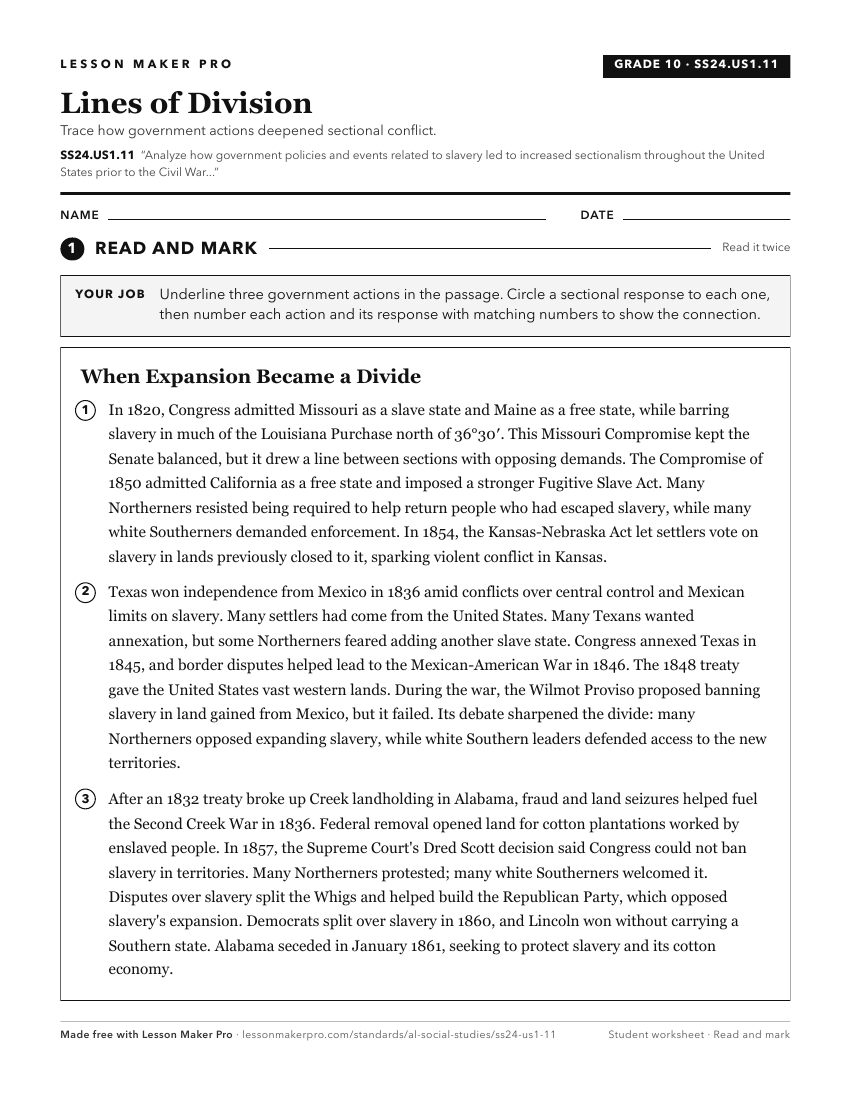
A ready-to-print activity worksheet aligned to SS24.US1.11, with an answer key for the teacher on its own page. No account needed.
PDF, US Letter, prints cleanly in black and white.
Download the worksheetKeep exploring
Related Standards
- SS24.4.13
Describe how slavery contributed to sectional disagreements, divisions over states’ rights, and economic disputes resulting in the Civil War.
- SS24.4.13a
Identify and describe how key events from the Missouri Compromise (1820) to the election of Abraham Lincoln (1860) contributed to growing sectional divisions.
Turn this cluster into a lesson
Grade, subject, topic, and the complete cluster are prefilled. Create one free, no account needed.
Also for this cluster:Make a WorksheetMake a QuizMake a Sub Lesson