Alabama Social Studies SS24.US1.11a
The Standard
- SS24.US1.11
- Analyze how government policies and events related to slavery led to increased sectionalism throughout the United States prior to the Civil War.
Summarize major legislation and court decisions from 1820 to 1861 that sought to address the issue of slavery, and describe the sectional responses to these government actions.
2024 Alabama Course of Study: Social Studies
Teacher's field guide
What This Standard Means
What Students Need to Do
- Students explain what the Missouri Compromise, Compromise of 1850, Fugitive Slave Act, Kansas-Nebraska Act, and Dred Scott ruling did. They describe how people in northern and southern states responded.
What Mastery Looks Like
- A student can put these actions in order and state what each changed. They can explain why the Fugitive Slave Act angered many northerners and why the Dred Scott ruling pleased many slaveholders.
Common Misconceptions
- Students may think the Missouri Compromise banned slavery in every state north of its line, rather than in part of the Louisiana Purchase territory. They may think the Dred Scott ruling freed Scott or that popular sovereignty settled the dispute peacefully.
How to Assess It
- Exit ticket: What did the Kansas-Nebraska Act change, and why did many northerners oppose it while many southerners supported it? Answer in three sentences.
Lesson moves
Ways to Teach It
Give pairs cards for the Missouri Compromise, Compromise of 1850, Fugitive Slave Act, Kansas-Nebraska Act, and Dred Scott; sort by date and sectional response.
Ask students to write: Why did the Fugitive Slave Act turn some northerners against compromise?
Play a card match: pair each law or ruling with its effect, then check the matches against a dated timeline.
Show a recent court-ruling headline and two opposing Dred Scott headlines; students circle words that signal each paper's view.
Free download
Printable SS24.US1.11a Worksheet
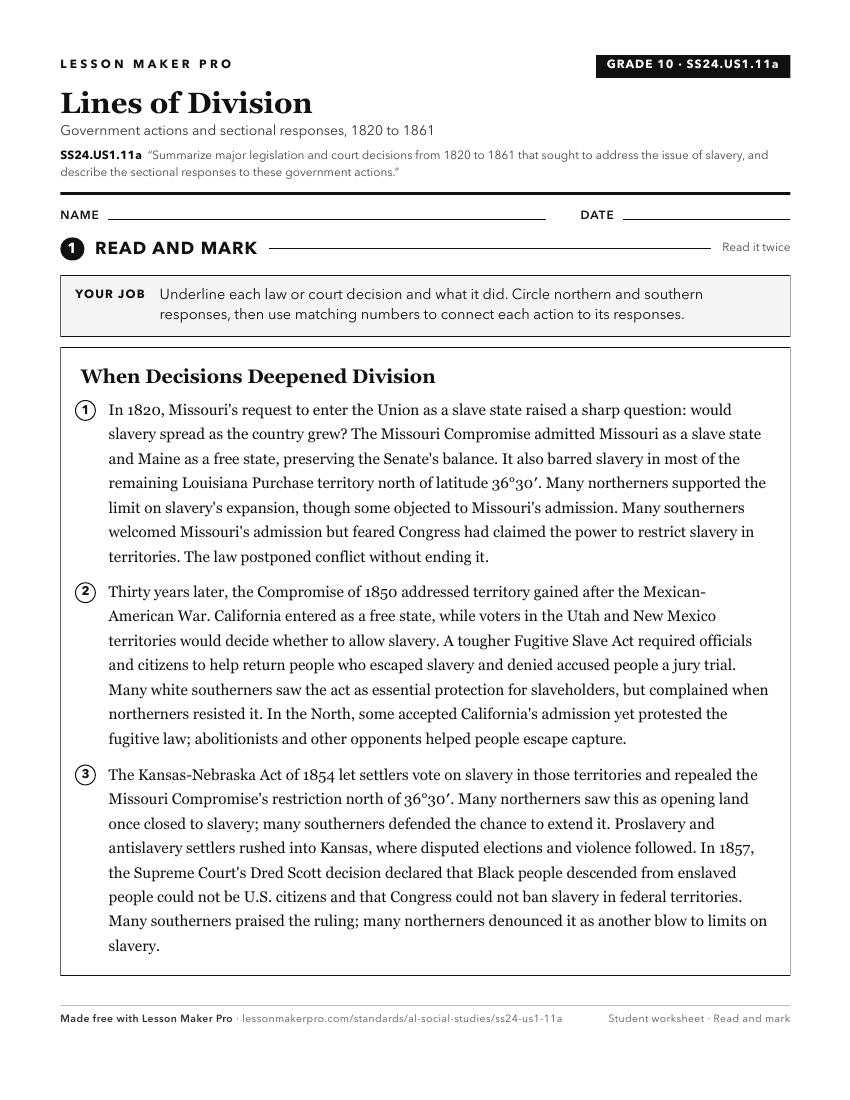
A ready-to-print activity worksheet aligned to SS24.US1.11a, with an answer key for the teacher on its own page. No account needed.
PDF, US Letter, prints cleanly in black and white.
Download the worksheetKeep exploring
Related Standards
- SS24.4.13
Describe how slavery contributed to sectional disagreements, divisions over states’ rights, and economic disputes resulting in the Civil War.
- SS24.4.13a
Identify and describe how key events from the Missouri Compromise (1820) to the election of Abraham Lincoln (1860) contributed to growing sectional divisions.
- SS24.US1.10
Trace the evolution and expansion of abolitionism, examining the contributions of key abolitionist figures and analyzing the reactions of both southern and nort...
- SS24.US1.11
Analyze how government policies and events related to slavery led to increased sectionalism throughout the United States prior to the Civil War.
Turn this exact standard into a lesson
Grade, subject, topic, and the complete standard are prefilled. Create one free, no account needed.
Also for this standard:Make a WorksheetMake a QuizMake a Sub Lesson