Alabama Social Studies SS24.4.13
Standard Cluster
Describe how slavery contributed to sectional disagreements, divisions over states’ rights, and economic disputes resulting in the Civil War. 13a Identify and describe how key events from the Missouri Compromise (1820) to the election of Abraham Lincoln (1860) contributed to growing sectional divisions. 13b Describe the influence of abolitionists, including enslaved persons and self-liberated Black Americans, on efforts to end slavery in the United States. 13c Describe the significance of the Clotilda’s delivery of kidnapped people to Mobile Bay as an effort to expand slavery. 13d Summarize Alabama’s role in the formation of the Confederate States of America, including the pivotal events that took place in Montgomery and the division over secession in the northern part of the state.
2024 Alabama Course of Study: Social Studies
Cluster contents
Standards in This Cluster
SS24.4.13 is a cluster heading. These are the individual standards under it.
- SS24.4.13a
Identify and describe how key events from the Missouri Compromise (1820) to the election of Abraham Lincoln (1860) contributed to growing sectional divisions.
- SS24.4.13b
Describe the influence of abolitionists, including enslaved persons and self-liberated Black Americans, on efforts to end slavery in the United States.
- SS24.4.13c
Describe the significance of the Clotilda’s delivery of kidnapped people to Mobile Bay as an effort to expand slavery.
- SS24.4.13d
Summarize Alabama’s role in the formation of the Confederate States of America, including the pivotal events that took place in Montgomery and the division over...
Teacher's field guide
What This Cluster Means
What Students Need to Do
- Students explain how slavery drove disputes over new states, state power, and the economy. They trace events leading to war and describe how enslaved and self-liberated Black Americans worked to end slavery. They connect the Clotilda’s arrival and Alabama’s secession to those divisions.
What Mastery Looks Like
- A student can put the Missouri Compromise, Kansas-Nebraska Act, and Lincoln’s election in order and explain how each deepened divisions over slavery. They can explain why the Clotilda’s arrival in Mobile Bay broke federal law. They can identify Montgomery as the Confederacy’s first capital and note that some northern Alabamians opposed secession.
Common Misconceptions
- Students may think states’ rights arguments had nothing to do with slavery, or that every Alabamian supported secession. Some may think bringing kidnapped Africans into the country was legal in 1860, or that only white Americans worked to end slavery.
How to Assess It
- On an exit slip, ask students to name one event that widened divisions over slavery, one action Black abolitionists took, and one fact about either the Clotilda or Alabama’s secession.
Lesson moves
Ways to Teach It
Mark Maine and Missouri on a paper map, color their admission as free and slave states, then explain the compromise.
Read a short account of Harriet Tubman’s escape, then ask, “How did self-liberated people help others resist slavery?”
Play a timeline relay with cards for the Missouri Compromise, Kansas-Nebraska Act, Clotilda arrival, Lincoln’s election, and Alabama’s secession.
Find Africatown on a current Mobile map, then write a map caption explaining how Clotilda survivors built it after emancipation.
Free download
Printable SS24.4.13 Worksheet
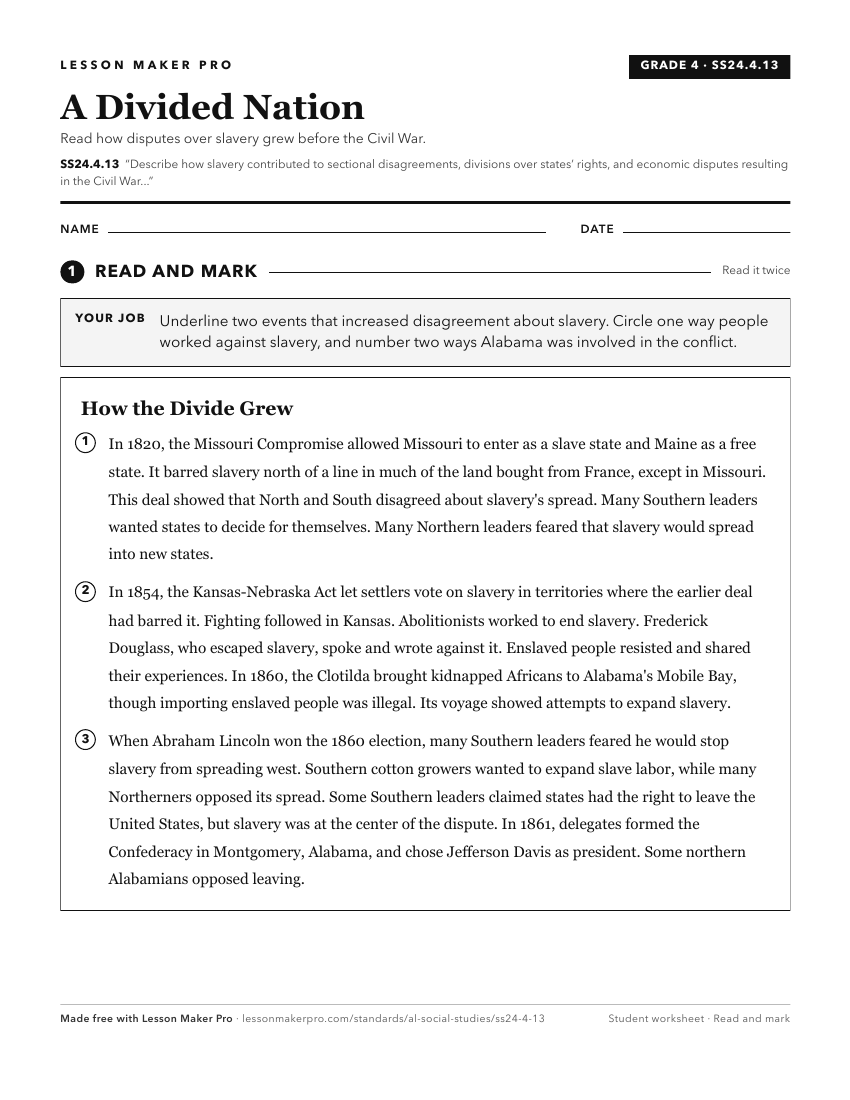
A ready-to-print activity worksheet aligned to SS24.4.13, with an answer key for the teacher on its own page. No account needed.
PDF, US Letter, prints cleanly in black and white.
Download the worksheetKeep exploring
Related Standards
- SS24.US1.9
Explain how economic and social divisions led to heightened sectionalism between the North and the South, examining their geographical and economic distinctions...
- SS24.US1.11
Analyze how government policies and events related to slavery led to increased sectionalism throughout the United States prior to the Civil War.
- SS24.US1.12c
Describe the social, economic, and political conditions that affected citizens during the Civil War and explain how both citizens and enslaved people contribute...
Turn this cluster into a lesson
Grade, subject, topic, and the complete cluster are prefilled. Create one free, no account needed.
Also for this cluster:Make a WorksheetMake a QuizMake a Sub Lesson