Alabama Social Studies SS24.US1.10d
The Standard
- SS24.US1.10
- Trace the evolution and expansion of abolitionism, examining the contributions of key abolitionist figures and analyzing the reactions of both southern and northern communities to this campaign.
Evaluate how the Underground Railroad and its leaders shaped the national discussion over slavery, including the passage of the Fugitive Slave Act and publication of Harriet Beecher Stowe’s Uncle Tom’s Cabin.
2024 Alabama Course of Study: Social Studies
Teacher's field guide
What This Standard Means
What Students Need to Do
- Students explain how people such as Harriet Tubman and William Still helped enslaved people escape and brought attention to slavery. They connect the 1850 Fugitive Slave Act and Harriet Beecher Stowe’s 1852 novel to growing national arguments. They use evidence to judge what changed public opinion.
What Mastery Looks Like
- A student can explain why reaching a free state did not guarantee safety after 1850. They can compare a rescue account with an excerpt from Stowe’s novel and explain how each affected the debate over slavery.
Common Misconceptions
- Some students picture the Underground Railroad as a train or a single route. Others think escapees were safe in free states, even after the 1850 law. Some think Stowe’s novel was a firsthand account or appeared before the law.
How to Assess It
- Exit ticket: In three sentences, explain how Harriet Tubman’s actions and Stowe’s novel each influenced the debate over slavery. Include why the 1850 law mattered.
Lesson moves
Ways to Teach It
On a paper map, trace an escape route from Maryland through Pennsylvania to Canada, then mark where the 1850 law put escapees at risk.
Read a short account of Tubman’s rescues and an excerpt from Stowe’s novel, then write which might change a reader’s mind and why.
Match cards for the 1850 law, an escape account, and Stowe’s novel with cards showing public reactions, then defend each match.
Compare an 1854 Anthony Burns protest poster with a local newspaper opinion letter, and underline how each asks readers to take a side.
Free download
Printable SS24.US1.10d Worksheet
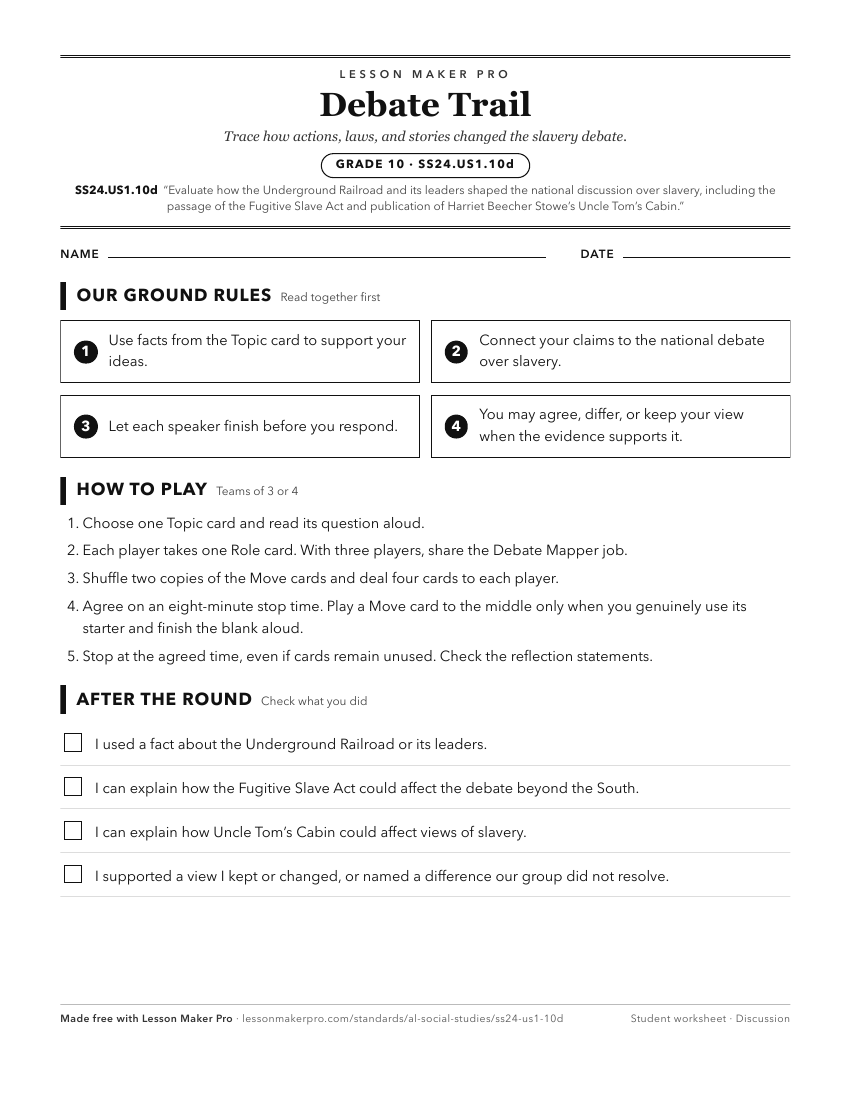
A ready-to-print activity worksheet aligned to SS24.US1.10d, with an answer key for the teacher on its own page. No account needed.
PDF, US Letter, prints cleanly in black and white.
Download the worksheetKeep exploring
Related Standards
- SS24.US1.10
Trace the evolution and expansion of abolitionism, examining the contributions of key abolitionist figures and analyzing the reactions of both southern and nort...
- SS24.US1.10c
Identify leading abolitionists, including Frederick Douglass and William Lloyd Garrison, and summarize the arguments they made in opposition to slavery and in r...
- SS24.4.13b
Describe the influence of abolitionists, including enslaved persons and self-liberated Black Americans, on efforts to end slavery in the United States.
- SS24.US1.4
Assess how the American Revolution and its rhetoric affected the status of slavery in the newly formed United States.
Turn this exact standard into a lesson
Grade, subject, topic, and the complete standard are prefilled. Create one free, no account needed.
Also for this standard:Make a WorksheetMake a QuizMake a Sub Lesson