Alabama Social Studies SS24.US1.10b
The Standard
- SS24.US1.10
- Trace the evolution and expansion of abolitionism, examining the contributions of key abolitionist figures and analyzing the reactions of both southern and northern communities to this campaign.
Describe the rise of religious opposition to slavery during the Second Great Awakening, including the objections of Quakers, and how this fostered schisms within American churches.
2024 Alabama Course of Study: Social Studies
Teacher's field guide
What This Standard Means
What Students Need to Do
- Students explain why some revival leaders called slavery a sin and why Quakers had opposed it earlier. They show how arguments over slavery divided churches.
What Mastery Looks Like
- A student places Quaker objections before the revivals and explains how revival preaching added to antislavery work. They describe how a dispute over a slaveholding bishop led southern Methodists to form a separate church.
Common Misconceptions
- Students may think Quaker opposition began during the revivals. They may also assume every revival church opposed slavery, or that churches split over worship styles rather than slavery.
How to Assess It
- Ask students to write three sentences: Give one Quaker objection to slavery, explain how revival preaching supported antislavery work, and describe why Methodists split.
Lesson moves
Ways to Teach It
Give pairs four event cards: 1688 Quaker petition, 1830s antislavery preaching, 1844 Methodist bishop dispute, 1845 Methodist split; have them order the cards.
Ask: Why did northern Methodists object to a slaveholding bishop, and why did southern Methodists form a separate church?
Make two card piles: Quaker equality, revival preaching, slaveholding bishop; slavery objections, antislavery campaigns, Methodist split; have students match causes and effects.
Display a 2023 headline about United Methodist congregations leaving over LGBTQ inclusion; compare how divisions formed while keeping the issues distinct.
Free download
Printable SS24.US1.10b Worksheet
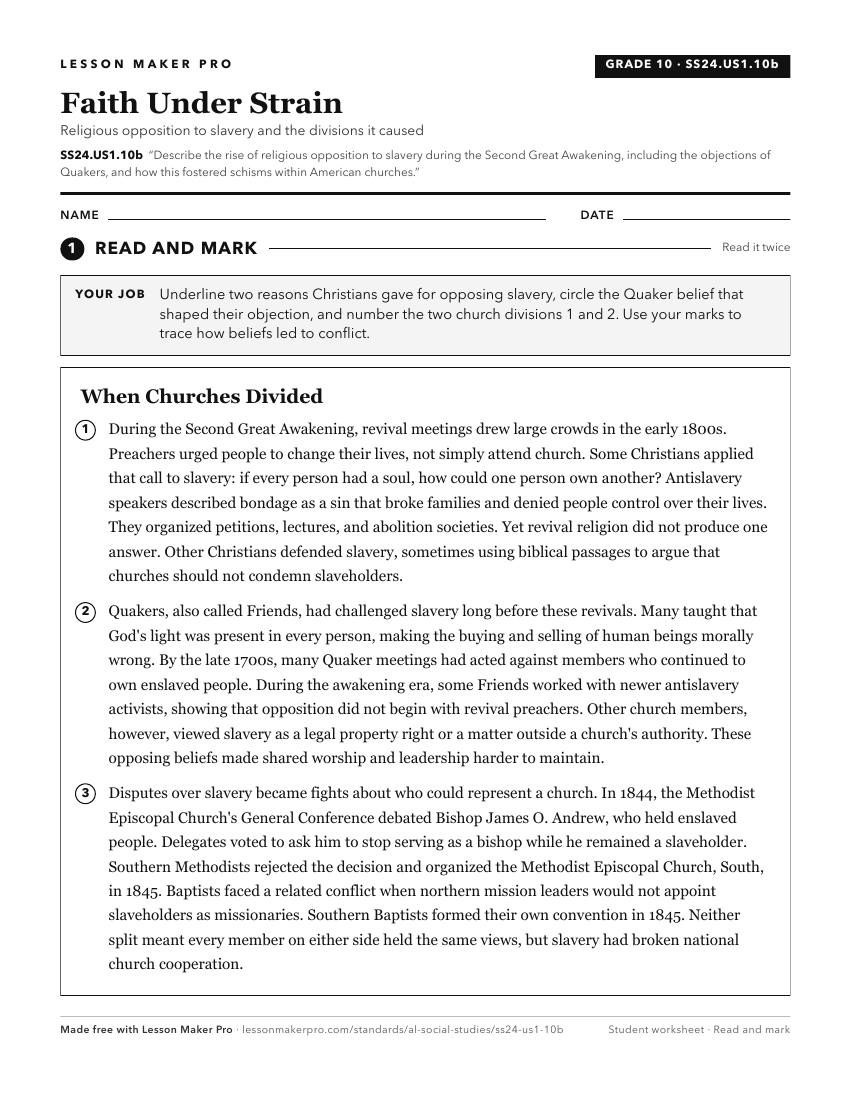
A ready-to-print activity worksheet aligned to SS24.US1.10b, with an answer key for the teacher on its own page. No account needed.
PDF, US Letter, prints cleanly in black and white.
Download the worksheetKeep exploring
Related Standards
- SS24.6.5c
Explain the influence of the Great Awakening on colonial society, including how it shaped the political beliefs of colonists.
- SS24.US1.10c
Identify leading abolitionists, including Frederick Douglass and William Lloyd Garrison, and summarize the arguments they made in opposition to slavery and in r...
- SS24.6.6c
Describe how enslaved people and abolitionists sought to oppose slavery in colonial America.
- SS24.US1.4
Assess how the American Revolution and its rhetoric affected the status of slavery in the newly formed United States.
Turn this exact standard into a lesson
Grade, subject, topic, and the complete standard are prefilled. Create one free, no account needed.
Also for this standard:Make a WorksheetMake a QuizMake a Sub Lesson