Alabama Science ESS.2
Standard Cluster
Obtain, evaluate, and communicate information about the structure and motion of components of the universe and solar system. a. Use mathematics and computational thinking to predict the motion of natural and man-made objects in the solar system, using Kepler’s laws, Newton’s laws of motion, and Newton’s gravitational laws. b. Use mathematics and computational thinking to explain the relationships between the properties of light and distances in the solar system and universe, including the Doppler effect, red shift, light years, and astronomical units. c. Analyze spectroscopic data to determine the properties and motion of objects in space. d. Investigate and communicate major properties of bodies in the solar system and the zones they inhabit. e. Use mathematics to explain how solar intensity and the tilt of the Earth’s axis impact the distribution of sunlight on the Earth’s surface, including zenith angle, solar angle, and surface area.
2023 Alabama Course of Study: Science · Earth’s Place in the Universe
Cluster contents
Standards in This Cluster
ESS.2 is a cluster heading. These are the individual standards under it.
- ESS.2.a
Use mathematics and computational thinking to predict the motion of natural and man-made objects in the solar system, using Kepler’s laws, Newton’s laws of moti...
- ESS.2.b
Use mathematics and computational thinking to explain the relationships between the properties of light and distances in the solar system and universe, includin...
- ESS.2.c
Analyze spectroscopic data to determine the properties and motion of objects in space.
- ESS.2.d
Investigate and communicate major properties of bodies in the solar system and the zones they inhabit.
- ESS.2.e
Use mathematics to explain how solar intensity and the tilt of the Earth’s axis impact the distribution of sunlight on the Earth’s surface, including zenith ang...
Teacher's field guide
What This Cluster Means
What Students Need to Do
- Students use orbit and gravity equations to predict how planets and satellites move. They use light, spectra, light years, and astronomical units to describe distance and motion. They compare solar system bodies and calculate how Earth’s tilt and solar angle change sunlight intensity.
What Mastery Looks Like
- Given an orbital period, a student calculates a planet’s distance from the Sun and explains gravity’s role. They use shifted spectral lines to tell whether an object is approaching or receding, and distinguish a light year from an astronomical unit. They place rocky and icy bodies in the right zones and explain how a low Sun angle spreads light over more ground.
Common Misconceptions
- Students may think summer happens because Earth is closer to the Sun. They may treat a light year as a unit of time or think redshift means an object looks red. Some think a planet’s mass, rather than its distance from the Sun, sets its orbital speed.
How to Assess It
- Exit ticket: A planet takes 8 years to orbit the Sun. Use P² = a³ to find its distance in astronomical units, then state whether a redshifted spectrum means it is approaching or receding.
Lesson moves
Ways to Teach It
Shine a flashlight on a tilted globe at two latitudes, trace each light patch on paper, and compare patch areas.
Ask students to write: If Earth is nearest the Sun in January, why is Alabama colder then than in July?
Give teams shifted hydrogen spectra, orbit period cards, and body descriptions; have them calculate distances, identify motion, and place bodies in zones.
Use two time-stamped ISS tracker screenshots to predict its next position, then explain how gravity keeps it in orbit.
Free download
Printable ESS.2 Worksheet
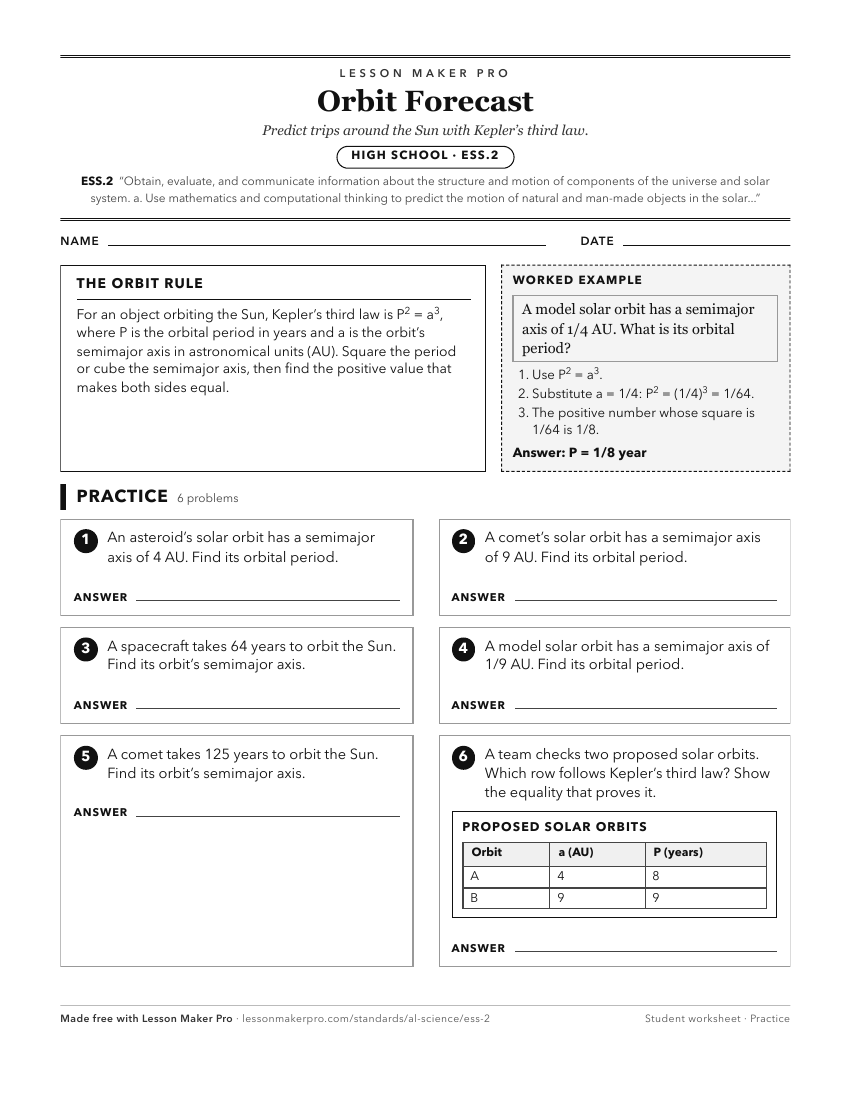
A ready-to-print activity worksheet aligned to ESS.2, with an answer key for the teacher on its own page. No account needed.
PDF, US Letter, prints cleanly in black and white.
Download the worksheetKeep exploring
Related Standards
- ESS.3.a
Obtain and evaluate scientific information that explains how the application of new knowledge and technological advances has improved human understanding of the...
- ESS.5
Obtain, evaluate, and communicate information about major events in Earth’s history.
- PS.4.a
Obtain, evaluate, and communicate information from the periodic table concerning the structure of an atom and the arrangement of the atom’s protons, neutrons, a...
Turn this cluster into a lesson
Grade, subject, topic, and the complete cluster are prefilled. Create one free, no account needed.
Also for this cluster:Make a WorksheetMake a QuizMake a Sub Lesson