Alabama Science ESS.2.e
The Standard
- ESS.2
- Obtain, evaluate, and communicate information about the structure and motion of components of the universe and solar system.
Use mathematics to explain how solar intensity and the tilt of the Earth’s axis impact the distribution of sunlight on the Earth’s surface, including zenith angle, solar angle, and surface area.
2023 Alabama Course of Study: Science · Earth’s Place in the Universe
How Alabama's version differs
Alabama’s high-school course requires mathematical explanations using axial tilt, zenith and solar angles, and surface area, while MS-ESS1-1 uses an Earth–Sun–Moon model to explain seasons, lunar phases, and eclipses.
Teacher's field guide
What This Standard Means
What Students Need to Do
- Students calculate noon Sun angles for different latitudes and seasons. They use cosine to show how a slanted beam spreads across more ground, reducing sunlight per square meter.
What Mastery Looks Like
- At 40°N, a student calculates noon zenith angles of 40° on an equinox and 16.5° in June. They use cosine to show why June sunlight is more concentrated.
Common Misconceptions
- Students may say summer happens because Earth is closer to the Sun. Some confuse zenith angle, measured from overhead, with solar angle, measured from the horizon. Others think a beam spread over more ground delivers more energy per square meter.
How to Assess It
- Exit ticket: At 40°N, calculate the noon zenith and solar angles for an equinox and the June solstice, using solar declinations of 0° and 23.5°N. Use cosine to identify which date gets more sunlight per square meter.
Lesson moves
Ways to Teach It
Hold a flashlight steady over grid paper, tilt the paper, and count lit squares at two angles to compare beam area.
Ask why noon sunlight covers less ground at 40°N in June than in December; require a sketch and both zenith angles.
Give pairs latitude and solar declination cards; have them calculate noon zenith angles and rank the cards by sunlight per square meter.
For a flat rooftop panel at 40°N, calculate June and December noon energy per square meter, assuming equal incoming sunlight.
Free download
Printable ESS.2.e Worksheet
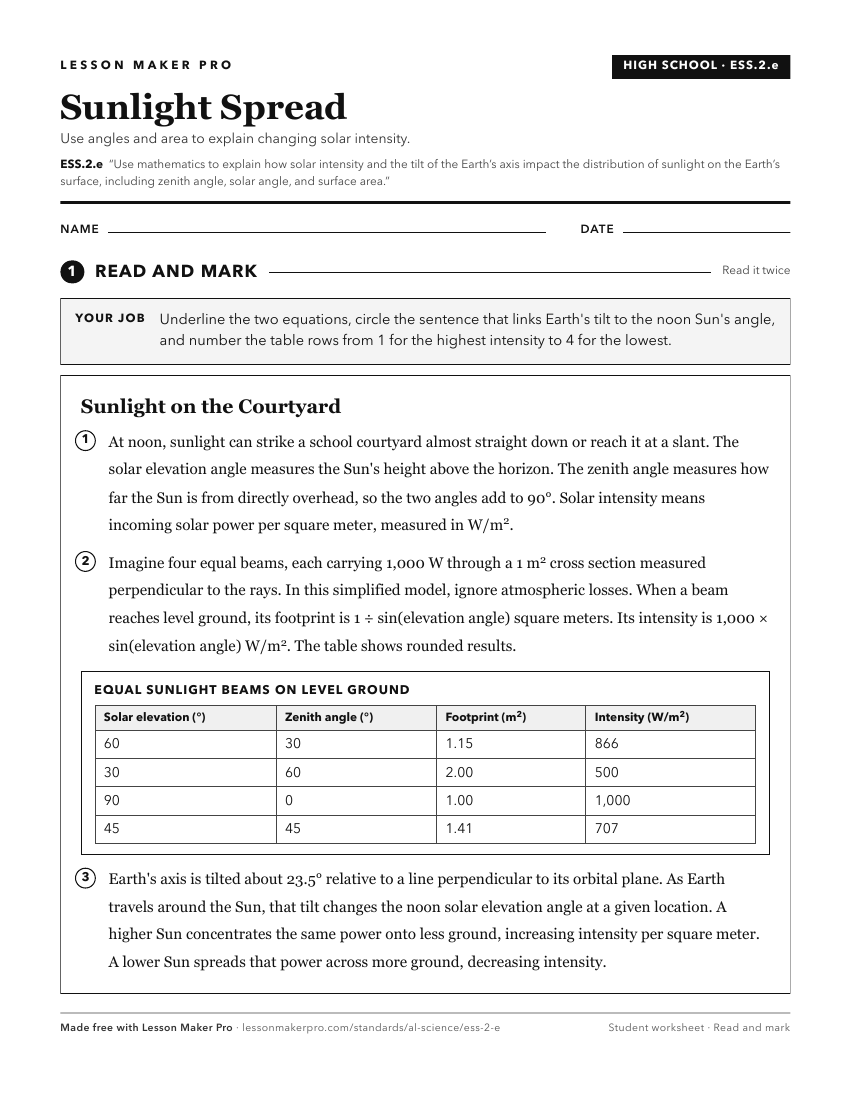
A ready-to-print activity worksheet aligned to ESS.2.e, with an answer key for the teacher on its own page. No account needed.
PDF, US Letter, prints cleanly in black and white.
Download the worksheetKeep exploring
Related Standards
- 6.1.a
Construct an evidence-based explanation of how the relative positions of the sun and Earth result in observable phenomena, including day and night cycles, lengt...
- 6.10.b
Construct explanations of how the tilt and curvature of the Earth cause unequal heating of its surface, resulting in regional climates based on patterns of lati...
- 6.1.b
Construct an evidence-based explanation of how the relative positions of the sun, moon, and Earth result in observable phenomena, including lunar cycles, eclips...
Turn this exact standard into a lesson
Grade, subject, topic, and the complete standard are prefilled. Create one free, no account needed.
Also for this standard:Make a WorksheetMake a QuizMake a Sub Lesson