Alabama Science 6.1.a
The Standard
- 6.1
- Manipulate models to demonstrate the patterns of motion of the sun, Earth, and moon.
Construct an evidence-based explanation of how the relative positions of the sun and Earth result in observable phenomena, including day and night cycles, length of year, and seasons.
2023 Alabama Course of Study: Science · Earth’s Place in the Universe
Teacher's field guide
What This Standard Means
What Students Need to Do
- Students use a model or drawing to show Earth spinning and moving around the sun. They explain how spinning makes day and night, one orbit makes a year, and Earth's tilt causes seasons.
What Mastery Looks Like
- A student can point to the sunlit half of Earth and explain how a town moves into daylight as Earth spins. They can trace one orbit as a year and explain why Alabama gets more direct sunlight and longer days in summer.
Common Misconceptions
- Some students think day and night happen because Earth goes around the sun, rather than spinning. Others say summer happens when Earth is closer to the sun, or think both hemispheres have summer at the same time.
How to Assess It
- Hand out a sketch of Earth on opposite sides of the sun, with its axis tilted the same way at both positions. Ask students to mark where Alabama has summer, draw arrows for the motions that cause day and night and a year, and explain their summer choice.
Lesson moves
Ways to Teach It
Tilt a foam ball on a skewer; spin it by a fixed flashlight, then move it around the light without changing its tilt.
Ask pairs: If Earth is closest to the sun in January, why is it winter in Alabama? Have them explain with a sketch.
Give teams picture cards showing rotation, orbit, and tilted orbit; have them match each to day and night, year, or seasons.
Compare sunrise and sunset times for a June and December day in Alabama; calculate daylight hours and explain the difference using Earth's tilt.
Free download
Printable 6.1.a Worksheet
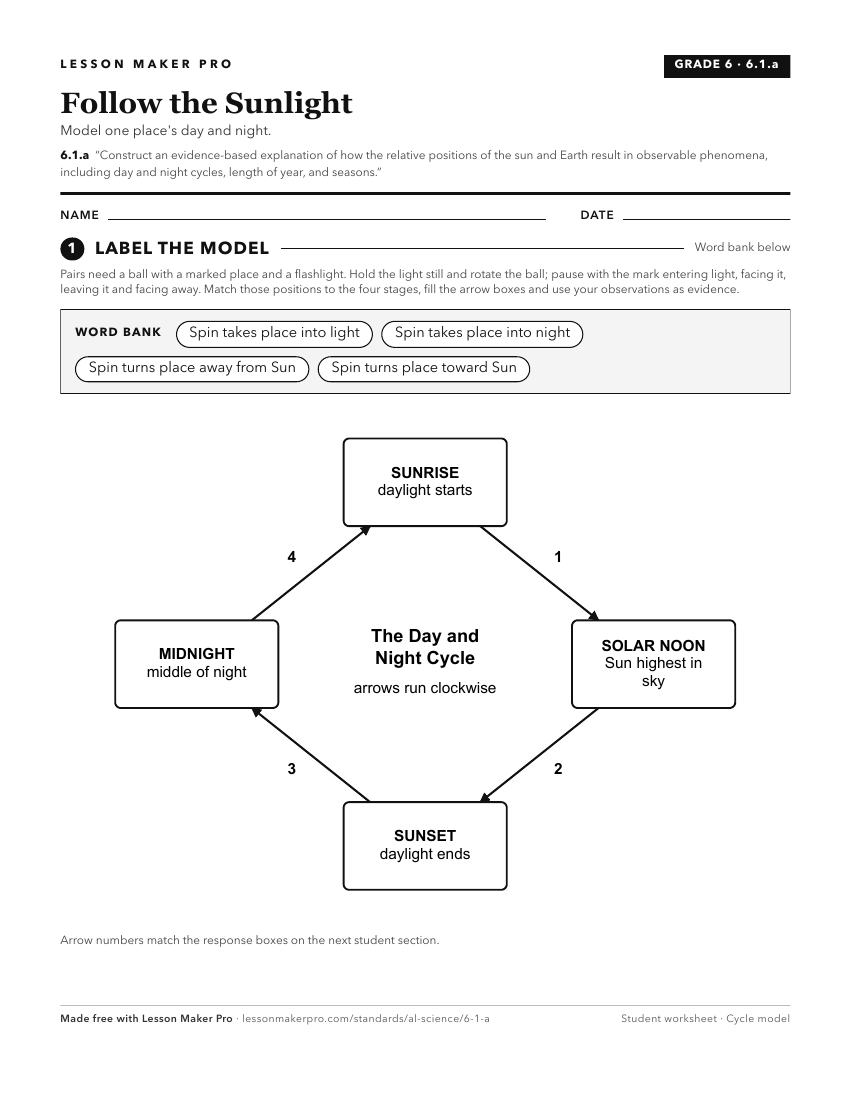
A ready-to-print activity worksheet aligned to 6.1.a, with an answer key for the teacher on its own page. No account needed.
PDF, US Letter, prints cleanly in black and white.
Download the worksheetKeep exploring
Related Standards
- 6.1.b
Construct an evidence-based explanation of how the relative positions of the sun, moon, and Earth result in observable phenomena, including lunar cycles, eclips...
- 6.8
Construct an evidence-based explanation of how the sun’s energy drives the motion and cycling of water through the hydrosphere.
- 1.9
Use observations of seasonal sunrise and sunset patterns to describe the relationship between the number of hours of daylight and the time of year.
- ESS.3.b
Construct an evidence-based explanation of the connections among various cosmic phenomena, citing leading scientific theories.
Turn this exact standard into a lesson
Grade, subject, topic, and the complete standard are prefilled. Create one free, no account needed.
Also for this standard:Make a WorksheetMake a QuizMake a Sub Lesson